
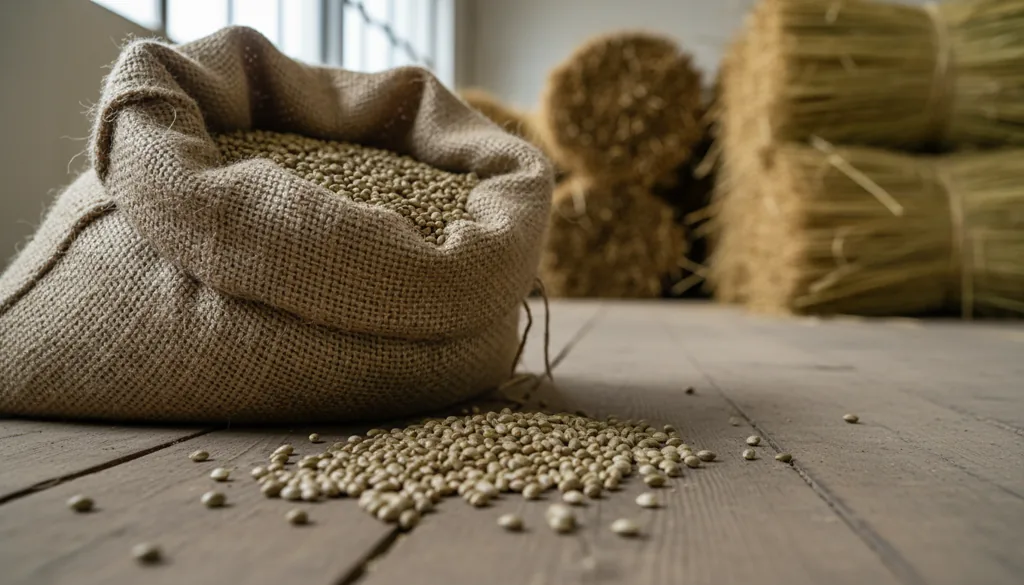
Ghana has established detailed specifications for whole hemp seed storage at primary production facilities and for hemp straw intended for decortication to ensure quality and safety during handling and processing.
Ghana has set strict new rules for storing whole hemp seed and hemp straw, tightening controls on the country’s emerging industrial cannabis sector.
The measures, published by the Ghana Standards Authority (GSA) under a World Trade Organization technical barrier notification, apply to all primary production facilities handling hemp seed for human or animal use. They take effect on 1 January 20251. Every storage bin must now be checked weekly for moisture, mould and heating, and seed moisture must be kept below 8% for safe storage1.
It is the first time Ghana has spelled out storage conditions for industrial hemp, a crop the government legalised in 2020 for medical and industrial use only. The rules sit alongside a licensing regime run by the Narcotics Control Commission (NACOC), which allows cultivation of cannabis plants with no more than 0.3% THC on a dry-weight basis2.
Seed storage: what the rules demand
The new standard, labelled DGS 1410:2026, covers everything from drying and cleaning to temperature monitoring. Seed must be dried to a safe moisture level before storage, and any extraneous material—stems, leaves, immature seeds—must be removed to prevent uneven drying and hot spots1. Facilities must calibrate moisture meters according to the manufacturer’s instructions and keep records of every test1.
What DGS 1410:2026 requires of seed stores
Storage bins must be checked at least once a week for signs of spoilage: pooling water, crusting, mould or areas where the seed is heating. If moisture rises above 8%, the seed must be re-dried or moved to a different bin1. The rules also require that seed be stored in a way that allows uniform airflow, and that any seed mixed with other material be separated before storage1.
Who pays for the extra testing and monitoring is left open. The notification does not say whether the cost falls on farmers, processors or the state, but the requirement for weekly checks and calibrated equipment suggests higher compliance costs for the companies selling the seed1.
The legal framework: who can grow and sell
Ghana’s cannabis programme is tightly controlled. Only plants with 0.3% THC or less can be cultivated, and only for medical or industrial use—never for recreational purposes2. The Narcotics Control Commission (Amendment) Act 2023 and the Cultivation and Management of Cannabis Regulation 2023 set out the licensing process, which is overseen by NACOC3.
Maximum levels the rules set, %
Applicants must show they have secure storage, traceability systems and a plan for waste disposal. The commission has said it will work with the GSA to speed up testing, but the documents do not say how long the approval process will take4. What is clear is that every licence holder must keep records of every harvest, every sale and every disposal of plant material5.
The programme is still small. No figures are given for current production, but in 2023 NACOC destroyed 50 tonnes of illegal marijuana worth 50 million Ghana cedis (£3.2m; $4.1m)6. The contrast between the two volumes suggests that legal production is still in its early stages.
What the rules change—and what they leave alone
The new storage standard replaces a patchwork of informal practices. Before, farmers and processors had no official guidance on moisture levels, drying methods or bin checks. The old regime relied on general food-safety rules, which did not address the specific risks of hemp seed—mould, heating and uneven drying7.
Hemp seed storage, before and after
| Question | Before DGS 1410:2026 | From 1 Jan 2025 |
|---|---|---|
| Moisture guidance | None for hemp seed | Below 8% |
| Bin checks | Informal practice | At least weekly |
| Drying and cleaning | General food-safety rules | Standard-specific requirements |
| Permitted uses | Food, feed, industry | Unchanged |
| Fibre and CBD | Separate GSA standards | Still separate |
What has not changed is the list of permitted uses. Hemp seed can still be sold for food, animal feed or industrial processing, but the seed itself cannot be used to grow plants for recreational use. The rules also do not cover hemp fibre or CBD extraction; those remain under separate GSA standards3.
The timing is notable. The standard was notified to the WTO in February 2024, but it does not take effect until 1 January 20251. That gives farmers and processors eleven months to upgrade storage facilities, train staff and calibrate equipment. It also gives NACOC time to issue more licences; the documents do not say how many have been granted so far.
Who the rules bind—and who they do not
The standard applies to every facility that stores whole hemp seed for sale or processing. That includes farms, seed-cleaning plants and warehouses, but it does not cover retail outlets or end-users1. The rules also do not apply to hemp straw intended for decortication unless the straw is stored alongside seed; straw has its own moisture and storage requirements, which are not detailed in the notification1.
The rules are silent on whether smallholder farmers must comply. The notification says the standard is for “broad acre production”, but it does not define what that means. In practice, any farmer who sells seed to a processor or exporter will have to meet the storage rules, because the processor will demand it1.
The standard also does not say how compliance will be enforced. The GSA has the power to inspect facilities and test samples, but the documents do not say how often inspections will happen or what penalties will apply for non-compliance7.
The bigger picture: Ghana’s push for industrial hemp
The new rules are part of a wider effort to build a regulated hemp industry. In 2020, Ghana amended its narcotics law to allow cultivation of low-THC cannabis for medical and industrial use2. Since then, NACOC has worked with the GSA to set standards for seed quality, storage and processing.
The road to a regulated hemp industry
The government sees hemp as a way to diversify agriculture and create jobs. The crop can be used for fibre, seed oil, animal feed and construction materials. The GSA has said it will work with NACOC to develop standards for hemp fibre and CBD extraction, but those are still in the pipeline4.
The push comes as other African countries legalise industrial hemp. South Africa, Zimbabwe and Malawi have all set up licensing regimes, and Kenya is drafting its own rules. Ghana’s move puts it in the middle of the pack: stricter than some, but less developed than South Africa’s programme, which already has licensed producers.
The next milestone is March 2025, when the GSA is due to review the storage standard1. By then, the first licensed harvests will have been stored, sold and processed, giving regulators real-world data on what works and what does not. Until then, farmers and processors will have to navigate the new rules without knowing how strictly they will be enforced.
Sources
- ↩ WTO TBT notification 26-02490 — Ghana https://members.wto.org/crnattachments/2026/TBT/GHA/26_02490_00_e.pdf
- ↩ Narcotics Control Commission Act, 2020 (Act 1019) https://repository.parliament.gh/bitstreams/2ae84af6-4f3f-49e5-aae1-b340fe350cb8/download
- ↩ Cannabis Regulations under the Narcotics Control Commission https://www.ncc.gov.gh/cannabis-regulations/
- ↩ Narcotics Control Commission Cannabis Regulation Initiative https://www.ncc.gov.gh/2025/10/nacoc-gsa-collaborates-to-kick-start-cannabis-regulation/
- ↩ Narcotics Control Commission Licensing and Permits Framework https://www.ncc.gov.gh/licensing_permits/
- ↩ NACOC Destroys 50 Tonnes of Marijuana Worth GH 50 Million https://www.ncc.gov.gh/2023/02/nacoc-destroys-50-tonnes-of-marijuana-worth-gh-50-million/
- ↩ GSA Digest: Inspections Highlight Clean Storage and Honest Pricing in Ghana https://gsa.gov.gh/wp-content/uploads/2026/01/GSA-DIGEST-VOL-5-ISSUE-47_Website-Compressed.pdf