
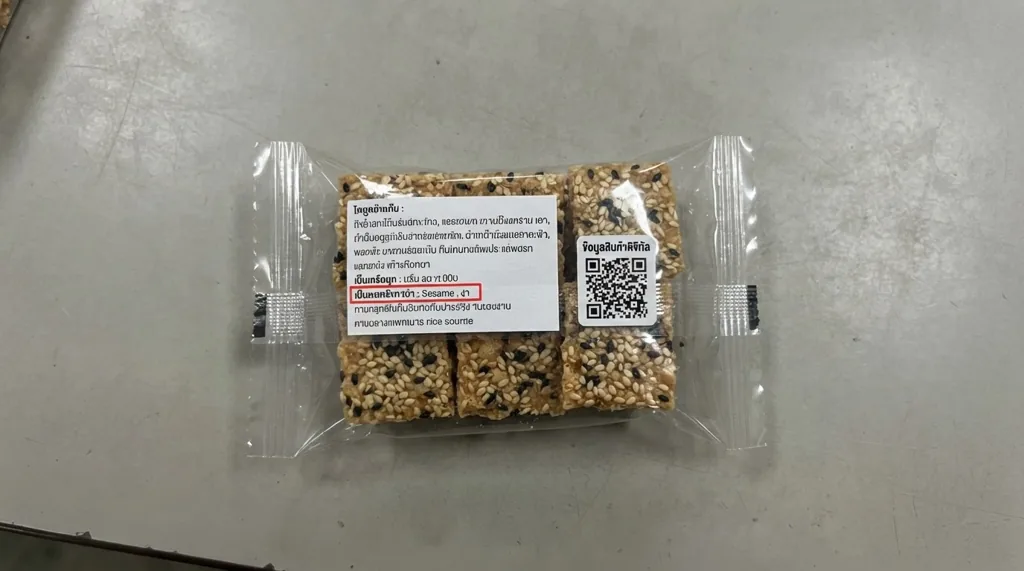
Thailand requires packaged food labels to declare sesame and allows optional digital labels from Oct. 31, 2026.
Thailand’s Ministry of Public Health changed its labelling rules for packaged food on Oct. 31, 2026, adding sesame to the allergen list and allowing digital labels.
The change comes in Ministry of Public Health Notification No. 474, issued in 2026 under the Food Act of 19791. It was printed in the Royal Gazette, Thailand’s official journal, on Oct. 30, 20262. The Food Division of the Thai Food and Drug Administration (FDA) lists it as in force from Oct. 31, 20263.
In short, a box or bottle of food sold in Thailand must now warn buyers about sesame. Some details may move to a digital label, but seven key facts must stay printed on the pack.
What does Notification No. 474 change?
Notification No. 474 is the second version of the rules on labels for food in packages1. It amends Notification No. 450, the main labelling rule, which took effect on July 19, 20244. The FDA’s Food Division announced the new text on Nov. 2, 20261.
Main changes in Notification No. 474
| Topic | New rule |
|---|---|
| Allergens | Sesame added, 9 tree nuts named |
| Sulphites and lactose | Moved from allergen list to warnings |
| Direct sales | 9 kinds of food lose label exemption |
| Digital labels | Optional, 7 items stay printed |
| Export food | Country of manufacture no longer required |
| Letter size | Applies to Thai text only |
The Food Division’s announcement lists seven groups of changes1:
- Labels for direct sales: nine kinds of food lose their exemption from full labels.
- Allergens: sesame is added, tree nuts are named one by one, and sulphites and lactose move to warnings.
- Food additives: new rules on how additives with more than one job are described.
- Digital labels: a new, optional way to give part of the label online.
- Export food: the country of manufacture is no longer required on food made only for export.
- Letter size: the minimum letter size applies to Thai text only.
- Drained weight: the general requirement is removed.
Each change is explained below. The rules cover every packaged food sold in Thailand. A foreign maker that ships packed food to a Thai importer prints its labels to these rules.
Which allergens must sesame food labels now show?
The biggest change for shoppers is a new allergen. The notification adds sesame and sesame products to the list of allergens that labels must declare1. Sauces, snacks, breads and oils that contain sesame now need an allergen statement.
The notification also spells out what "tree nuts" means. The rule now names nine nuts and the products made from each of them1:
- almonds
- cashew nuts
- hazelnuts
- pecans
- pistachios
- walnuts
- Brazil nuts
- macadamia nuts
- pine nuts
A pack that contains any of these nuts must declare it as a tree-nut allergen. The named list tells makers exactly which nuts count.
How do the new sulphite and lactose warnings work?
Two items leave the allergen list. Sulphites and lactose are no longer treated as allergens1. Sulphites are preservatives, and lactose is the sugar found in milk.
They do not disappear from the label. Instead, the notification adds a warning for food that contains lactose1. It also adds a warning for food with leftover sulphites of 10 milligrams per kilogram or more, measured as sulphur dioxide1. So a pack above that level still carries a message, but as a warning rather than an allergen line.
When can a food skip the allergen statement?
The notification adds one exemption for allergen statements. A maker can leave out the statement when it has assessed the allergen risk using the guidance of Codex, the joint food standards programme of the Food and Agriculture Organization (FAO) and the World Health Organization (WHO)2. The protein left in the food must also meet the limits that Codex sets1.
Both conditions must be met. Without the risk study and the low protein level, the full allergen statement stays on the label.
What can go on a digital label?
The rules now allow a digital label, information given online, for example through a code printed on the pack. The Food Division calls this an optional measure1. A maker that does not want a digital label keeps the full printed label.
What must stay on the printed pack
| Requirement | Details |
|---|---|
| Printed items | Name, Thai FDA number, quantity, ingredients |
| Safety items | Allergen information, warnings, expiry date |
| Foods excluded | 5 kinds, including infant formula and dietary supplements |
| Excluded foods | Every required item printed on the pack |
A maker that uses one must still print 7 items on the physical label1:
- the name of the food
- the Thai FDA number, the registration number of the product
- the quantity of food
- the ingredients
- the allergen information
- warnings
- the expiry date
Other label details may then move to the digital label. The printed pack keeps the facts a buyer needs for safety.
Which foods cannot move details to a digital label?
Five kinds of food are left out of the digital label option1. For these, a maker that wants a digital label must still print every required item on the physical label1. The five are:
- infant formula and food for babies
- follow-on formula for older babies
- supplementary food for babies and young children
- food for special purposes
- dietary supplements
For these products, a digital label can only add to the printed one. It cannot replace any part of it.
Which foods lose the direct-sale label exemption?
Thai rules let some sellers skip labels when the maker sells straight to the buyer and can explain the product in person. Notification No. 474 removes that exemption for nine kinds of food, however they are sold and through any channel1. These foods must always carry a full label:
- food additives
- infant formula, including formula for medical purposes
- follow-on formula for babies aged 6 to 12 months, and formula for young children
- supplementary food for babies and young children
- food for special purposes
- dietary supplements
- food with added extracts, nutrients or synthetic substances
- food covered by a specific warning rule
- food covered by the rules on production methods, equipment and storage
The notification adds definitions of "food with added extracts", "food with added nutrients" and "food with added synthetic substances"1. Sellers who are still exempt, such as restaurants, must follow the notification if they choose to show a label1. If they show an expiry date or a "best before" date, they must follow the date rules too1.
How do the rules treat food additives?
Some food additives do more than one job in a food. The notification lets the label show the additive’s other job when the production process needs it1. The amount used must match the purpose of that other job1.
The notification also removes the need to list additives for two jobs1:
- carriers, substances that dissolve or carry another ingredient
- packaging gas, gas put into a pack to keep the food fresh
A pack filled with such gas no longer has to list that gas as an additive.
What changes for food made for export?
Thai makers who ship food abroad gain one change. The rule to show the country of manufacture is dropped for food made only for export1. The label of an export product can then follow the buyer country’s rules on origin.
This change does not apply to food sold inside Thailand. Food on Thai shelves keeps every required item, including the maker’s country.
What happens to letter size and drained weight?
The rules on minimum letter size are now clearer. The size limits in clauses 5 and 15 of the notification apply to Thai-language text only1. English or other text on the same pack does not have to meet those sizes.
The notification also removes the general rule to show drained weight, the weight of food without its liquid1. The Food Division says another notification, on food in sealed containers, already requires drained weight for foods where it can be separated1.
When did the rules take effect and what comes next?
The Royal Gazette printed the notification on Oct. 30, 20262. The Food Division lists it as in force from Oct. 31, 20263. Its announcement does not give a separate grace period for packs printed under the old rules1.
Dates for Thailand’s food label rules
The Food Division also announced, on Nov. 2, 2026, a briefing meeting on new food notifications for the 2027 budget year5. The earlier rule, Notification No. 450, gave a two-year delay for one change, labels on food with shellfish and squid4. That delay ran to July 18, 20264. Notification No. 474 sets its own changes on top of that base rule.
Key points on Thailand’s packaged food labels
The table sums up the changes in Notification No. 474.
| Question | Answer |
|---|---|
| What changed? | Labels on packaged food |
| Who issued it? | Thailand’s Ministry of Public Health |
| Which rule does it amend? | Notification No. 450 of 2024 |
| Gazette date | Oct. 30, 2026 |
| In force from | Oct. 31, 2026 |
| New allergen | Sesame and sesame products |
| Tree nuts named | 9 kinds |
| Sulphite warning level | 10 mg per kg or more |
| Digital label | Optional, with 7 items still printed |
| Foods kept off digital labels | 5 kinds, including infant formula |
| Export food | Country of manufacture no longer required |
| Letter size rule | Thai text only |
The new rules apply from Oct. 31, 2026. A pack of food with sesame that reaches a Thai shelf now needs a sesame allergen statement on its printed label.
Sources
- ↩ กองอาหาร — press release / law474 no2 https://food.fda.moph.go.th/press-release/law474-no2/
- ↩ 135122.pdf https://ratchakitcha.soc.go.th/documents/135122.pdf
- ↩ กองอาหาร — category / announcement of the ministry of public health 1 https://food.fda.moph.go.th/food-law/category/announcement-of-the-ministry-of-public-health-1/
- ↩ กองอาหาร — press release / newslaw450 detail https://food.fda.moph.go.th/press-release/newslaw450-detail
- ↩ กองอาหาร — category / news1 https://food.fda.moph.go.th/press-release/category/news1/