
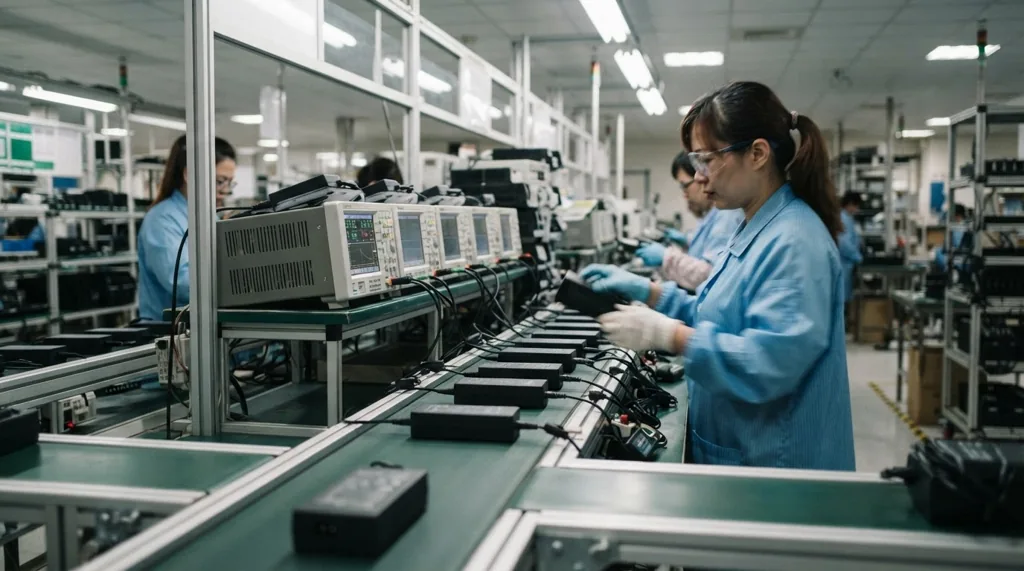
Taiwan will require safety certificates for more battery chargers and newer standards for backup power units from 1 July 2027.
Taiwan’s Bureau of Standards, Metrology and Inspection (BSMI) has updated testing rules for battery chargers, power adapters and backup power units, with key changes from 1 July 2027.
The bureau signed the notice on Sept. 8, 2026, and it took effect the same day1. It amends two sets of rules: one for power supply equipment such as battery chargers, and one for information technology products such as uninterruptible power supplies1.
In short, more battery chargers will need a BSMI certificate before they can be sold in Taiwan from 1 July 2027. For backup power units and some adapters, test reports must follow newer national standards from the same date.
What did BSMI announce on Sept. 8, 2026?
BSMI is the agency under Taiwan’s Ministry of Economic Affairs that checks whether products meet safety rules before sale. Its notice is numbered 11530016180 and was dated Sept. 8, 20261. The ministry posted it on its own website on Sept. 10, 20262.
The notice changes two lists of goods that must pass mandatory inspection. The first list covers power supply equipment, led by battery chargers1. The second covers information technology products, led by uninterruptible power supplies (UPS), the backup units that keep computers running during a power cut1.
The bureau’s branch offices also published the notice. The Tainan branch posted it on Sept. 10, 2026, with the full text attached3.
Why is Taiwan changing the charger and UPS rules?
The notice gives two reasons. First, the test standards for static converters and UPS units had been updated and brought into line with Taiwan’s national standards1. BSMI says it wants the new versions used so the rules match international practice and keep the products safe1.
Second, BSMI wants to widen the range of battery chargers it checks for safety. The notice brings more charger types into mandatory inspection, including chargers powered by direct current (DC)1.
The legal basis is the Commodity Inspection Act, Taiwan’s main law on product checks1. The notice cites Articles 3, 5, 10, 28, 35 and 39 of that law1.
Which power supply products are covered?
The power supply list has four items1:
- Battery chargers, except those that are medical devices or telecom terminal equipment.
- Wireless chargers, with the same exclusions.
- Car cigarette-lighter power supplies, the plugs that draw power from a car’s lighter socket.
- Other static converters, limited to adapters that turn alternating current (AC) into DC, but not adjustable DC power supplies.
Each item must meet its own list of Chinese National Standards (CNS), Taiwan’s national standards. Every item must also meet Section 5 of CNS 15663, on marking restricted substances1.
Battery chargers have two test routes. One route uses CNS 15936 and CNS 15598-1. The other uses CNS 13783-1, CNS 60335-1 and CNS 60335-2-29, standards based on household appliance safety1.
Chargers for some vehicles stay out. The notice excludes chargers for electric cars, electric motorcycles, electric bicycles and power-assisted bicycles1.
Which IT products and UPS units are covered?
The IT list has three items1:
- Uninterruptible power supplies with an output current of no more than 400A, except medical or telecom units. They must meet CNS 14757-2 and CNS 62040-1.
- Static converters for computers and telecom equipment, limited to AC-to-DC adapters. They must meet CNS 15936 and CNS 15598-1.
- Other switch-mode power supplies, also limited to AC-to-DC adapters. They must meet CNS 15936 plus either CNS 15598-1 or the pair CNS 61558-1 and CNS 61558-2-16.
Standards for the IT product list
| Product | Standards required |
|---|---|
| UPS units up to 400A | CNS 14757-2 and CNS 62040-1 |
| Adapters for computers and telecom | CNS 15936 and CNS 15598-1 |
| Other switch-mode supplies | CNS 15936 plus CNS 15598-1, or CNS 61558-1 and 61558-2-16 |
| All listed products | CNS 15663 Section 5 substance marking |
Adapters made only for high-end audio systems are excluded from the second and third items1. Medical devices and telecom terminal equipment are excluded as well1.
BSMI’s draft of this IT list, issued for comment before adoption, dated the standards4. It lists CNS 14757-2 (2019), CNS 62040-1 (2022), CNS 61558-1 (2026) and CNS 61558-2-16 (2025)4. The draft said static converters were only regrouped, with no real change to their rules4.
Which customs codes do the new rules list?
The notice gives reference codes from Taiwan’s tariff list, the C.C.C. codes1. Their first six digits are the same as the international Harmonized System (HS) codes4. All of them start with 8504.401.
For the power supply list, the codes are1:
- Battery chargers: 8504.40.20.00.3C, 8504.40.91.00.7C, 8504.40.94.00.4B and 8504.40.99.90.0C.
- Wireless chargers: 8504.40.99.29.6.
- Car lighter power supplies: 8504.40.99.90.0G.
- Other static converters: 8504.40.99.90.0A.
For the IT list, UPS units use 8504.40.92.00.6 and 8504.40.93.00.51. Static converters for computers use 8504.40.20.00.3A, and other switch-mode supplies use 8504.40.91.00.7A1.
The codes are for reference only. If customs or the International Trade Administration decides a product falls under another code, it must still pass inspection before it goes on sale1.
How do the BSMI approval routes work?
BSMI uses two approval routes for these goods. The first is Registration of Product Certification (RPC). A BSMI-designated laboratory tests a sample, and the applicant declares that every unit made matches it4. Once registered, goods can clear customs without further checks unless picked for a border spot-check4.
BSMI review time, working days
The second is Type-Approved Batch Inspection (TABI). The applicant first gets a type approval certificate4. It must then apply for inspection of each batch before the goods leave the factory or arrive at the port4.
Most items on both lists use RPC only1. Wireless chargers and UPS units can use either RPC or TABI1.
BSMI reviews an application within 14 working days. If it takes samples for testing, it adds 7 working days after the samples arrive1. Time spent waiting for missing papers does not count1.
The bureau’s draft gave the fees. An RPC application costs NT$5,000 per product type, with the same amount charged each year4. A type approval costs NT$3,500, and both certificates last three years4. The adopted notice says fees follow the Regulations Governing Fees for Commodity Inspection1.
What changes at the border for chargers and UPS units?
Customs treatment differs by product. Wireless chargers and UPS units carry import code C021. For these goods, the BSMI check comes before customs clearance.
For a UPS shipment under TABI, the importer must hold a type approval and then apply for inspection before import1. Under RPC, the importer must register the product before import or before it leaves the factory1. Importers apply at the BSMI office that covers the port where the goods arrive1.
The newly covered battery chargers have no import code1. Importers do not need any BSMI document to clear customs1. They must still finish the RPC procedure before the chargers enter the market1. The same applies to other static converters and other switch-mode supplies1.
In practice, the change for newly covered chargers lands at the point of sale. Customs will not stop them, but they cannot be sold legally without a certificate after the start date.
When do the new rules start?
The notice took effect on Sept. 8, 20261. Several key dates follow from it.
Key dates in the BSMI notice
| Date | What happens |
|---|---|
| Sept. 8, 2026 | Notice takes effect; new standards usable |
| 30 June 2027 | Last day to certify under old standards |
| 1 July 2027 | Newly covered chargers inspected; old UPS standards end |
For newly covered battery chargers, inspection of imported and locally made goods starts on 1 July 20271. BSMI already accepts RPC applications1. A certificate lasts three years from issue. If issued on or before 30 June 2027, it runs from 1 July 20271.
For other static converters on the power supply list, the new standard applies from the notice date. The old standard stops applying on 1 July 20271. For UPS units, the old standards also stop on 1 July 20271.
The switch works the same way for UPS units, other switch-mode supplies and other static converters1:
- Existing certificates under the old standards stay valid until they expire.
- Holders can add related models under the old standards while the main model is unchanged.
- Until 30 June 2027, renewals and new certificates may still use the old standards.
- From 1 July 2027, renewals and new applications need test reports to the new standards.
Each new certificate is valid for three years from the date it is issued1.
What about old test reports and hazardous-substance labels?
Makers do not always need a full new test. Some UPS units already have reports under the older CNS 14757-2, CNS 14843-1 and CNS 14843-21. For these, the original laboratory can test only the differences and reissue the report1. The same applies to adapters with reports under the 2009 international version of standard 61558-11.
All listed goods must show which of six restricted substances they contain. These are lead, cadmium, mercury, hexavalent chromium, polybrominated biphenyls (PBB) and polybrominated diphenyl ethers (PBDE)4. The information must appear on the product, packaging, label or manual, or at a web address printed there1.
The BSMI inspection mark is printed by the applicant. Its number combines a letter, a five-digit applicant code and the substance status, such as "RoHS"1. "RoHS" here means no restricted substance exceeds its limit, except for exempt items1. The mark must be permanent and easy to read, in a clear place on the product1.
Who is affected by the BSMI changes?
Foreign makers of chargers, adapters and UPS units are the first group. They need test reports from a BSMI-designated laboratory for each product type1. Those making DC-powered or non-3C chargers will need certificates for the first time.
Importers in Taiwan are the second group. For UPS units, they must clear inspection before the goods can pass customs1. For chargers and adapters, they must hold a certificate before sale1.
Multi-function products are also caught. If a product falls in scope, it must meet the relevant standards1. Any accessory that is itself on the list must also meet its standards1. Products already approved by the health ministry or under vehicle safety rules fall outside BSMI’s scope1.
Key points on Taiwan’s charger and UPS rules
The main facts of the BSMI notice are below.
| Question | Answer |
|---|---|
| Who issued it? | Bureau of Standards, Metrology and Inspection (BSMI) |
| When was it signed? | Sept. 8, 2026, effective that day |
| Which goods? | Battery chargers, wireless chargers, adapters, UPS units |
| What is new? | More chargers, including DC-powered ones, need inspection |
| Main start date | 1 July 2027 |
| Old UPS standards end | 1 July 2027 |
| UPS limit | Output current up to 400A |
| Approval routes | RPC, or TABI for wireless chargers and UPS |
| Review time | 14 working days, plus 7 with samples |
| Certificate life | Three years from issue |
| Excluded | Electric vehicle and e-bike chargers, medical, telecom |
From 1 July 2027, newly covered battery chargers cannot be sold in Taiwan without a BSMI certificate. From the same date, UPS units and some adapters need test reports to the new standards for new certificates.
Sources
- ↩ file_act.jsp https://tainan.bsmi.gov.tw/wSite/record/file_act.jsp?ixCuAttach=36731
- ↩ 訊息公告 – 新聞與公告 – 中華民國經濟部(Ministry of Economic Affairs,R.O.C.)全球資訊網 https://www.moea.gov.tw/Mns/Populace/news/News.aspx?kind=2&menu_id=41&news_id=123937
- ↩ 公告修正「應施檢驗電源供應設備類之電池充電器等商品之相關檢驗規定」及「應施檢驗資訊產品類之不斷電式電源供應器等商品之相關檢驗規定」 https://tainan.bsmi.gov.tw/wSite/ct?xItem=129309&ctNode=8322&mp=1
- ↩ Microsoft Word – Proposal for Amendments to the Legal Inspection Requirements for UPS_0422.docx https://www.knowtbt.kr/mrim/rsti/download?tbtNotiSeq=725873&fileMasterSeq=273390&fileSeq=602690