
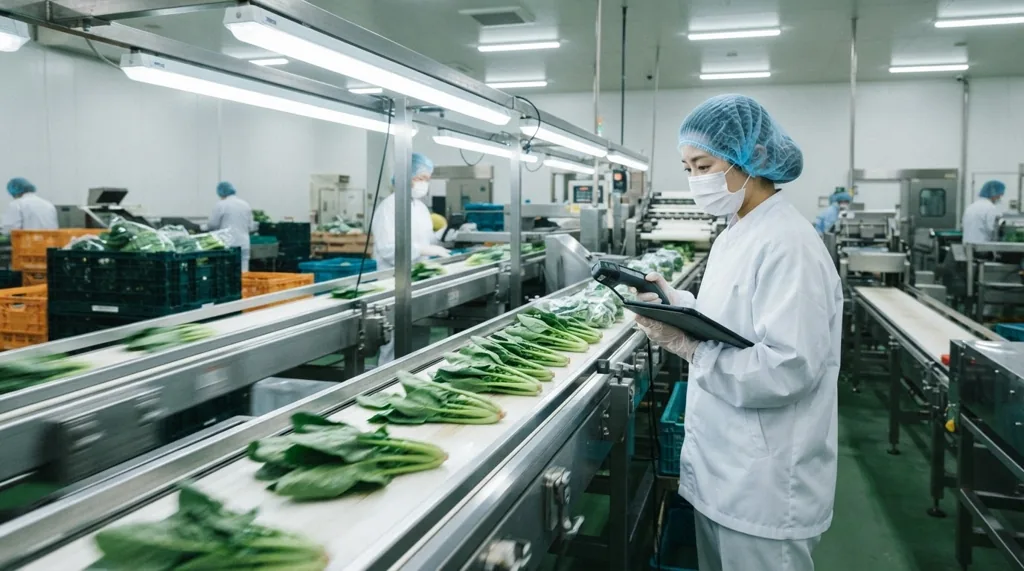
Japan has implemented comprehensive amendments and revisions to its Food Sanitation Act, updating specifications and standards for foods and food additives while establishing stricter agricultural chemical residue limits.
Japan’s Consumer Affairs Agency changed pesticide limits for imported and domestic foods on Sept. 10, 2026, and will remove all chlorpyrifos limits from Sept. 10, 2027.
The change comes in Cabinet Office Notification No. 114 of 2026. It amends Japan’s main food standards rulebook, the Specifications and Standards for Foods, Food Additives, etc.1. The rulebook dates from Ministry of Health and Welfare Notification No. 370 of 19591.
In short, food shipments to Japan will be tested against new pesticide limits. Higher limits apply now, but most lower limits wait one year. From Sept. 10, 2027, foods with chlorpyrifos above 0.01 parts per million (ppm) cannot be sold in Japan.
Which pesticides does the Sept. 10 notice cover?
The notice covers five farm chemicals. It sets or revises maximum residue limits, the highest amount of a pesticide allowed to remain in a food, for four of them1:
- Quinoclamine, a weed killer used on rice and vegetables.
- Spirodiclofen, an insecticide used on fruit, nuts and vegetables.
- Spiropidion, an insecticide that gets limits in the rulebook for the first time.
- Propamocarb, a fungicide used on vegetables, fruit and rice.
The fifth chemical is chlorpyrifos, an insecticide. The notice deletes all of its food limits1. When a food has no limit for a pesticide, Japan applies a default limit of 0.01 ppm1. This is very close to zero.
The Consumer Affairs Agency, the government body that now writes Japan’s food safety standards, announced the change in its circular No. 385 to prefectures and cities1. The agency lists the circular among its 2026 pesticide notices2.
How do the new limits reach the border?
The Ministry of Health, Labour and Welfare sent the circular to all of Japan’s quarantine stations on the same day1. These stations inspect imported food when it arrives in Japan. The ministry asked them to tell the businesses involved and apply the rules without error1.
The rule sits on Article 13 of the Food Sanitation Act3. Under that article, nobody may make or sell food that fails the standards3. The same article sets the default 0.01 ppm limit for any pesticide without a specific limit3.
So a shipment of imported vegetables, fruit, tea or meat is judged against the new numbers. A test result above the limit means the food cannot be sold in Japan.
Why did Japan change the pesticide limits?
The agency said it considered international standards for these pesticides3. It also considered how the chemicals are used in Japan and abroad3. The Food Safety Commission, Japan’s food risk assessment body, carried out a health evaluation before the change3.
A pesticide and veterinary drug committee of the Food Sanitation Standards Council approved the draft. It met on Jan. 20, 2026, and March 13, 20263. The agency published the draft for public comment on June 11, 20263.
For quinoclamine and propamocarb, there was a further reason. The Ministry of Agriculture, Forestry and Fisheries told the agency it was re-checking these pesticides under the Agricultural Chemicals Regulation Act1. The limits were revised after that notice1.
When do the new limits start?
The notice took effect on the day it was published, Sept. 10, 20261. Every limit that goes up applies from that day1.
Two start dates for the new limits
| Date | What applies | Example |
|---|---|---|
| Sept. 10, 2026 | All higher and new limits | Spiropidion on tea: 20 ppm |
| Sept. 10, 2027 | All lower limits and chlorpyrifos deletion | Chlorpyrifos on tea: 0.01 ppm |
Limits that go down follow a slower timetable. The lower limits for listed foods apply from Sept. 10, 2027, one year after publication1. The same date applies to the chlorpyrifos deletion1.
The draft of June 11, 2026, had planned a faster start for chlorpyrifos, around December 20263. The final notice gave chlorpyrifos the same one-year wait as the other lower limits1.
There is one more protection for chlorpyrifos. Food that was made, imported or processed before the start date may still follow the old limits1. This covers food that is later processed, used, cooked, stored or sold1.
What changes for chlorpyrifos on imported crops?
Chlorpyrifos had limits on a very long list of foods. All of them go, and the default 0.01 ppm applies from Sept. 10, 20271. For some crops this is a large cut.
Old chlorpyrifos limits, all cut to 0.01 ppm, ppm
The old limits included1:
- Tea: 10 ppm.
- Other oilseeds and other spices: 5 ppm each.
- Broccoli, bananas and sweet peppers: 2 ppm each.
- Lemons, oranges, grapefruit and limes: 1 ppm each.
- Wheat, apples, grapes and plums: 0.5 ppm each.
- Fish and shellfish: 0.3 ppm.
- Corn oil: 0.2 ppm.
- Soybeans: 0.1 ppm.
- Corn, almonds, walnuts, pecans and coffee beans: 0.05 ppm each.
- Bottled mineral water: 0.03 ppm.
Beef and other meat from land mammals other than pigs also lose their 0.05 ppm limit1. Pork, poultry, eggs and milk already had a chlorpyrifos limit of 0.01 ppm1. For those foods, the level does not change.
Exporters of tea, citrus, bananas and spices face the biggest drop. A tea shipment that met the 10 ppm limit could fail a 0.01 ppm test after September 2027.
What changes for propamocarb on vegetables?
Propamocarb limits go up for many vegetables and for meat. The higher limits apply from Sept. 10, 20261. Examples1:
- Leeks and green onions: 30 ppm, up from 3 ppm.
- Kale: 20 ppm, a new limit.
- Broccoli: 3 ppm, up from 0.5 ppm.
- Cabbage: 1 ppm, up from 0.1 ppm.
- Cauliflower and onions: 2 ppm, up from 0.2 ppm.
- Liver and kidneys of cattle, pigs and other land mammals: 2 ppm, up from 0.01 ppm.
- Beef and pork muscle and fat: 0.03 ppm, up from 0.01 ppm.
Propamocarb limits, before and after
| Food | Old limit | New limit |
|---|---|---|
| Leeks and green onions | 3 ppm | 30 ppm |
| Broccoli | 0.5 ppm | 3 ppm |
| Cabbage | 0.1 ppm | 1 ppm |
| Spinach | 40 ppm | 0.01 ppm default |
| Watermelons and melons | 0.5 ppm, flesh | 5 ppm, with rind |
Other propamocarb limits are removed, so the default 0.01 ppm applies from Sept. 10, 20271. These include spinach, which had a 40 ppm limit. They also include Chinese cabbage, lettuce and ginger at 10 ppm each1. Rice, celery, strawberries and bamboo shoots also lose their limits1.
For watermelons and melons, the old limit of 0.5 ppm covered the flesh. The new limit is 5 ppm, measured with the rind1. That change also starts on Sept. 10, 20271. Honey gets a new 0.05 ppm limit1.
What changes for spirodiclofen on fruit and nuts?
Most spirodiclofen changes are cuts. They apply from Sept. 10, 20271. Examples1:
- Oranges: 0.5 ppm, down from 2 ppm.
- Lemons, grapefruit, limes and apples: 1 ppm, down from 2 ppm.
- Other fruit: 2 ppm, down from 5 ppm.
- Persimmons: 0.8 ppm, down from 1 ppm.
- Chestnuts, pecans, almonds and walnuts: 0.08 ppm, down from 0.1 ppm.
- Cucumbers: 0.07 ppm, down from 0.1 ppm.
Eggplant loses its 2 ppm limit, so the default 0.01 ppm applies1. Some limits go up from Sept. 10, 2026. Japanese pears, European pears and quinces rise to 1 ppm from 0.8 ppm1. Blueberries and huckleberries get a new 4 ppm limit, and honey gets 0.05 ppm1.
Mandarins and loquats are now measured on the whole fruit with peel1. Mandarins with peel get 0.5 ppm. Loquats with peel and seeds, without the stem, get 0.8 ppm1.
Which foods get new spiropidion limits?
Spiropidion had no limits in the rulebook before1. All of its limits are new and apply from Sept. 10, 20261. Examples1:
- Tea: 20 ppm.
- Other spices: 15 ppm.
- Sweet peppers: 5 ppm.
- Eggplant: 4 ppm.
- Soybeans and citrus fruit: 3 ppm.
- Potatoes and tomatoes: 2 ppm.
- Cucumbers, pumpkins, melons and okra: 1 ppm.
- Honey: 0.05 ppm.
Meat, milk and eggs also get spiropidion limits. They range from 0.01 ppm for muscle, milk and eggs to 0.2 ppm for liver and kidneys1. For crops, the test counts spiropidion and one breakdown product, called metabolite B1. For animal foods, the test counts metabolite B only1.
What changes for quinoclamine on rice?
Quinoclamine changes are small. The limit for brown rice falls to 0.01 ppm from 0.02 ppm1. The limit for "other vegetables" also falls to 0.01 ppm from 0.02 ppm1. Both cuts apply from Sept. 10, 20271.
Limits for other plants in the carrot family and for fish and shellfish stay at 0.02 ppm1.
How does the rind rule work for melons and kiwis?
The notice also explains how to read limits for some fruit1. It names watermelons, melons, oriental melons, mandarins, loquats, peaches and kiwis1.
Sometimes the notice removes the flesh-only limit for one of these fruits and sets no new limit. Sometimes it sets a pesticide limit but leaves these fruits out. In both cases, the default 0.01 ppm applies to the whole fruit with peel or rind1. For loquats, the stem is removed. For peaches, the skin and stone are included1.
This matters for testing labs. A sample may need to include the rind or peel, not just the part people eat.
Who is affected by the new limits?
Foreign growers who use these five pesticides are most affected. They must keep residues on crops sent to Japan below the new numbers. Growers who use chlorpyrifos need to plan for the 0.01 ppm limit by September 2027.
Japanese importers carry the risk at the border. A shipment above the limit cannot be sold in Japan, under Article 13 of the Food Sanitation Act3. Testing labs may need to update their methods, including the new rind and peel rules.
Some exporters gain. Higher propamocarb limits help vegetable growers, and new spiropidion limits open a path for crops treated with that insecticide1.
Key points on Japan’s new pesticide limits
The table sums up the Sept. 10, 2026 notice.
| Question | Answer |
|---|---|
| What changed? | Pesticide limits in foods |
| Who issued it? | Consumer Affairs Agency |
| Legal instrument | Cabinet Office Notification No. 114 of 2026 |
| Legal basis | Food Sanitation Act, Article 13 |
| Pesticides covered | Quinoclamine, spirodiclofen, spiropidion, propamocarb, chlorpyrifos |
| Biggest change | All chlorpyrifos limits deleted |
| Default limit | 0.01 ppm |
| Higher limits start | Sept. 10, 2026 |
| Lower limits start | Sept. 10, 2027 |
| Chlorpyrifos old tea limit | 10 ppm |
| Who checks imports | Quarantine stations |
The next date is Sept. 10, 2027. From then, chlorpyrifos on tea, citrus, grains, nuts and meat must stay at or below 0.01 ppm, unless the food was made, imported or processed before that day1.
Sources
- ↩ 001748742.pdf https://www.mhlw.go.jp/content/11135200/001748742.pdf
- ↩ 施行通知 | 消費者庁 https://www.caa.go.jp/policies/policy/standards_evaluation/pesticide_residues/notice
- ↩ 概要(キノクラミン等) https://public-comment.e-gov.go.jp/pcm/download?seqNo=0000315820