
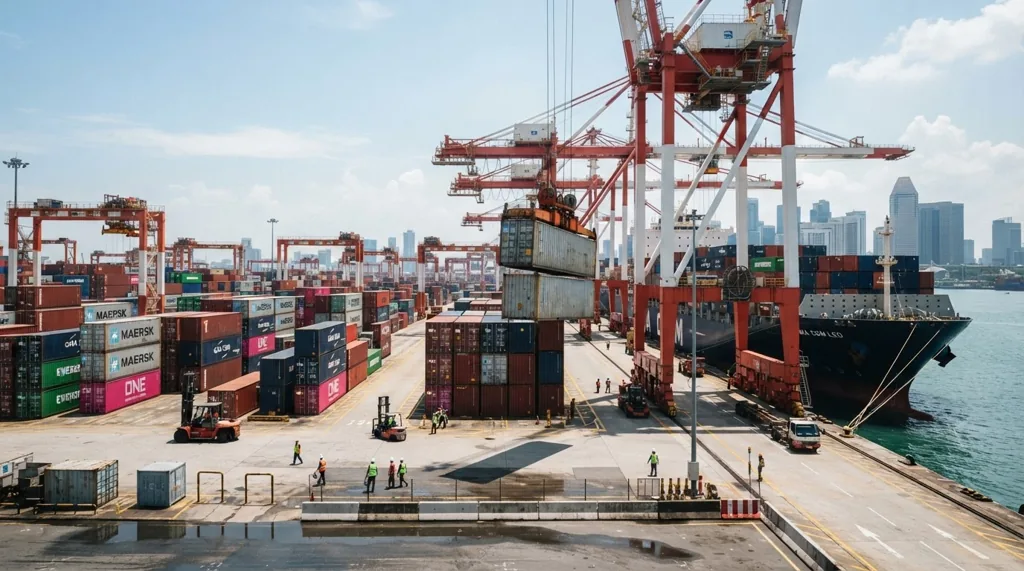
European Union drops the written confirmation for medicine ingredients made in Singapore, starting Nov. 15, 2026.
The European Commission has added Singapore to its list of countries whose medicine-ingredient controls match European Union (EU) rules, effective Nov. 15, 2026.
The change is set out in Commission Implementing Decision (EU) 2026/2347 of Oct. 23, 2026, published in the Official Journal of the European Union on Oct. 26, 20261. It replaces the list in an older decision from 2012, which names the non-EU countries that enjoy this status1.
In short, active ingredients for human medicines made in Singapore will no longer need a special certificate from Singapore’s authorities for each shipment to the EU. A European buyer can import them on the same paperwork terms as ingredients from the United States, Japan or Switzerland.
What is changing for Singapore drug ingredients?
The goods concerned are active pharmaceutical ingredients, the substances in a medicine that treat the illness. EU law calls them "active substances"1. Since 2013, these ingredients may enter the EU only with a written confirmation from the authority of the exporting country2.
Singapore ingredient shipments, before and after
| Question | Before Nov. 15, 2026 | From Nov. 15, 2026 |
|---|---|---|
| Singapore on EU list? | No | Yes |
| Written confirmation needed? | Yes, with each shipment | No |
| Quality rules for making ingredients | At least equal to EU rules | At least equal to EU rules |
The written confirmation is an official letter from that authority. It states that the factory follows good manufacturing practice, the quality rules for making medicines, at a level at least equal to the EU’s2. It also confirms that the factory faces regular, strict controls, including repeated and unannounced inspections2.
The European Commission waives this letter for a short list of countries3. Ingredients made in a listed country do not need a written confirmation4. With the new decision, Singapore joins that list1.
Which countries are on the EU list now?
The new decision replaces the whole annex, or attached list, of Implementing Decision 2012/715/EU1. After the change, the list has 10 countries and territories1:
- Australia
- Brazil
- Canada
- Israel
- Japan
- Singapore
- South Korea
- Switzerland
- Taiwan
- United States
Places on the EU equivalence list
The list began in 2012 with Switzerland as its only entry5. The Commission’s public health department records when each other country was added3. For example, the United States joined in June 2013, Canada in January 2023 and Taiwan in November 20233.
The list covers countries and territories, and it is not limited to countries the EU recognises3. The decision adds two notes. One limits Israel’s entry to the State of Israel, without the territories under Israeli administration since June 19671. The other says the Taiwan entry reflects no EU position on Taiwan’s legal status1.
Why did the European Commission list Singapore?
EU medicines law lets a non-EU country ask to be assessed1. The Commission then checks whether that country’s rules for exported active ingredients protect public health as well as EU rules do1. It also checks the country’s inspections and enforcement1.
From request to listing
Singapore asked to be listed in a letter dated Feb. 11, 20251. The Commission reviewed Singapore’s documents. It also sent a team to review Singapore’s system on site from March 18 to 25, 20261.
That on-site review included two observed inspections1. It also took account of answers and documents from the Health Sciences Authority (HSA), Singapore’s medicines regulator1. Based on this assessment, the Commission concluded that Singapore met the legal requirements1.
Why did Singapore wait so long?
Singapore first asked to be listed on Sept. 17, 2012, according to the Commission’s application table3. That first request did not lead to a listing3.
The table gives the reason. Singapore’s law at the time had a non-mandatory certification scheme for good manufacturing practice3. The Commission noted that contacts continued and that, in the meantime, Singapore issued written confirmations3.
The 2025 request led to the full assessment and the new decision1. The Commission’s online table still shows the old 2012 status and has not yet been updated for the decision3.
How does the written confirmation work today?
The Commission’s questions-and-answers guide on importing active ingredients explains the current rules4. These rules are found in Articles 46b and 111b of Directive 2001/83/EC, the main EU law on human medicines4.
For a factory in a non-listed country, the process works in these steps4:
- The authority of the country where the ingredient is made issues a written confirmation for the factory.
- The confirmation covers that factory and the named ingredients made there, not a single batch.
- Each shipment to the EU carries the confirmation, or a copy if the original is still valid.
- The EU maker of the finished medicine checks that the confirmation came with the shipment.
National authorities may also check the papers at import or during inspections, depending on each EU country’s law4. The issuing authority sets how long a confirmation stays valid4. The confirmation must come from the country where the ingredient is made, even if it is shipped through another country4.
Once the decision applies, step 1 and step 3 fall away for ingredients made in Singapore. Singapore’s factories no longer need an HSA letter, and each shipment no longer needs one to enter the EU.
Which goods are covered and which are not?
The rules apply only to active ingredients for medicines for human use4. Ingredients for veterinary medicines are outside the written confirmation rules4. Blood plasma is also outside, but processed plasma products with a medical action count as active ingredients4.
What the written confirmation rules cover
| Goods | Rule |
|---|---|
| Active ingredients for human medicines | Covered |
| Ingredients for veterinary medicines | Not covered |
| Finished medicines | Separate import rules |
| Starting materials and intermediates | Not covered |
| Ingredients for EU medicines made only for export | Covered |
The guide lists several other cases outside the rules4:
- Finished medicines: these follow separate import rules, including an import licence and batch release by a qualified person.
- Starting materials and intermediates: chemicals used to make an active ingredient do not count as the ingredient itself.
- Ingredients already mixed with other substances but not yet a finished medicine.
- Ingredients passing through the EU for export without being imported.
- Ingredients for research trials of unauthorised medicines.
A written confirmation is still needed when the finished medicine made in the EU is only for export4. If an ingredient arrives without a confirmation, it cannot be used in a human medicine4.
Who is affected by the Singapore listing?
Makers in Singapore that sell active ingredients to EU buyers gain the most. They will no longer need to request a written confirmation from the HSA for each factory and ingredient2.
EU importers of active ingredients and EU medicine makers using Singapore ingredients also benefit. They will no longer need to check for a written confirmation on Singapore shipments4. The listing confirms the Commission’s view that Singapore’s controls protect public health as well as EU controls do1.
The rules on quality stay in place. Active ingredients must still be made under good manufacturing practice at least equal to EU standards2. The EU standard for making active ingredients is ICH Q7, a guideline from the International Conference for Harmonisation2.
The decision does not change paperwork for ingredients made elsewhere. The written confirmation must come from the country of manufacture4. So an ingredient made in another non-listed country still needs that country’s confirmation, even if it is shipped through Singapore.
What other checks still apply?
EU inspections continue whatever the paperwork. When an EU country finds a factory does not follow good manufacturing practice, it issues a statement of non-compliance4. Such statements are stored in the EudraGMDP database, an EU database of factory inspections, and are public4.
The guide also notes that the written confirmation is separate from mutual recognition agreements4. These are deals in which the EU and another country accept each other’s factory inspections4. A listing under the 2012 decision is a different status from such an agreement.
In some cases, an EU country may waive the written confirmation for a non-listed factory it has inspected4. This happens only exceptionally, when needed to keep medicines available, and for no longer than the factory’s quality certificate is valid4.
When does the Singapore change take effect?
The decision enters into force on the 20th day after publication in the Official Journal1. Publication was on Oct. 26, 2026, so the decision takes effect on Nov. 15, 20261.
Until that date, shipments of active ingredients from Singapore still need the written confirmation. The Commission’s guide also covers shipments made under a confirmation that has since expired4. Such a shipment can still be imported if its papers prove it was made and released before the expiry date4.
Key points on Singapore drug ingredients
The table sums up the decision and its effect on shipments.
| Question | Answer |
|---|---|
| What changed? | Singapore added to EU equivalence list |
| Which measure? | Implementing Decision (EU) 2026/2347 |
| Who issued it? | European Commission |
| Which goods? | Active ingredients for human medicines |
| What paperwork goes? | Written confirmation for Singapore-made ingredients |
| Who is Singapore’s regulator? | Health Sciences Authority (HSA) |
| When did Singapore ask? | Feb. 11, 2025 |
| When was the on-site review? | March 18 to 25, 2026 |
| How many places on the list? | 10 countries and territories |
| When published? | Oct. 26, 2026 |
| When does it apply? | Nov. 15, 2026 |
| What is not covered? | Veterinary ingredients and finished medicines |
From Nov. 15, 2026, active ingredients made in Singapore can enter the EU without a written confirmation. They will join ingredients from the nine other listed countries and territories, while quality rules and EU inspections stay in place.
Sources
- ↩ Implementing decision – EU – 2026/2347 – EN – EUR-Lex https://eur-lex.europa.eu/eli/dec_impl/2026/2347/oj/eng
- ↩ active_pharmaceutical_ingredients_leaflet_en_0.pdf https://health.ec.europa.eu/system/files/2016-11/active_pharmaceutical_ingredients_leaflet_en_0.pdf
- ↩ Importation of active substances – Listing of third countries – Public Health https://health.ec.europa.eu/medicinal-products/falsified-medicines/importation-active-substances-listing-third-countries_en
- ↩ health.ec.europa.eu — 2016 11 / qa importation 0 https://health.ec.europa.eu/system/files/2016-11/qa_importation_0.pdf
- ↩ L_2012325EN.01001501.xml https://eur-lex.europa.eu/legal-content/EN/TXT/HTML/?uri=CELEX:32012D0715