
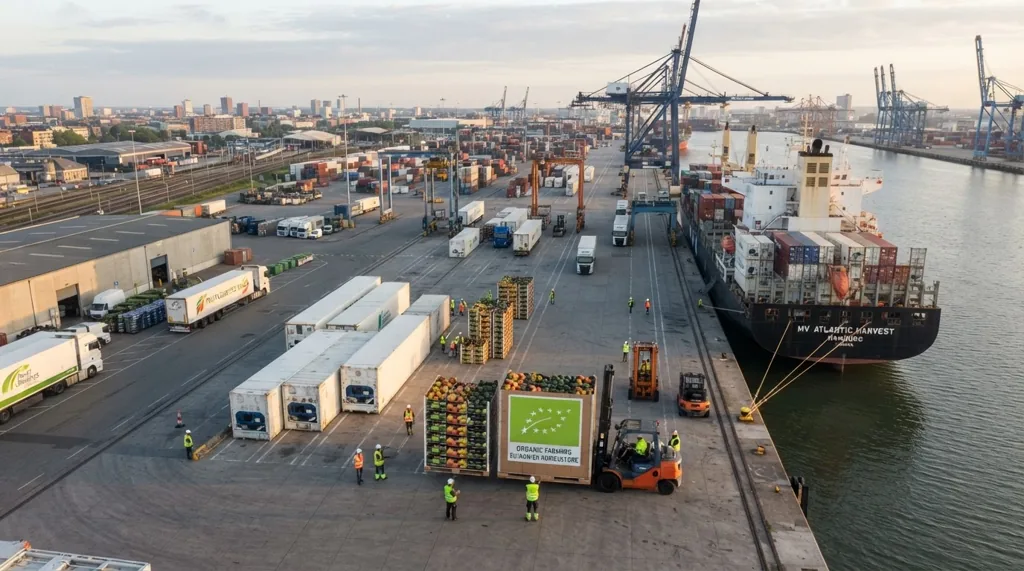
European Union lawmakers agreed to keep organic imports from 11 recognised countries flowing until Dec. 31, 2036.
The European Parliament and the Council agreed to keep organic imports from 11 recognised non-EU countries flowing until Dec. 31, 2036, with new logo conditions.
The European Commission welcomed the political agreement in a press release dated Oct. 19, 20261. The deal amends Regulation (EU) 2018/848, the European Union (EU) law on organic production and labelling, including its rules on trade with non-EU countries1.
In short, organic food and feed from the 11 recognised countries can keep entering the EU as organic for 10 more years. But a shipment from those countries may carry the green EU organic logo only if it also meets extra EU farming and control rules.
Why did the EU act on organic imports now?
The EU recognises some non-EU countries as having organic farming and control systems "equivalent" to its own. Equivalent means the system meets the same goals and principles, even if it reaches them by different means2. Products from these countries can be sold in the EU as organic.
That recognition was due to run out. The Commission’s proposal of Dec. 16, 2025, known as COM(2025) 780, says the recognition of these countries will expire on Dec. 31, 20262. The proposal says talks with those countries on organic trade agreements are still going on2.
The Commission called the extension "necessary and urgent" to avoid disruptions in organic trade2. Its press release on the deal says the extension avoids disruptions in organic imports and exports while trade agreements are negotiated1.
What did the EU court decide about the organic logo?
A second reason is a ruling by the Court of Justice of the European Union, the EU’s highest court. In Case C-240/23, known as Herbaria Kräuterparadies, the court looked at products imported under the equivalence system3.
The court ruled that such products may not carry the EU organic logo2. In principle, they also may not use terms such as "organic" on the label. The reason is that they meet only standards equivalent to EU rules, not the EU rules themselves2.
The court did allow one thing. A product may carry the organic logo of the country it comes from, even if that logo contains words like "organic"2. The Commission said its proposal was a response to this judgment, and that the labelling of equivalent imports needed to be clarified1.
Which countries keep their organic recognition until 2036?
The deal extends the recognition of 11 non-EU countries until Dec. 31, 20361. These are the countries recognised for equivalence under the EU’s older organic law, Regulation (EC) No 834/20072.
The documents do not list the 11 countries by name. They are the countries whose products currently enter the EU under the equivalence system rather than under a trade agreement2. The Commission says the extra 10 years give time to move to recognition through international agreements2.
The Commission will keep supervising these countries during the extension. It does so under Article 48 of the organic regulation2.
What changes for the EU organic logo on imports?
Under the deal, imported organic products from countries with equivalent systems may use the EU organic logo. They must meet additional EU production and control requirements to do so1.
Equivalent organic imports, before and after the deal
| Question | Current rules | Under the deal |
|---|---|---|
| Recognition of 11 countries ends | Dec. 31, 2026 | Dec. 31, 2036 |
| EU organic logo on imports | Not allowed, per Case C-240/23 | Allowed if extra EU rules are met |
| Home country organic logo | Allowed | Allowed |
The Commission’s proposal explains which kinds of rules these extra requirements will cover. They are rules that play an important role in organic farming in the EU2. The proposal names three examples:
- living soil, meaning crops grown in healthy, living soil
- animal welfare standards for livestock
- processing with few artificial inputs, meaning food made with a minimum of additives and aids
The Commission says the differences between EU and equivalent rules sometimes matter for consumers and for fair competition2. The proposal would let the Commission add or change these extra requirements later through delegated acts, rules the Commission adopts under powers given by the law2.
How will labels on equivalent imports work?
The logic of the new rules is a two-level label for shipments from equivalent countries. A product that meets only the equivalent rules can still be sold as organic in the EU2. A product that also meets the extra EU requirements can carry the EU logo as well1.
The proposal explains why organic terms on labels matter. Not every recognised country has its own organic logo2. Without terms such as "organic", "biological" or "ecological", makers in those countries could not show the organic status of their goods2.
The proposal points to the Codex Alimentarius guidelines CAC/GL 32, the international food standards on organic labelling2. These guidelines use such terms to tell buyers how a product was made2.
The EU logo matters for sales. A Eurobarometer survey in June and July 2024 found it is the food logo Europeans know best2. It helps buyers find organic products and helps producers sell them across the EU3.
What did Parliament propose on ingredients and small sellers?
The Parliament’s legislative file sets out amendments that lawmakers proposed during the talks. The file says the EU logo should also be allowed on some products processed in the EU3. These are products with organic ingredients from equivalent countries, if those ingredients make up 5% or less of the farm ingredients by weight3.
Lawmakers also proposed changes for small shops. Some small sellers of unpacked organic products directly to consumers do not need an organic certificate3. Rising prices pushed some of them above the turnover limit, so they lost this exemption3.
Lawmakers proposed raising the yearly turnover limit from €20,000 to €25,0003. They proposed raising the sales limit from 5,000 kg to 10,000 kg3. The Commission’s release says the final deal adapts and streamlines certification conditions for small retailers and groups of operators1. It does not give the final figures.
What else changes for organic farms and processors?
The deal also changes some rules on farming in the EU. The Commission lists rules on poultry, feed, conversion period and veterinary treatments1. It also covers soil fertility in greenhouses1. The conversion period is the time a farm must follow organic rules before its products can be sold as organic.
Estimated savings from simpler organic rules, EUR million
The Parliament’s file gives details from the proposals3:
- Poultry: only birds with enough feathers to control their body heat must have outdoor access.
- Quails: a conversion period of five weeks and a minimum slaughter age of 42 days.
- Cleaning products: organic operators could use cleaning and disinfection products already on sale, without waiting for an EU list.
The Commission’s proposal estimated the savings from these simpler rules2. It put yearly administrative savings at EUR 47.8 million, with EUR 45.9 million for businesses and EUR 1.9 million for public offices2. It also estimated EUR 109.2 million in one-off savings for businesses and EUR 90.2 million in yearly adjustment savings2.
Who is affected by the organic import deal?
Several groups face changes:
- Exporters in the 11 countries can keep selling organic goods to the EU after 2026, under their own national rules.
- EU importers of these goods avoid a sudden stop to organic imports at the start of 2027.
- Brand owners and packers must check whether a product meets the extra EU requirements before printing the EU logo on it.
- Small EU retailers may find it easier to qualify for an exemption from organic certification.
For exporters, the main choice is between two labels. Goods that meet only their home country’s equivalent rules can use their country’s own organic logo2. Goods that also meet the extra EU rules can carry the EU logo1.
Organic farming covers 11% of EU farmland, according to the Commission1. The current organic law has applied since January 20221.
When will the new organic rules take effect?
The deal is not yet law. The political agreement must now be formally approved by the Parliament and the Council1.
Steps toward the new organic rules
Once approved, the regulation will enter into force the day after its publication in the Official Journal of the European Union1. The Parliament’s file says the aim is an agreement before the end of the year3. That timing ensures a smooth transition before the current recognition ends on Dec. 31, 20262.
The law went through several steps before the deal. The Council adopted its negotiating position on May 11, 20263. Parliament’s agriculture committee adopted its position on July 14, 2026, and the full Parliament confirmed talks could open on Sept. 16, 20263.
Key points on EU organic import rules
The table below sums up the deal.
| Question | Answer |
|---|---|
| What changed? | Political deal to amend the EU organic law |
| Who agreed it? | European Parliament and Council |
| Law amended | Regulation (EU) 2018/848 |
| Which goods? | Organic products from 11 recognised countries |
| Old expiry date | Dec. 31, 2026 |
| New expiry date | Dec. 31, 2036 |
| EU logo on imports | Allowed if extra EU rules are met |
| Examples of extra rules | Living soil, animal welfare, few artificial inputs |
| Court ruling behind it | Case C-240/23 |
| Next step | Formal approval by Parliament and Council |
| Start date | Day after publication in the Official Journal |
The next step is formal approval by both lawmakers, before the old recognition ends on Dec. 31, 20262. If that happens, organic shipments from the 11 countries can keep entering the EU without a break.
Sources
- ↩ Commission welcomes political agreement on the future organic rulebook https://ec.europa.eu/commission/presscorner/detail/en/ip_26_2210
- ↩ IMMC.COM%282025%29780%20final.ENG.xhtml.1_EN_ACT_part1_v5.docx https://eur-lex.europa.eu/legal-content/EN/TXT/HTML/?uri=COM:2025:780:FIN
- ↩ Carriages preview | Legislative Train Schedule https://www.europarl.europa.eu/legislative-train/theme-sustaining-our-quality-of-life-food-security-water-and-nature/file-organic-farming-and-labelling