
Canada’s trade tribunal found signs of harm from Chinese paper cups, so border agency decisions follow by Nov. 16, 2026.
Canada’s trade tribunal ruled on Oct. 16, 2026, that cheap Chinese paper cups and food containers may be hurting Canadian makers.
The Canadian International Trade Tribunal (CITT) found a "reasonable indication" that dumped and subsidized imports from China have caused injury to Canadian producers1. Because of that finding, the Canada Border Services Agency (CBSA) will continue its two investigations into the goods1.
In short, the case is still open and no new duty applies yet. The next step comes by Nov. 16, 2026, when the CBSA makes its preliminary decisions, and extra duties may start on shipments from China at that point2.
What did the tribunal decide on paper cups?
The tribunal ran a preliminary injury inquiry, a first and quick check of whether imports are harming Canadian industry. The case number is PI-2026-0041. On Oct. 16, 2026, it found a reasonable indication of injury from the dumping and subsidizing of paperboard cups and containers from China1.
This is a low first test, not a final ruling. Had the tribunal found no sign of harm, the case would have stopped. Instead, the border agency’s investigations go on1.
The tribunal is an independent, court-like body that reports to Parliament through the Minister of Finance1. It hears cases on dumped and subsidized imports, safeguard complaints and customs appeals1.
What are dumping and subsidizing?
Dumping means selling goods abroad below their normal value. The CBSA says dumping happens when the normal value of the goods is higher than the export price to Canadian importers3. Normal value is usually the selling price in the exporter’s home market, or the cost of making the goods plus costs and profit3.
Subsidizing means a foreign government gives money or other help to the companies making the goods. Canada can answer with an anti-dumping duty, an extra import tax on goods sold below their normal price. It can also add a countervailing duty, an extra import tax that cancels out a foreign subsidy.
Both tools come from the Special Import Measures Act (SIMA), Canada’s trade remedy law2. The CBSA says that in 2025, duties under this law applied to about $3.3 billion worth of imports4. It also says 185 such measures are now in force in Canada4.
Which paper cups and containers are covered?
The CBSA defines the goods as paperboard cups and containers rolled from coated paperboard stock2. The case also covers blanks or flats, the flat die-cut pieces of paperboard ready to be formed into a cup or container3. The goods must come from, or be shipped from, the People’s Republic of China2.
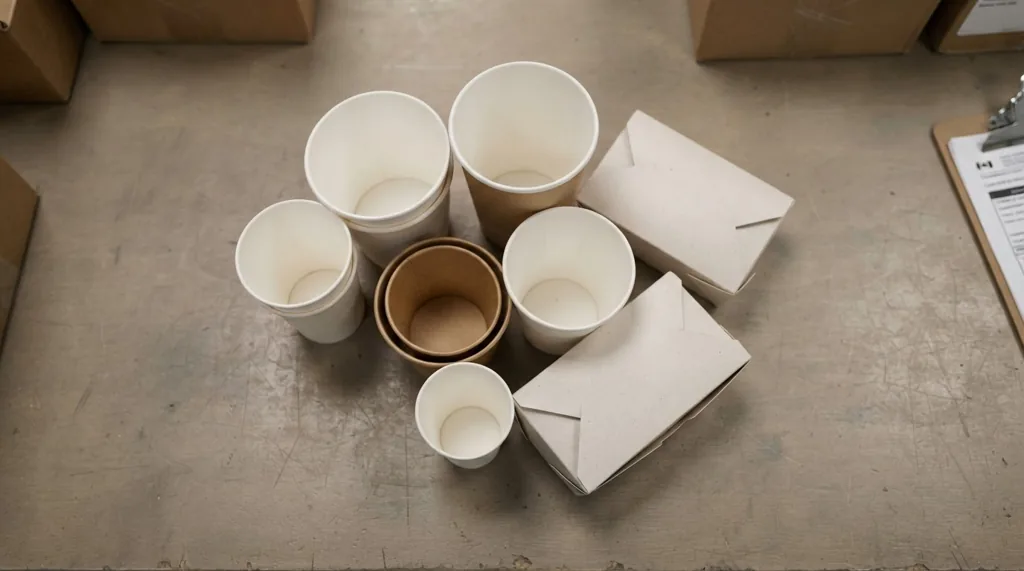
In plain words, these are the common coffee cups, soft drink cups and takeaway soup or wet food containers3. Cups are usually sold in sizes from 4 to 32 ounces3. Food containers and low bowl-style containers range from 2 to 40 ounces3.
The case covers all sizes, including single-wall and double-wall cups3. Most of these goods are made from paperboard with a plastic coating called polyethylene (PE)3. Other coatings, such as polylactic acid, are also covered, and the pulp source, such as wood or bamboo, does not matter3.
Printing, colouring, embossing, punching and other finishing do not take a cup out of the case3.
Which products are left out of the case?
The CBSA lists several products that are not part of the investigations:
- Enhanced clay-coated containers, such as ice cream tubs made for frozen food, and their flats3.
- Folded paperboard food pails, which are made by folding rather than rolling, and their flats3.
- Molded fiber products, which lack the lasting moisture resistance of coated paperboard3.
- Party sets, where paper cups are packed together with other types of tableware2.
- Printed rolls not yet cut, even when they come to Canada for cutting3.
What the case covers and leaves out
| Item | In or out of the case |
|---|---|
| Coated paperboard cups and containers from China | Covered |
| Die-cut blanks or flats | Covered |
| Enhanced clay-coated frozen-food containers | Left out |
| Folded paperboard food pails | Left out |
| Molded fiber products | Left out |
| Cups in party sets with other tableware | Left out |
The agency explains that frozen-food containers face tougher food safety and tracing rules than ordinary cups3. Folded pails are made on different machines, from differently shaped blanks3.
Which tariff codes do the goods use?
The CBSA says the goods are normally imported under two tariff classification numbers2:
- 4823.69.00.10
- 4823.69.00.90
These codes are only a guide. They also include goods outside the case, and some covered goods may enter under other codes2. The written product definition decides what is covered, not the code3.
Who asked for the investigation?
The case started with a complaint from Great Pacific Enterprises Limited Partnership, which operates as Genpak, of Mississauga, Ontario3. Genpak filed on June 22, 2026, and filed again on July 9, 2026, to fix gaps the CBSA had found3.
Genpak says its production is at least 90% of all Canadian production of these goods3. The CBSA found that the Canadian industry is made up of Genpak, Star Cups and Express Paper Products Inc.3. Express Paper supports the complaint3.
The complaint lists several kinds of harm4:
- price undercutting and falling prices
- lost sales and lost market share
- lower profit margins and less use of factory capacity
- fewer jobs and less investment
The CBSA says the Canadian market for these cups and containers is worth about $289 million a year4.
How big is China’s share of cup imports?
The CBSA’s own estimate shows Chinese goods make up about half of all imports of these cups and containers3. That share rose to more than 56% in the first three months of 20263.
China’s share of Canada’s paper cup imports, %
The agency’s figures for China’s share of imports are3:
- 2023: 50.6%
- 2024: 48.8%
- 2025: 51.8%
- first quarter of 2026: 56.2%
The investigation period runs from April 1, 2025, to March 31, 20263. The CBSA will refine these estimates as it gathers more data for that period3.
Who is affected by the cup investigations?
The case reaches many companies. The CBSA identified 225 potential exporters or producers in China and 296 potential importers in Canada3. It sent questionnaires, called requests for information, to all those it could contact3.
The Government of China also received questionnaires on subsidies and on its role in setting prices3. The CBSA invited China to talks before it started the subsidy case, but it received no request for talks3.
Genpak also argues that China’s papermaking sector may not run under normal market conditions3. If the CBSA agrees, it may set normal values from other data rather than Chinese home prices, under section 20 of the law3. The CBSA starts such cases assuming section 20 does not apply, unless evidence shows otherwise3.
For Canadian importers, the risk is cost. If duties start, Canadian importers would pay them on each shipment from China. Coffee shops, restaurants and food packagers that buy imported cups could face higher prices.
How the cup case moves step by step
The case follows a fixed timetable under the law. The steps so far, and those still to come, are:
- Aug. 17, 2026: the CBSA opened its dumping and subsidy investigations2.
- Aug. 18, 2026: the tribunal opened its preliminary injury inquiry5.
- Oct. 16, 2026: the tribunal found a reasonable indication of injury1.
- By Nov. 16, 2026: the CBSA makes preliminary decisions on dumping and subsidizing1.
Key dates in the paper cup case
The CBSA has said provisional duties may apply when it makes those preliminary decisions2. Provisional duties are temporary extra charges, collected while the case continues.
If the preliminary decisions find dumping or subsidizing, the CBSA keeps investigating5. At the same time, the tribunal opens a final injury inquiry5. Interested persons, groups or governments can join the tribunal’s inquiry by filing a notice of participation5.
Key points on the paper cup case
The table below sums up the case so far.
| Question | Answer |
|---|---|
| What happened? | Tribunal found a reasonable indication of injury |
| Who decided? | Canadian International Trade Tribunal |
| Case number | PI-2026-004 |
| Which goods? | Coated paperboard cups, containers and their flats |
| From where? | China |
| Tariff codes | 4823.69.00.10 and 4823.69.00.90 |
| Who complained? | Genpak, of Mississauga, Ontario |
| Main exclusions | Clay-coated frozen-food tubs, folded pails, molded fiber |
| China’s import share, Q1 2026 | 56.2% |
| Is any duty in force now? | No, not yet |
| Next date | CBSA preliminary decisions by Nov. 16, 2026 |
The next date is Nov. 16, 2026. By then the CBSA will issue its preliminary decisions, and provisional duties may start on Chinese paper cups and containers entering Canada1.
Sources
- ↩ Tribunal Issues Determination of Reasonable Indication of Injury—Paperboard Cups and Containers from China – Canada.ca https://www.canada.ca/en/international-trade-tribunal/news/2026/10/tribunal-issues-determination-of-reasonable-indication-of-injurypaperboard-cups-and-containers-from-china.html
- ↩ Notice of initiation of investigations: Paperboard Cups and Containers (PCC 2026 IN) https://www.cbsa-asfc.gc.ca/sima-lmsi/i-e/pcc2026/pcc2026-ni-eng.html
- ↩ Statement of Reasons—Initiation of investigation: Paperboard Cups and Containers (PCC 2026 IN) https://www.cbsa-asfc.gc.ca/sima-lmsi/i-e/pcc2026/pcc2026-in-eng.html
- ↩ The CBSA launches investigations into the alleged dumping and subsidizing of paperboard cups and containers from China – Canada.ca https://www.canada.ca/en/border-services-agency/news/2026/08/the-cbsa-launches-investigations-into-the-alleged-dumping-and-subsidizing-of-paperboard-cups-and-containers-from-china.html
- ↩ Tribunal Initiates Inquiry—Paperboard Cups and Containers from China – Canadian International Trade Tribunal https://www.citt-tcce.gc.ca/en/news/tribunal-initiates-inquiry-paperboard-cups-and-containers-china