
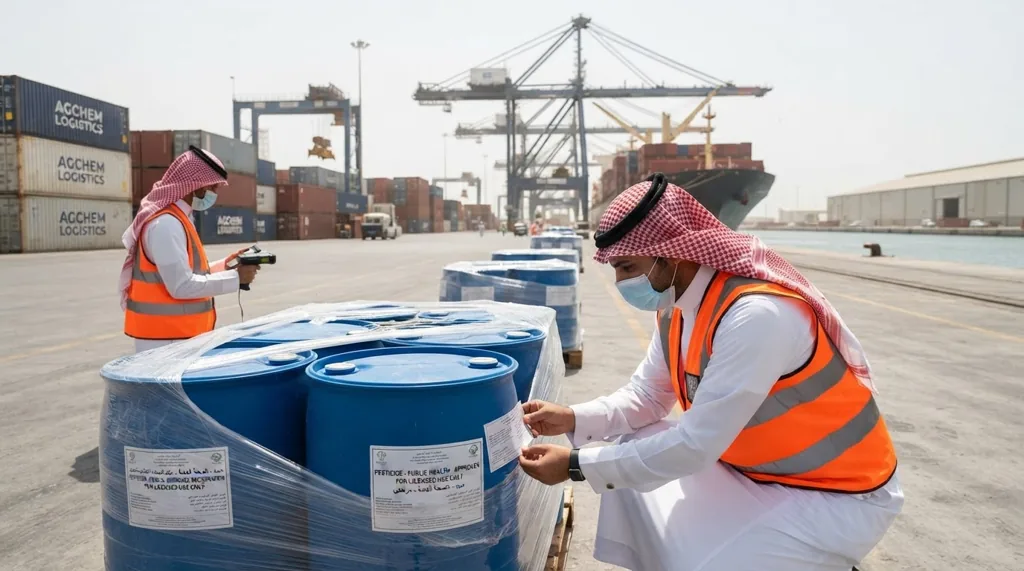
Saudi Arabia has implemented comprehensive technical requirements, registration standards, and handling protocols governing pesticides and agrochemicals across manufacturing, storage, transportation, and usage.
The Saudi Food and Drug Authority (SFDA) has issued two draft rules for public health pesticides, covering their labels and the factories and warehouses handling them1.
The first draft sets out what the label on each pesticide pack must show1. The second sets building, storage, testing and record rules for factories and warehouses2.
In short, a pesticide shipped to Saudi Arabia will need a fixed Arabic label with its Saudi registration number, batch number and expiry date. Makers and warehouses will also face detailed rules on buildings, batch testing and tracking.
Which pesticides do the Saudi drafts cover?
Both drafts deal with public health pesticides. These are products used to kill, repel or control pests that threaten human health, such as household insect sprays and rodent baits1. The labelling draft defines them as any chemical, natural or biological product, or mixture, used against such pests1.
Both documents carry the same product code in the international classification for standards, I.C.S 65.100, which covers pesticides and other farm chemicals2. Neither draft lists customs tariff codes.
The factory draft defines handling broadly. It covers every stage from production to the buyer, including import, export, storage, transport and sale2.
Why is the SFDA acting on pesticide labels?
The labelling draft states its purpose directly. It obliges the maker and the importer to put clear and accurate information on the pack1.
That information must let buyers identify the product, its ingredients, how dangerous it is and how to use it safely1. It must also let inspectors trace each product through its batch number, its production and expiry dates, and the maker’s or importer’s details1. The draft says this protects human health and the environment1.
The SFDA prepared both drafts under Article 5 of its founding law, No. M/62. Each draft says it builds on existing Gulf rules, including the Gulf Cooperation Council (GCC) pesticide requirements, GSO 1332.
What must a public health pesticide label show?
Every label must be in Arabic, and the SFDA may allow another language as well1. The label must be fixed to the inner or outer pack and must not come off1. The print must be permanent, with clear contrast, such as dark text on a light background1.
Main label rules in the draft
| Requirement | Details |
|---|---|
| Language | Arabic, other languages may be added |
| Front of label | The words “public health pesticide” |
| Trade name | Arabic and English, matching the registration certificate |
| Tracing details | Batch, production date, expiry date, Saudi registration number |
| QR code | As shown on the registration certificate |
| Banned claims | Absolute safety, no toxicity, total effectiveness |
The front of the label must carry the words "public health pesticide"1. Labels may not carry misleading claims, such as absolute safety, no toxicity or total effectiveness1. Advertising claims that the product file does not prove are also banned1.
The draft lists the details each label must include:
- Trade name in large print in Arabic and English, matching the registration certificate.
- Ingredients, giving the active substance and its percentage, and the share of inactive ingredients.
- Properties, including the chemical group, how the product acts on the pest, its form and the target pest.
- Directions and dose, including the dilution rate and treated area, based on the efficacy studies.
- Warnings, such as "keep away from children" and the health ministry’s unified phone number.
- Net quantity in grams, millilitres, kilograms or litres, or international units for biological products.
- Company details: name, address, phone, email and logo of the importer or maker, and of the exporter if different.
- Batch number, production date, expiry date and Saudi registration number.
- QR code, the scannable square code shown on the registration certificate.
- Safety and first aid: protective equipment, first-aid steps, possible symptoms and any antidote.
- Storage and disposal: the best storage temperature, what to do after a spill or fire, and how to dispose of empty packs.
The list closes with a guarantee. The company must state that the product works for its whole shelf life when stored correctly1.
How are hazards shown on the label?
The label must carry a strip of warning pictures, called pictograms1. These are chosen by the product’s acute oral toxicity in rats, measured as LD501. LD50 is the dose that kills half of the test animals.
The pictures must follow the World Health Organization (WHO) hazard classification for pesticides1. Warning signs and phrases may follow the WHO system or the Gulf version of the Globally Harmonized System (GHS), the international system for labelling dangerous chemicals1.
Some products may only be applied by trained people. For these restricted pesticides, the middle of the label must say the product is used by a qualified technician1. That phrase must be in a clear colour that stands apart from the rest of the text1.
What about small pesticide packs?
Some packs are too small to hold all the required details. In that case, the pack must go inside a sturdy outer container of cardboard or sealed plastic1.
A leaflet with all the details must go inside the outer container1. The outer container must also state that the leaflet is inside and must be followed1.
What must pesticide factories and warehouses do?
The second draft covers factories and warehouses that make, pack or store public health pesticides2. Its stated aim is to check that they meet approved rules and follow good production practice2.
Minimum heights in the factory draft, metres
A firm must get the SFDA’s approval of the site before it makes or stores pesticides there2. Main warehouses must stand outside residential areas, at a safe distance from neighbouring buildings2. All buildings must follow the Saudi Building Code2.
The draft sets several hard building limits:
- Fence of at least 1.5 metres around the factory, with at least two gates, one for entry and one for exit.
- Concrete wall of at least 2 metres for a factory outside an industrial city.
- Production halls at least 6 metres high, with fire-resistant, self-closing doors.
- Floors sloping 0.5 centimetres per metre toward the waste drains.
- Air exchanged at least 12 times an hour by central extractor fans.
- Machine noise no higher than 85 decibels.
Raw materials, finished goods and gas cylinders need separate stores2. Damaged, returned and expired pesticides need their own area2.
How must pesticides be stored?
Liquids and solids must be kept in separate sections2. Dangerous materials need their own rooms, fully separated from other stores2.
Packs inside a warehouse may not be stacked higher than three tiers2. Pallets must be made of plastic2. Large stores must be split into smaller units, so a fire can be contained2.
There must be a passage 3.5 metres wide for every 60 metres of stacked containers, so firefighting equipment can get through2. Raw material tanks outside the factory must stand at least 10 metres from the nearest building2. Each tank needs a shade, a water sprinkler and a basin around it to catch leaks2.
How will each pesticide batch be tested and traced?
Each factory needs its own quality laboratory, in a separate building2. The laboratory must test the products against the specifications in the registration papers2.
Each production batch, step by step
The draft sets these steps for every production batch:
- The factory gives each batch a unique code so it can be traced through the supply chain.
- Staff take samples of the finished product and test them before supply.
- The factory keeps a reference sample of each batch for the product’s whole shelf life.
- Staff clean the production line fully before the next product starts, and record the cleaning.
The factory must also have a system to recall products2. It must keep tracking records for at least 180 days after the expiry date2. Reference samples must be kept for at least 180 days from the date they were taken2.
What changes for pesticide shipments and labels at the factory?
Product labels must be registered with the SFDA2. Labels and packing materials must be kept in a locked store2. Old labels must be destroyed safely2.
Each shipment must travel with papers giving the product details and the emergency steps2. Trucks must be cleaned and checked before loading2. Loading must follow the separate Saudi rule on transporting public health pesticides2.
The factory must keep a record of its customers and the quantities sent to each one2. Workers who handle pesticides directly must hold valid, official certificates2.
What quality system must pesticide makers run?
Each factory needs a written quality system approved by its top management2. The draft names Good Manufacturing Practice (GMP), a set of rules for steady, controlled production, or an equal system2.
Factories must also apply Hazard Analysis and Critical Control Points (HACCP), a method for finding and controlling the risky steps in production2. A named quality manager must answer to top management for the system2.
Waste from factories and warehouses must be handled under Saudi Arabia’s waste management law2. The guidance of the National Center for Waste Management also applies2.
Who is affected by the pesticide rules?
Importers carry direct duties under the labelling draft. They must make sure each pack shows the full Arabic label, with their own name and contact details1. Foreign makers must print labels that match the Saudi registration certificate, including the QR code1.
Saudi factories and warehouses face the building, storage and record rules2. Firms that rent space in another firm’s licensed warehouse are named in the draft too2. Carriers must use trucks that meet the transport rule2.
Products must also be registered. The SFDA runs an online service for makers and importers to register public health pesticides3. The SFDA lists the fee as 4,100 Saudi riyals and the processing time as one day3.
When do the Saudi pesticide rules start?
Neither rule is in force yet. Both documents say they are drafts circulated for comment and may change1. They may not be cited as Saudi technical regulations until the SFDA approves them2.
The drafts leave the approval date blank2. They give no start date and no transition period for products already on sale1.
Key points on the Saudi public health pesticide drafts
The table sums up the two drafts.
| Question | Answer |
|---|---|
| Who issued the drafts? | Saudi Food and Drug Authority (SFDA) |
| Which goods? | Public health pesticides |
| Product code | I.C.S 65.100 |
| Label language | Arabic, other languages allowed |
| Must the label show? | Trade name, ingredients, batch, expiry, registration number, QR code |
| Hazard pictures based on | Rat oral toxicity (LD50), WHO classification |
| Small packs | Outer container with full leaflet |
| Who must act on labels? | Makers and importers |
| Warehouse stacking limit | Three tiers |
| Record keeping | At least 180 days after expiry |
| Registration fee | 4,100 Saudi riyals |
| Start date | Not set, still drafts |
For now, the drafts change nothing at the border. Once the SFDA approves them, packs without the full Arabic label and Saudi registration number will not meet the rules1.
Sources
- ↩ 26_05335_00_x.pdf https://members.wto.org/crnattachments/2026/TBT/SAU/26_05335_00_x.pdf
- ↩ 26_05357_00_x.pdf https://members.wto.org/crnattachments/2026/TBT/SAU/26_05357_00_x.pdf
- ↩ Registration of Pesticide Products | General Authority for Food and Drug https://www.sfda.gov.sa/en/eservices/registration-pesticide-products