
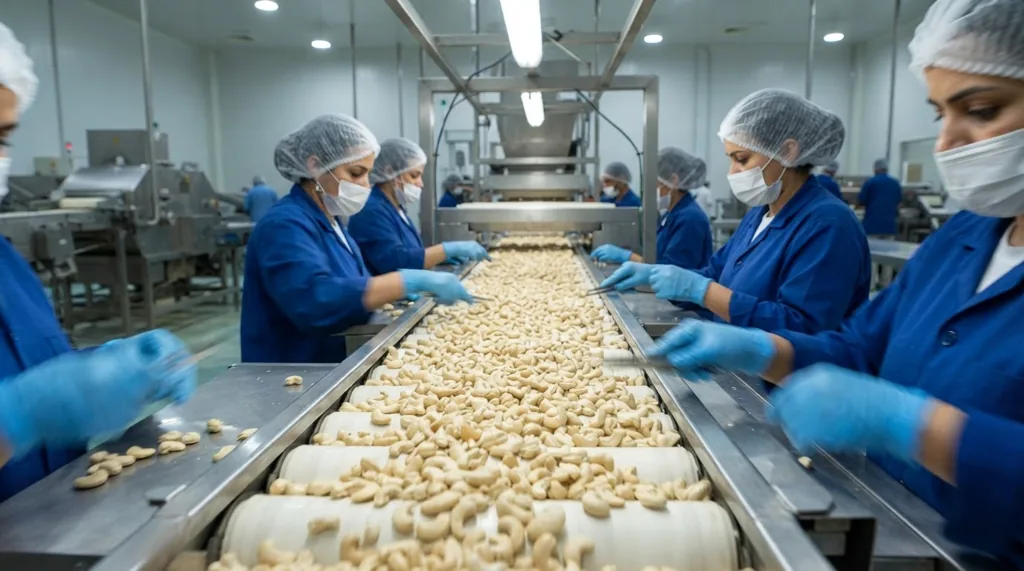
Bahrain has implemented comprehensive regulatory requirements for cashew kernels covering import specifications, quality standards, and food safety compliance.
Bahrain and six other governments told the World Trade Organization (WTO) on Oct. 13, 2026, of a draft quality standard for cashew kernels.
The draft is a new edition of Gulf standard GSO 788, a shared food rule for the Gulf states. It sets limits on moisture, insects and mould, names 24 trade grades, and says what the label must show1. Bahrain’s version of the notice carries the number G/TBT/N/BHR/7902.
In short, a shipment of cashew kernels into Bahrain would need to be dry, clean and free of rancid nuts. It would also need a grade name on the label that matches what is inside the pack.
What is the draft cashew kernel standard?
The draft is titled "GSO Standard GSO 788: Cashew Kernels"1. GSO stands for the Gulf Standardization Organization, the body that writes shared standards for the Gulf states. The draft covers kernels of the cashew nut tree prepared for people to eat1.
Bahrain already has a cashew kernel rule with the same number. Bahrain’s Ministry of Industry and Commerce lists GSO 788:1997 as a Gulf Technical Regulation, approved on 15 October 19973. A technical regulation is a rule that goods must meet before they are sold, not a voluntary guide. The ministry’s standards store shows that edition as the current one, based on the international standard ISO 6477:19883.
The new draft also lists ISO 6477:1988 as its reference1. So the draft updates a rule that has been in place for almost 30 years. It keeps the same scope and the same international basis.
Who notified the cashew rule to the WTO?
The notice went to the WTO’s committee on technical barriers to trade (TBT), which handles product rules and standards. Seven members sent it together, each under its own number4. They are:
- Bahrain, G/TBT/N/BHR/790
- United Arab Emirates, G/TBT/N/ARE/719
- Kuwait, G/TBT/N/KWT/784
- Oman, G/TBT/N/OMN/613
- Qatar, G/TBT/N/QAT/764
- Saudi Arabia, G/TBT/N/SAU/1451
- Yemen, G/TBT/N/YEM/361
The Estonian Centre for Standardisation, which tracks these notices, dates all seven to Oct. 13, 20264. Turkey’s Ministry of Trade lists the same date and the same product, "Kaju İçi", Turkish for cashew kernels2. Because one Gulf standard applies across these markets, an exporter would face the same cashew rules in each of them.
What must the cashew kernels meet?
The draft sets out basic quality rules in its fourth clause. Cashew kernels must be reasonably dry and must have their usual shape1. They can be whole or in pieces, and they can be scorched or not scorched1.
Core quality rules in draft GSO 788
| Requirement | Standard / Details |
|---|---|
| Rancid kernels | None allowed |
| Moisture | No more than 5% by weight |
| Pests and mould | No living insects, mould or visible damage |
| Pesticide residues | Within GSO 382 limits |
| Contaminants and toxins | Within GSO 193 limits |
The draft defines a cashew kernel as the product made by roasting, shelling and peeling the fruit of the cashew tree1. The core limits are:
- No rancid kernels. The kernels must be completely free of nuts that have gone bad1.
- Moisture of no more than 5% by weight1.
- No pests. There must be no living insects or mould, and no visible dead insects, mites, insect parts, rodent traces or insect damage1.
- Pesticide residues must stay within the limits in Gulf standard GSO 3821.
- Contaminants and toxins must stay within the limits in Gulf standard GSO 1931.
- Microbe counts must stay within permitted limits1.
The pest check is made by eye or with a magnifying glass when needed. If the inspector uses more than 10 times magnification, the test report must say so1. A shipment that fails any of these points would not meet the standard.
How are cashew grades like W 240 defined?
The draft sorts cashew kernels into 24 grades in its first table1. Each grade has a short trade code, such as W 240 or LWP, and a description. The code tells a buyer what is in the pack.
Kernels per kilogram by whole grade (midpoint of range)
For white whole kernels, the grade depends on how many kernels weigh 1 kilogram. Fewer kernels per kilogram means larger nuts. The draft lists these counts for whole white kernels1:
- W 180: 265 to 396 kernels per kilogram
- W 240: 485 to 530 kernels per kilogram
- W 320: 660 to 706 kernels per kilogram
- W 450: 880 to 990 kernels per kilogram
- W 500: 990 to 1,100 kernels per kilogram
The table also lists W 210, W 280 and W 400 between these sizes1. White whole kernels must be white, very pale or light ash-grey in colour. They must be free of black or brown spots and fully free of their skin1.
Grade 8, "scorched wholes" (SW), covers whole kernels darkened by too much heat. They may be light ash-grey or deep ivory1. Grades 9 and 10 cover lower "dessert" wholes, which may be shrivelled, speckled or carry deep black spots1.
Which cashew pieces does the standard cover?
Broken cashews have their own grades, numbered 11 to 241. White pieces start with butts (B), kernels broken across, and splits (S), kernels split along their length1.
Smaller pieces are graded by sieve, a metal screen with holes of a set size. Large white pieces (LWP) must not pass through a 4.75 mm sieve1. Small white pieces (SWP) must not pass a 2.80 mm sieve, and baby bits (BB) must not pass a 1.70 mm sieve1.
Scorched pieces follow the same pattern, from scorched bits (SB) to scorched small pieces (SSP)1. The lowest grades are dessert pieces, dessert butts and dessert splits, which may be deeply scorched and deformed1.
How much mixing between cashew grades is allowed?
No pack is perfect, so the draft sets a tolerance, an allowed share of off-grade nuts. For whole kernels, broken kernels and kernels of the next lower grade together must not exceed 5% by weight at packing1.
For most pieces grades, the limit is also 5% of the next lower grade or pieces1. The lowest dessert grades, 22 to 24, have a looser limit of 10% by weight1.
The draft also says how to check these limits. For grades 1 to 7, the tester counts the kernels in 1 kilogram and the share of pieces and lower-grade nuts1. For grades 11 to 24, the tester runs a sieve test against the tolerance1.
How will cashew shipments be tested and labelled?
Samples must be taken under Gulf standard GSO 1287, the sampling method for packed fruit and vegetable products1. Moisture is found by oven drying, under the method in GSO ISO 10261. The tester also checks the sample by eye against the grade rules1.
Kernels must be packed in clean, sound and leak-proof containers1. They must travel in a way that protects them from damage and dirt. Warehouses must be well aired and kept away from heat, damp and contamination1.
The label must follow Gulf standard GSO 9 on packaged food labels and GSO 150-2 on expiry dates1. On top of those, it must show1:
- the name of the product
- storage instructions
- the grade designation, such as W 240
- any other marking the buyer asks for, such as the harvest year
The draft also links to Gulf rules on food hygiene, food plants, storage and food transport1. A supplier that already meets those rules would use them for cashews as well.
Who would the new cashew rules affect?
Cashew processors abroad would feel the change first. Their packs must carry a grade name that matches the counts and sieve sizes in the draft. Kernels over 5% moisture, or with any rancid nuts, would fail.
Importers and food traders in Bahrain would need test results and labels that match the draft. Packers in the Gulf states that repack cashews would also need to print the grade on the label. Because seven members notified the same text, a single label could serve several Gulf markets4.
Bahrain’s ministry files the cashew standard under ICS 67.080, the international standards group for fruits and vegetables3. This is a standards code, not a customs tariff code.
When could the cashew standard take effect?
The draft is not yet in force. Turkey’s Ministry of Trade lists Dec. 12, 2026 as the last day for comments2. Cashew-exporting countries can raise concerns about the draft until then.
Key dates for the cashew standard
The draft itself gives no date for adoption or entry into force. Bahrain’s ministry still lists the 1997 edition as the current one3.
Key points on the Gulf cashew kernel standard
The table sums up the draft as notified.
| Question | Answer |
|---|---|
| What changed? | Draft new edition of GSO 788 for cashew kernels |
| Who notified it? | Bahrain and six other WTO members |
| Bahrain’s notice number | G/TBT/N/BHR/790 |
| Date notified | Oct. 13, 2026 |
| Goods covered | Cashew kernels for people to eat |
| Moisture limit | No more than 5% by weight |
| Number of grades | 24, from W 180 to dessert splits |
| Grade tolerance | 5% by weight, 10% for grades 22 to 24 |
| Label must show | Product name, storage, grade |
| Rule in force now | GSO 788:1997 |
| Comment deadline | Dec. 12, 2026 |
| Entry into force | Not yet set |
Comments on the draft close on Dec. 12, 20262. After that, the Gulf states can adopt the final text. Cashew kernels sold in Bahrain would then need to meet its moisture, grade and label rules.
Sources
- ↩ SASO 1148 https://members.wto.org/crnattachments/2026/TBT/SAU/26_05358_00_e.pdf
- ↩ T.C. Ticaret Bakanlığı Ticarette Teknik Engeller Bilgi Ve Bildirim Merkezi https://teknikengel.ticaret.gov.tr/bildirimler
- ↩ GSO 788:1997 – Standards Store – Ministry of Industry & Commerce – Kingdom of Bahrain https://bsmd.moic.gov.bh/store/standards/GSO:485686?lang=en
- ↩ TBT notifications – EVS standard evs.ee | en https://www.evs.ee/en/wtonotifications/tbtnotifications