
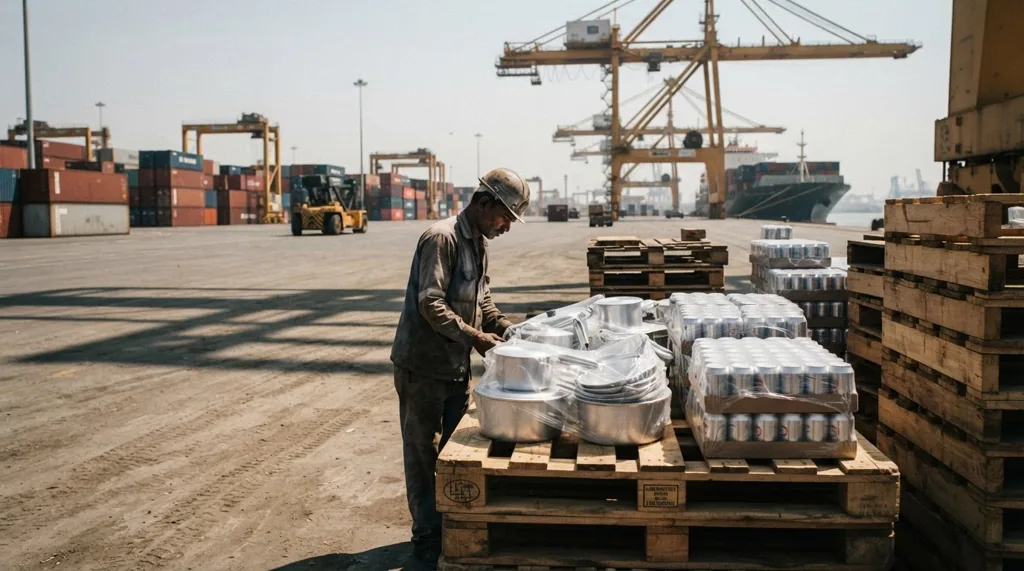
India requires a Bureau of Indian Standards mark on aluminium utensils at once and on drink cans from April 1, 2027.
India’s commerce ministry on Oct. 13, 2026 required a national standards mark on aluminium utensils at once, and on drink cans from April 1, 20271.
The new rule is the Cookware, Utensils and Cans for Foods and Beverages (Quality Control) Second Order, 2026. It replaces the first order of the same name, issued in January 20261.
In short, aluminium pots, pans and other utensils need the BIS mark now, with no later date for small makers. Aluminium drink cans get more time, and need the mark from April 1, 2027 for most makers.
Who issued the cookware and cans order?
The Department for Promotion of Industry and Internal Trade (DPIIT), part of the Ministry of Commerce and Industry, issued the order. It was published in the Gazette of India, the government’s official journal, as S.O. 5624(E)1.
The order rests on the Bureau of Indian Standards Act, 2016. The Bureau of Indian Standards (BIS) is India’s national standards body. The government says it acted in the public interest, after consulting the BIS1.
The order came into force on the day it was published in the gazette1.
What must aluminium utensils and cans do?
The order lists goods that must meet an Indian Standard. They must also carry the BIS Standard Mark, used under a licence from the BIS1.
The order covers two standards:
- IS 1660:2024, the Indian Standard for wrought aluminium utensils. These are pots, pans and other kitchen items shaped from solid aluminium.
- IS 14407:2023, the Indian Standard for aluminium cans for beverages, such as soft-drink and beer cans.
The licence follows Scheme-1 of Schedule-II of the BIS testing and approval rules of 20181. In practice, a maker needs a BIS licence before it can put the mark on its goods. Without the mark, the goods cannot be sold in India.
The order also says the latest version of each standard applies. Any change the BIS later notifies takes effect from the date of that notice1.
When do the new rules start for utensils and cans?
The dates differ by product and by the size of the maker. The order treats micro and small enterprises, as defined in India’s 2006 law on such firms, separately1.
When aluminium drink cans need the BIS mark
| Date | Who it catches |
|---|---|
| April 1, 2027 | Most can makers and importers |
| July 1, 2027 | Small enterprises |
| Oct. 1, 2027 | Micro enterprises |
For aluminium utensils, the rule applies with immediate effect for all makers. That includes large, small and micro enterprises1.
For aluminium beverage cans, the order sets three dates1:
- April 1, 2027 for most makers.
- July 1, 2027 for small enterprises.
- Oct. 1, 2027 for micro enterprises.
What changed from the January 2026 order?
The first order, S.O. 219(E), was published on Jan. 15, 20262. It covered the same two standards, but set one set of dates for both products.
January order and second order compared
| Question | January 2026 order | Second order, Oct. 2026 |
|---|---|---|
| Utensils, most makers | Oct. 1, 2026 | Immediately |
| Utensils, small and micro makers | Jan. 1 and April 1, 2027 | Immediately |
| Drink cans, most makers | Oct. 1, 2026 | April 1, 2027 |
| Penalty clause | Not included | Under the BIS Act, 2016 |
Under the January order, the rule began on Oct. 1, 2026 for most makers2. Small enterprises had until Jan. 1, 2027, and micro enterprises until April 1, 2027.
The second order changes this in two ways. First, can makers get about six months more time, from Oct. 1, 2026 to April 1, 20271. Small and micro can makers also get later dates.
Second, small and micro makers of aluminium utensils lose their extra time. They had dates in January and April 2027 under the first order2. Now the rule applies to them at once1.
The second order also adds a clause on penalties. Anyone who breaks the order can be punished under the BIS Act, 20161. The January order did not include this clause2.
What does the order mean for importers?
Imported utensils and cans must meet the same standards as goods made in India. An exporter abroad selling aluminium utensils to India needs a BIS licence and the mark on its goods.
For aluminium utensils, there is no waiting period under the new order. Shipments of utensils without the BIS mark can no longer be sold in India, except under the old-stock rule below.
For drink cans, foreign can makers have until April 1, 2027 to get a BIS licence1. Indian drink companies that buy empty cans from abroad depend on those suppliers having the licence by then.
The BIS is the authority that certifies the goods and enforces the order1. It decides who gets a licence and checks the mark. A seller who breaks the order can face penalties under the BIS Act, 20161.
Domestic makers and importers face the same dates. A small or micro enterprise gets the later can dates whether it makes cans in India or imports them, if it meets the 2006 definition1.
Which goods does the order leave out?
The order lists several exemptions1:
- Goods made in India for export. Indian factories can make utensils and cans for foreign buyers without the BIS mark.
- Filled goods. The order does not apply to imported goods filled with a solid, liquid or gas. A can of imported juice or beer is not covered, only the empty can.
- Research samples. Makers of cookware, utensils and cans may import up to 200 items a year for research and development.
What the order does not cover
| Exemption | Condition |
|---|---|
| Goods made in India for export | No BIS mark needed |
| Filled imports | Goods filled with a solid, liquid or gas |
| Research samples | Up to 200 items a year, not for sale |
The research samples come with conditions. They cannot be sold and must be thrown away as scrap. The maker must keep a yearly record and give it to the central government1.
Can old stock still be sold?
Yes, for a limited time. The order protects goods made or imported before the start date for the product1.
This applies to three groups: makers already certified by the BIS, makers who have applied for certification, and importers of the goods. They may sell or display this stock for up to six months after the start date1.
To use this, the maker or importer must send a declaration to the BIS. A chartered accountant, a qualified accountant, must certify it1. The same rule was in the January order2.
What happens next for beverage cans?
The next date is April 1, 2027, when most can makers must carry the mark. Small enterprises follow on July 1, 2027, and micro enterprises on Oct. 1, 20271.
Under the old-stock rule, declared cans made or imported before April 1, 2027 could be sold until about October 2027. For utensils, the six-month period counts from the order’s start date.
Key points on India’s cookware and cans order
The table sums up the main facts of the second order.
| Question | Answer |
|---|---|
| What is the measure? | Cookware, Utensils and Cans (Quality Control) Second Order, 2026 |
| Who issued it? | DPIIT, Ministry of Commerce and Industry |
| When was it published? | Oct. 13, 2026 |
| Which goods? | Aluminium utensils and aluminium drink cans |
| Which standards? | IS 1660:2024 and IS 14407:2023 |
| What is required? | BIS Standard Mark under a BIS licence |
| Start for utensils | Immediately, for all makers |
| Start for cans | April 1, 2027 (most makers) |
| Small and micro can makers | July 1, 2027 and Oct. 1, 2027 |
| What is exempt? | Export goods, filled imports, 200 research items a year |
| Old stock | Up to six months, with declaration |
| Who enforces it? | Bureau of Indian Standards |
Aluminium utensils now need the BIS mark to be sold in India. For drink cans, the next deadline is April 1, 2027, when most makers and their imports must carry the mark.
Sources
- ↩ Cookware-Utensils-and-Cans-for-Foods-and-Beverages-Quality-Control-Second-Order-2026-October152026.pdf https://avantiscdnprodstorage.blob.core.windows.net/legalupdatedocs/60417/Cookware-Utensils-and-Cans-for-Foods-and-Beverages-Quality-Control-Second-Order-2026-October152026.pdf
- ↩ Cookware, Utensils and Cans for Foods and Beverages (Quality Control) Order, 2026 – Government of India https://www.sgs.com/-/media/sgscorp/documents/corporate/third-party-documents/cookware-utensils-and-cans-for-foods-and-beverages-quality-control-order-2026–government-of-india.cdn.en.pdf