
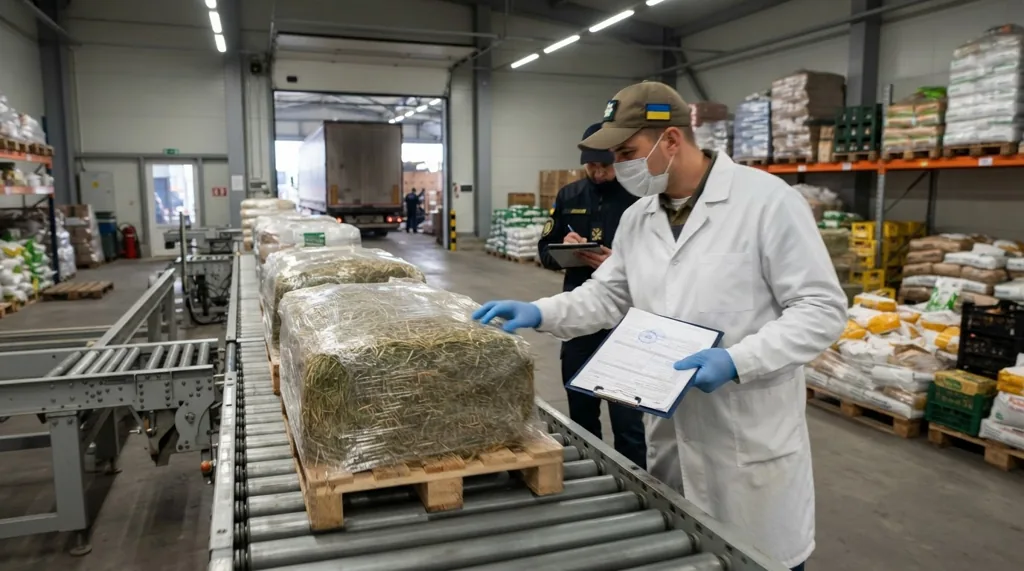
Ukraine has adopted standardized forms for veterinary and entry documents covering live animals, animal by-products, and food and feed to improve import efficiency and regulatory consistency.
Ukraine’s Cabinet of Ministers has approved three new standard entry forms for imports of live animals, animal products, and higher-risk food and feed of non-animal origin, in force since Sept. 23, 20261.
The measure is Resolution No. 1131 of Sept. 17, 20262. It replaces the forms Ukraine had used since 20182.
In short, every shipment of animals, meat, dairy, animal by-products or closely watched plant-based food and feed entering Ukraine now travels with one of three new entry documents. The importer fills in the first part, and the state veterinary inspector at the border fills in the second part with the check results and the decision on the shipment.
What did Resolution No. 1131 approve?
The resolution approves three forms, each in its own annex2. Each form is a common entry document, a single standard paper that records a shipment’s details and the results of the border checks.
The three new entry forms
| Question | CVED-A | CVED-P | CED |
|---|---|---|---|
| Goods covered | Live animals | Animal products | Higher-risk plant-based food and feed |
| Annex | Annex 1 | Annex 2 | Annex 3 |
| Languages | Ukrainian and English | Ukrainian and English | Ukrainian and English |
The three forms are:
- CVED-A, the Common Veterinary Entry Document for live animals (Annex 1).
- CVED-P, the Common Veterinary Entry Document for products (Annex 2).
- CED, the Common Entry Document for food and feed of non-animal origin that face an increased level of state control (Annex 3).
The forms are printed in Ukrainian and English side by side2. Each starts with a box for a QR code and a reference number2.
The same resolution cancels Cabinet Resolution No. 570 of July 18, 2018, which approved the earlier versions of these forms2. From the date the new resolution took effect, only the new forms apply.
Who issued the new entry forms, and why?
The Cabinet of Ministers adopted the resolution at its meeting of Sept. 17, 20263. The Ministry of Economy, Environment and Agriculture drafted it, according to the ministry’s report on that government meeting3.
The ministry first notified the draft to the World Trade Organization (WTO) on June 11, 2026, in notice G/SPS/N/UKR/2714. That notice gives two goals: food safety and animal health4.
The forms rest on Ukraine’s law on state control of food, feed, animal by-products, animal health and animal welfare, Law No. 2042-VIII of May 18, 20174. The resolution cites two articles of that law, Article 41 and Article 57, as its legal basis2.
The WTO notice also lists two European Union rules as related documents4. One is Regulation (EU) 2017/625, the EU’s rules on official checks of food and feed4. The other is Implementing Regulation (EU) 2019/1715, which sets up the EU’s computer system for those checks4. The new Ukrainian forms carry the same names and short codes as the EU’s entry documents, such as CVED-A and CED.
Which goods need a CVED-A, CVED-P or CED?
The WTO notice lists the goods covered in wide groups4:
- live animals;
- products of animal origin;
- composite products, which mix animal and plant ingredients;
- germinal products, used for breeding;
- biological materials and animal by-products, the parts of animals not meant for people to eat;
- hay and straw;
- food and feed of non-animal origin subject to enhanced state control.
The notice says the measure applies to all trading partners, not to any one country4. It also states that no international standard applies to these forms4.
The CED is only for plant-based food and feed under increased control2. Plant-based goods with normal checks do not use it. The resolution itself does not list which plant-based goods face increased control.
What must an importer write on the live animal form?
Part I of the CVED-A covers the shipment as presented at the border2. The person responsible for the shipment fills it in.
It asks for:
- the sender or exporter, the receiver or importer, and the place of destination, each with name, address and ISO country code;
- the designated border inspection post, the border point approved to check the animals;
- the accompanying documents, with type, date, number and the commercial document reference;
- the prior notification, with date and time;
- the means of transport (airplane, vessel, railway or road vehicle) and its identification;
- the country of origin, the zone or compartment of origin, and the establishment of origin with its approval number;
- the container number and seal number.
The form also asks what the animals are for2. The choices include breeding, slaughter, fattening, restocking, quarantine, exhibition and travelling circus, as well as pets such as dogs, cats and ferrets2.
The description of the shipment uses Ukraine’s goods code (UKTZED), entered as the HS code2. For each line it records the species, the individual ID number, the passport number, the quantity, the number of packages and the net weight in kilograms2. A journey log box asks whether the animals travelled with one2.
What does the products form ask about meat and other goods?
Part I of the CVED-P follows the same pattern for animal products2. It adds the country of dispatch, which may differ from the country of origin2.
It asks how the goods travelled: at ambient temperature, chilled or frozen2. It also asks what the goods are for: human consumption, pharmaceutical use, trade sample, feed, technical use, further processing or other2.
The importer must state whether the goods conform to Ukrainian law2. Goods that do not conform may be declared for an approved customs warehouse, a free zone or a vessel2. The description lines on this form record the HS code, species, batch number, quantity, packages, net weight and the final consumer2.
Both veterinary forms include a declaration signed by the person responsible for the shipment2. That person confirms that the information is true and complete2. The person also promises to pay for the state control checks, and where needed for sending the shipment back or destroying it2. On the live animal form, that promise also covers quarantine, isolation and euthanasia of the animals2.
How do border inspectors use Part II?
Part II of each veterinary form is for the state veterinary inspector2. It records the checks in order:
- A documentary check of the papers, marked satisfactory or not.
- An identity check, to confirm the goods match the papers. On the products form, this can be a seal check or a full check.
- A physical check of the animals or goods. On the products form, it can be a reduced check.
- A laboratory test, marked as random, on suspicion, an emergency measure or, for products, required or under intensified controls. The result can be pending, satisfactory or not satisfactory.
Checks recorded in Part II
For live animals, the inspector also records a welfare check2. This includes the number of dead animals, the number of animals unfit to travel and the number of births or abortions during transport2.
After the checks, the inspector records the decision2. Goods may be accepted for transit, for onward travel, for transshipment, for temporary admission or for the internal market2. The products form also has a box for monitoring at entry or re-entry2.
The inspector signs Part II to certify that the checks followed Ukrainian law2. The form also records the inspection fees and the customs document reference2.
What happens to a shipment that fails the checks?
A failed shipment is marked "not acceptable" with a deadline date2. For live animals, the form lists euthanasia, slaughter, sending back, destruction, special treatment or use for other purposes2. For products, the choices are destruction, sending back, special treatment or use for other purposes2.
The inspector must tick the reason for refusal2. The reasons are the papers, the identity check, the physical check, the laboratory tests, the origin or another reason2. For live animals, poor animal welfare is a further reason2.
If a shipment is sent back, the form records the destination country, the exit border post, the means of transport and the date2. If the inspector reseals the shipment, the new seal number goes on the form2.
For importers, the declaration they sign matters here. Under it, they have accepted the cost of sending back or destroying a refused shipment2.
When did the new forms take effect?
The draft notified to the WTO said the resolution would enter into force on the day of its official publication4. Trading partners could send comments until Aug. 10, 20264.
From draft to new forms
The Cabinet adopted the resolution on Sept. 17, 20262. Ukraine’s official legal database, run by the parliament, shows it in force from Sept. 23, 20261.
Since that date, the 2018 forms under Resolution No. 570 no longer apply, because the new resolution cancels them2. Exporters to Ukraine, their carriers and customs brokers deal with shipments that now use the new forms at the border.
Key points on Ukraine’s new import entry forms
The table sums up the main facts of Resolution No. 1131.
| Question | Answer |
|---|---|
| What changed? | Three new entry forms for imports |
| Who issued it? | Cabinet of Ministers of Ukraine |
| Which instrument? | Resolution No. 1131 of Sept. 17, 2026 |
| Who drafted it? | Ministry of Economy, Environment and Agriculture |
| Form for live animals | CVED-A |
| Form for animal products | CVED-P |
| Form for higher-risk plant-based food and feed | CED |
| What does it replace? | Resolution No. 570 of July 18, 2018 |
| Stated goals | Food safety and animal health |
| Which countries? | All trading partners |
| Who fills in Part I? | Person responsible for the shipment |
| In force from | Sept. 23, 2026 |
Since Sept. 23, 2026, live animals, animal products and higher-risk plant-based food and feed entering Ukraine have been checked against the new forms1. A shipment with incomplete Part I details risks a failed documentary check, the first step in the inspector’s review.
Sources
- ↩ Про затвердження форм загальног… | від 17.09.2026 № 1131 https://zakon.rada.gov.ua/laws/show/1131-2026-%D0%BF
- ↩ 26_05020_00_x.pdf https://members.wto.org/crnattachments/2026/SPS/UKR/26_05020_00_x.pdf
- ↩ Участь Мінекономіки у засіданні Уряду 17 вересня 2026 року | Міністерство економіки та довкілля України https://www.me.gov.ua/Documents/Detail/a9372734-2447-4089-9f24-4672806605b0?lang=uk-UA&title=UchastMinekonomikiUZasidanniUriadu17-Veresnia2026-Roku
- ↩ NOTIFICATION NOTIFICATION NOTIFICATION http://www.spsvietnam.gov.vn/Data/File/Notice/12000/NUKR271.pdf