
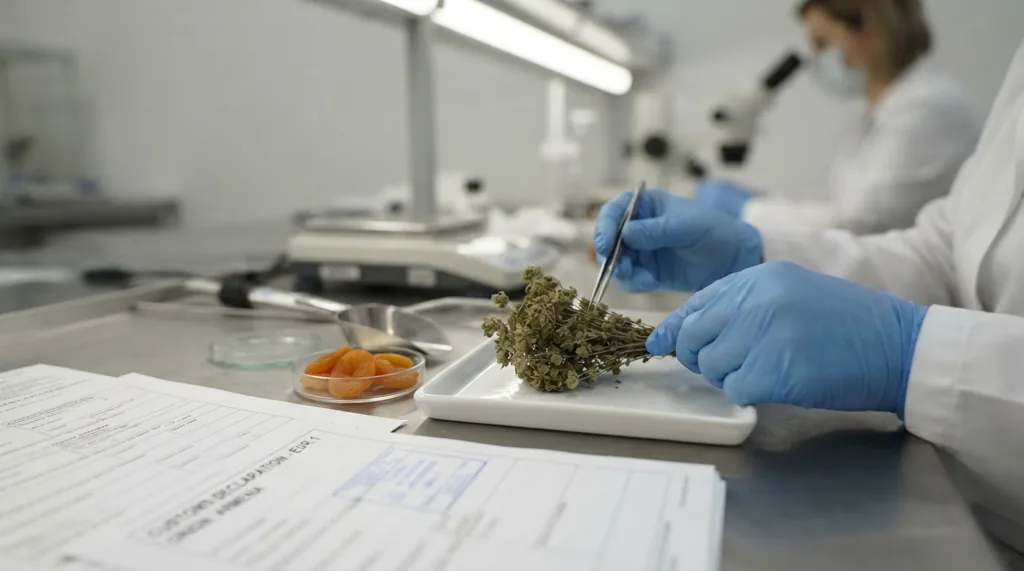
European Union removes ad valorem import duties on around 80% of Armenia’s exports from 10 October 2026 for two years.
The European Union has removed its percentage-based import duties on a long list of goods from Armenia, under Regulation (EU) 2026/2269, from 10 October 2026 for two years1.
The European Parliament and the Council adopted the regulation on 7 October 2026, and the European Commission announced its publication on 9 October1. According to the Council, the measure frees up around 80% of Armenia’s exports to the EU1.
In short, many Armenian goods now enter the EU without import duty, as long as the shipment proves it is Armenian. Some farm goods are duty-free only up to a yearly limit in tonnes, and the normal duty returns once that limit is used up1.
Why did the EU cut duties on Armenian goods?
The regulation states its reason plainly. Since May 2026, Russia has introduced large-scale trade measures against key Armenian exports, including alcoholic drinks, mineral water, fruits and vegetables2. These measures cut Armenia’s access to its traditional markets and disrupted its supply chains2.
EU-Armenia trade dates
The text says small and medium-sized businesses and farmers in Armenia have been hit hardest. It warns that the situation risks harming Armenia’s economic resilience and social stability2. The EU acted "in a spirit of solidarity with Armenia" and to help its exports find new markets2.
The measure rests on the Comprehensive and Enhanced Partnership Agreement between the EU and Armenia. That agreement entered into force on 1 March 2021, and its trade part has applied since 1 June 20182. The Commission says the new duty cuts aim to help Armenia sell to more markets within that agreement1.
What changes for Armenian goods at the EU border?
The regulation works through two lists, called annexes. Each list gives the goods by their CN code, the number the EU uses to classify goods in its tariff2:
- Annex I goods enter the EU free of ad valorem duty, with no limit on quantity1.
- Annex II goods enter free of ad valorem duty only within tariff quotas, measured in tonnes per calendar year1.
An ad valorem duty is a tax charged as a percentage of the value of the goods. This is the only kind of duty the regulation removes1. A specific duty, which is a fixed amount per kilo, litre or other unit, still applies1.
For the goods in Annex I, the duty cut applies directly, with no extra application1. The Commission advises checking each product’s CN code against the annexes and against TARIC, the EU’s online tariff database1.
Which Armenian products are covered?
The regulation follows the list of duty cuts in the EU’s GSP+ scheme, a set of trade preferences for some developing countries, with some changes2. The EU removed certain sensitive products from that list. It also added certain farm goods that Russia has banned2.
The first pages of Annex I show how wide the list is. It includes, among others2:
- live animals such as horses, asses, goats for breeding, domestic rabbits and pigeons;
- meat and offal of horses, and frozen livers of chickens, turkeys, ducks, geese and guinea fowl;
- flavoured yogurt, kefir and other fermented milk drinks, and dairy spreads;
- natural honey and birds’ eggs other than poultry eggs;
- fish and seafood, the whole of Chapter 3 of the tariff;
- live plants and cut flowers, the whole of Chapter 6;
- fresh vegetables such as potatoes, tomatoes, onions, cabbages, lettuce, carrots, mushrooms, sweet peppers, spinach and courgettes.
Some lines carry limits. Globe artichokes, for example, are covered only from 1 July to 31 October2. Codes marked with an asterisk can enter only under the conditions set by other EU law2.
Annex II covers eight farm products that are duty-free only within a quota2. The product descriptions in the annexes are only a guide; the CN code decides whether a product qualifies2.
How do the tonnage quotas work?
A tariff quota is a fixed amount of a product that may enter at a lower duty, or none, in a set period. The Commission manages the Armenian quotas under Articles 49 to 54 of Implementing Regulation (EU) 2015/2447, the EU’s detailed customs rules1.
Once the volume is used up, the normal tariff applies to further shipments1.
The first quota period is short. It runs from the date the regulation entered into force until 31 December 20261. After that, the quotas run by calendar year1.
What proof of origin must a shipment carry?
The duty cut applies only to goods that have Armenian preferential origin. That means the goods must meet the rules of origin that apply between the EU and Armenia1. The importer must hold a valid proof of origin when the goods are declared1.
Proof of Armenian origin
| Document | Who makes it out, and status |
|---|---|
| Movement certificate EUR.1 | Accepted; customs code N954 |
| Origin declaration on invoice | Exporter, or approved exporter above EUR 6,000; code N864 |
| REX invoice declaration | Registered Armenian exporter; not yet confirmed at the border |
The regulation allows three kinds of proof1:
- a movement certificate EUR.1, a certificate of origin;
- an origin declaration on the invoice or another commercial paper, made out by the exporter, or by an approved exporter when the shipment is worth more than EUR 6,000;
- an invoice declaration by a REX exporter, an Armenian exporter listed in the EU’s Registered Exporter system.
So far, the EU has confirmed that it accepts only the first two at the border1. The Commission has not yet confirmed the REX route in the customs declaration1.
How is the duty cut claimed in the customs declaration?
The Commission’s notice explains how to claim the lower duty in the H1 import declaration1. The declarant enters preference code 300 for this type of trade preference1.
The proof of origin goes in with a supporting document code1:
- code N954 for a movement certificate EUR.1;
- code N864 for an origin declaration on an invoice or other commercial document.
The duty cut can be claimed for goods declared for release into free circulation from 10 October 20261. Release into free circulation means customs clears the goods for sale anywhere in the EU. All the conditions must be met at that time, and the proof of origin must be ready1.
What must Armenia do to keep the duty-free access?
The duty cuts come with conditions on Armenia. First, it must follow the EU rules of origin and work closely with the EU to check proofs of origin and prevent fraud2.
Second, Armenia must not add new duties, charges or quantity limits on goods from the EU. It must not raise existing duties or bring in other trade barriers against the EU, unless they are justified and notified to the Commission2. Third, Armenia must respect democracy, the rule of law and human rights, and fight the spread of weapons of mass destruction2.
If Armenia breaks these conditions, the Commission may suspend the duty cuts in whole or in part2. When an EU member state asks for a suspension over new Armenian trade barriers, the Commission must give its view within four months2.
Can the EU bring the duties back for some goods?
Yes. The regulation contains a safeguard, a way to protect EU producers when imports rise fast. If Armenian imports harm the market for similar or competing goods in the EU or in a member state, the Commission may take any necessary measure2.
Safeguard time limits, days
The Commission can start a review on its own or at the request of a member state. It must finish the review within four months2. It looks at how fast and how much imports from Armenia have grown, and at their effect on EU production and prices2.
In urgent cases, the Commission can act faster. It may impose a temporary measure within 21 days of a member state’s request, lasting no more than 120 days2. Before a final measure, it must publish a notice, and interested parties get up to 10 days to send their views2.
Who is affected by the Armenian duty cuts?
EU importers of Armenian goods are the first to gain. A shipment on the Annex I list that carries a valid proof of origin now clears customs without ad valorem duty1. For quota goods, the gain depends on how fast the yearly volume fills1.
Armenian exporters must issue the right origin paper. For shipments over EUR 6,000, an invoice declaration needs an approved exporter1. Customs brokers in the EU must enter preference code 300 and the right document code in each declaration1.
EU farmers and food makers who compete with Armenian goods are protected by the safeguard clause2. The Commission will report on how the duty cuts work to the EU-Armenia Partnership Committee in its trade format2.
Key points on the EU duty cuts for Armenian goods
The table sums up the main facts of the regulation.
| Question | Answer |
|---|---|
| What changed? | EU ad valorem import duties removed on many Armenian goods |
| Which law? | Regulation (EU) 2026/2269 |
| Who adopted it? | European Parliament and Council, 7 October 2026 |
| Share of Armenian exports covered | Around 80% |
| Unlimited goods | Annex I list |
| Goods under quota | Eight farm products in Annex II |
| Duties still charged | Specific duties per unit |
| Proof needed | EUR.1 or origin declaration on invoice |
| Customs codes | Preference 300; N954 or N864 |
| Start date | 10 October 2026 |
| First quota period ends | 31 December 2026 |
| How long? | Two years |
The first quota period for the eight farm products closes on 31 December 2026, and a new yearly volume opens after that. The duty cuts as a whole run for two years from 10 October 2026, unless the Commission suspends them earlier1.
Sources
- ↩ The EU temporarily liberalises trade in certain products originating in Armenia | Access2Markets https://trade.ec.europa.eu/access-to-markets/en/news/eu-temporarily-liberalises-trade-certain-products-originating-armenia
- ↩ pdf https://data.consilium.europa.eu/doc/document/PE-61-2026-INIT/en/pdf