
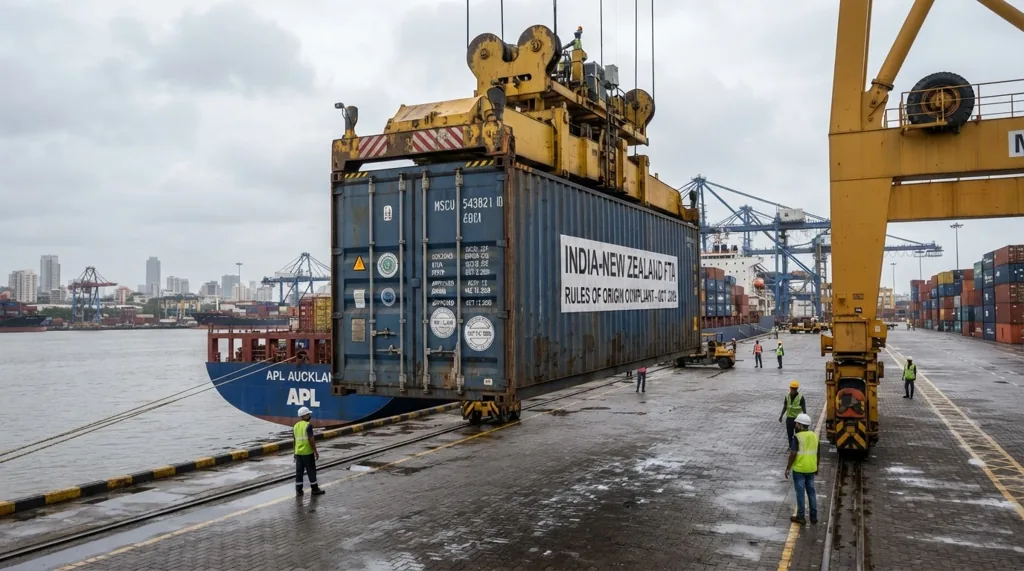
India requires goods to meet new origin rules and carry proof of origin for lower trade-deal duties with New Zealand from Oct. 20, 2026.
India’s finance ministry has set the origin rules that goods from New Zealand and India must meet for lower duties from Oct. 20, 2026.
The Central Board of Indirect Taxes and Customs (CBIC), India’s customs authority, published the rules as Notification No. 82/2026-Customs (N.T.) on Oct. 12, 20261. They are called the Customs Tariff (Determination of Origin of Goods under the Free Trade Agreement between India and New Zealand) Rules, 20261.
In short, a shipment gets the lower trade-deal duty only if the goods truly come from India or New Zealand. The importer must also hold a valid proof of origin, and the goods must travel without extra work on the way.
What do the New Zealand origin rules do?
A free trade agreement (FTA) cuts import duties between its members. But the cuts apply only to "originating" goods, meaning goods made or grown in a member country under set conditions. The new rules turn those conditions into Indian customs law1.
Key dates for the origin rules
The Indian government issued the rules under section 5(1) of the Customs Tariff Act, 19751. They take effect on Oct. 20, 20261. That is the same day the trade agreement itself enters into force2.
The rules apply to the agreement India and New Zealand signed on April 27, 20261. The Ministry of Commerce and Industry said New Zealand’s parliament passed its own law for the deal on Sept. 16, 20262.
Why does India need origin rules for this deal?
The lower duties are the reason the rules matter. The commerce ministry said every tariff line covering 100% of India’s exports to New Zealand becomes duty-free from entry into force2. It said New Zealand’s top tariffs of up to 10% will disappear2.
India’s tariff lines for New Zealand goods, by treatment, %
On the Indian side, the offer is narrower. The ministry’s question-and-answer guide says around 30% of India’s tariff lines get immediate duty-free access for New Zealand goods, such as wood, wool and sheep meat3. A further 35.6% of lines lose their duty step by step over 3 to 10 years3.
Another 4.37% of tariff lines get only a duty cut, including wine, medicines, aluminium and steel articles3. Only 0.06% of lines fall under tariff-rate quotas, a set amount at a lower duty, for honey, apples, kiwifruit and albumins3.
The guide also explains the purpose of the rules. It says goods from a third country cannot pass through New Zealand to claim the lower Indian duty3. Strict origin rules and a time-limited checking process are meant to stop this3.
Which goods count as made in India or New Zealand?
Under the rules, a good is "originating" in one of two ways1:
- Wholly obtained or produced: the good comes entirely from one or both countries, such as crops grown and harvested there.
- Product-specific rule met: the good meets the rule for its product listed in an annex to the rules.
The good must also meet all other conditions of the rules1. The list of wholly obtained goods includes plants, fruit, flowers and vegetables grown there1. It also includes live animals born and raised there, and goods taken from those animals1.
Fish caught at sea also count when a ship registered in India or New Zealand, and flying its flag, catches them1. Waste and scrap from production or use counts too, if it is only fit for recovering raw materials1. Precious metals are left out of that scrap rule1.
The commerce ministry’s guide says farm, animal and sea products follow the "wholly obtained" test3. Processed foods and industrial goods must show enough manufacturing3.
How do the product rules and value tests work?
Each product has its own rule, set at the 6-digit level of the Harmonized System (HS), the world’s customs code list3. Some rules ask for a change of HS code during production. Others ask for a minimum share of local value, called the qualifying value content (QVC)1.
The rules give two ways to calculate QVC1:
- Build-down method: take the free-on-board (FOB) price, the price at the export port. Subtract the value of foreign materials. Divide by the FOB price and multiply by 100.
- Build-up method: take the value of local materials. Divide by the FOB price and multiply by 100.
Producers may choose the method that suits their costs. Values must follow the World Trade Organization’s customs valuation agreement1. Costs must be recorded under the accounting rules used in the country where the goods are made1.
For imported materials, the value is the cost, insurance and freight (CIF) price, the price when unloaded at the import port1. For materials made in-house, the value is all production costs, including a fair share of overheads1. Costs that cannot be shown with evidence cannot be added or subtracted1.
Can Indian and New Zealand parts be combined?
Yes. The rules allow bilateral cumulation, which means counting a partner’s parts as local1. An originating material from one country, used in production in the other, is treated as originating in the second country1.
The commerce ministry’s guide stresses that this works only between the two countries3. Parts from any third country cannot be counted as local3.
Some materials do not count at all. Fuel, energy, tools, safety gear, spare parts for machines and lubricants are "indirect materials"1. They are treated as neither local nor foreign when the value is calculated1.
What work is too simple to give origin?
The rules list simple steps that never make foreign materials originating, alone or together1. They include:
- Keeping goods in good condition for transport or storage.
- Packing or presenting goods for transport or sale.
- Simple processes such as sifting, sorting, grading, sharpening, cutting, slitting, bending or coiling.
- Labelling: putting marks, labels or logos on goods or their packaging.
- Simple mixing and simple dilution with water that does not change the goods.
- Simple assembly of parts into a whole product, or splitting products into parts.
- Slaughter of animals, plus simple painting, polishing, peeling or removing stones or shells.
For clothing and fabric, adding straps, beads, cords or rings, or ironing, also counts as too simple1. "Simple" means work that needs no special skill and no machine made for the job1. Customs looks at all the work done in one country together1.
How much foreign material is allowed?
A small share of foreign material can fail the product rule without losing origin. This tolerance is called the de minimis rule1.
For most goods, foreign materials that fail the HS-code change test may make up no more than 10% of the FOB value1. This tolerance does not apply to goods in HS chapters 50 to 63, which cover textiles and clothing1.
For textiles and clothing, the limit is 10% of total weight or value1. For wholly obtained goods, the limit is 1% of weight or value for foreign materials from other HS chapters1. Any foreign material under these limits still counts in a QVC calculation1.
Retail packaging that is classified with the goods is ignored for the HS-code test1. Packing used only for transport is always ignored1. Normal accessories, spare parts and instruction papers sent with goods are also ignored, if they are not billed separately1.
What happens to goods that pass through another country?
Goods keep their origin when they ship directly between India and New Zealand1. They also keep it when they pass through other countries, under conditions1.
In the other country, the goods may be unloaded, reloaded, stored, repacked, relabelled, split or combined1. Work needed to keep them in good condition is allowed. No further production may take place. The goods must stay under customs control in the transit country1.
Customs in the importing country may ask for proof1. This can be customs papers from the transit country, an airway bill, a bill of lading or a multimodal transport document1. It can also be a non-manipulation certificate, a paper showing the goods were not changed in transit1.
What proof of origin must a shipment carry?
A claim for the lower duty must rest on a proof of origin1. There are two kinds:
- Certificate of origin: issued by an authority named by each country, with an authorised signature and official seal1.
- Origin declaration: written by the trader. In India, a "status holder" exporter may make it. In New Zealand, an "approved exporter" may make it1.
Proof of origin for the lower duty
| Document | Who issues it and the conditions |
|---|---|
| Certificate of origin | Authority named by each country, with signature and seal |
| Origin declaration (India) | Made by a status holder exporter |
| Origin declaration (New Zealand) | Made by an approved exporter |
| Any proof of origin | In English, unique number, valid 12 months |
The commerce ministry’s guide calls this "self-certification"3. It says Indian status holders may declare origin themselves from the day the agreement enters into force3. The rules say both countries will review this rule five years after entry into force1. That review will consider declarations by any exporter or producer1.
Each proof of origin must1:
- be in English.
- carry a unique certificate or identification number.
- state that the goods are originating and meet the rules.
- include the information set out in the annexes, such as the HS code at 6 digits.
A proof of origin is valid for 12 months from its issue or completion date1. For goods entering New Zealand, one proof may cover several shipments of the same goods over up to 12 months1. One proof may also cover goods on two or more invoices in a single import1.
When must the certificate be issued?
The proof of origin must be issued or completed before or at the time of import1. In exceptional cases, it may be issued after import, marked "Issued Retroactively" with a reason1. A retroactive proof may be issued up to 12 months after the import date1.
No erasing or writing over the document is allowed1. Mistakes must be crossed out and corrections added1. If a certificate is stolen, lost or destroyed, the exporter may ask for a certified copy within its validity period1. The copy carries the words "Certified True Copy"1.
To get a certificate, the exporter or producer applies to the issuing authority, on paper or electronically1. The application must include documents that prove origin, plus the commercial invoice1.
Who must act under the new rules?
Importers in India must show the proof of origin to CBIC when they claim the lower duty1. The exporter, producer or declarant sends the proof to the importer1. Customs may ask for the original1.
Exporters and makers in New Zealand must check each product against its product rule. Indian exporters face the same checks when they ship to New Zealand. On the New Zealand side, the New Zealand Customs Service handles both origin and customs matters1. In India, the Department of Commerce is the competent authority for origin and CBIC is the customs authority1.
Customs officers can check origin claims and visit the exporter’s premises3. The guide says preferences can be denied when goods fail the rules3. It says customs can also suspend preferences for a time where misuse is suspected3.
Key points on the India-New Zealand origin rules
The table sums up the main facts.
| Question | Answer |
|---|---|
| What changed? | Origin rules for India-New Zealand trade deal duties |
| Who issued it? | India’s finance ministry, through CBIC |
| Legal reference | Notification No. 82/2026-Customs (N.T.) |
| Published | Oct. 12, 2026 |
| Start date | Oct. 20, 2026 |
| Goods covered | All goods claiming the deal’s lower duty |
| Value tests | Build-down or build-up QVC on FOB price |
| Tolerance | 10% of FOB value, 1% for wholly obtained goods |
| Proof needed | Certificate of origin or origin declaration |
| Proof validity | 12 months |
| Transit rule | Goods stay under customs control |
| Next review | Self-declaration rule, five years after start |
From Oct. 20, 2026, a New Zealand shipment without a valid proof of origin pays India’s normal duty1. The same proof decides whether Indian goods enter New Zealand at zero duty2.
Sources
- ↩ 277082.pdf https://egazette.gov.in/WriteReadData/2026/277082.pdf
- ↩ Press Release Page | Press Information Bureau https://www.pib.gov.in/PressReleasePage.aspx?PRID=2313143
- ↩ FAQs – India-New Zealand FTA.pdf https://www.commerce.gov.in/files/2026-04/FAQs%20-%20India-New%20Zealand%20FTA.pdf