
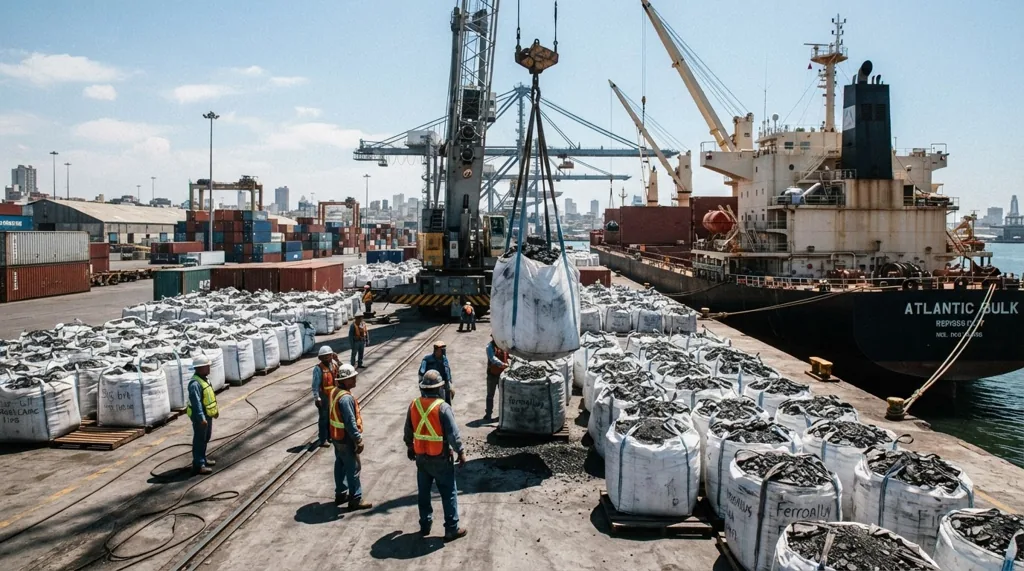
Mexico opened an expiry review of its 40.25% anti-dumping duty on ferrosilicomanganese from India on Oct. 8, 2026, keeping the duty in force while the review runs.
Mexico’s Ministry of Economy opened a review on Oct. 8, 2026 of its 40.25% anti-dumping duty on ferrosilicomanganese from India, and the duty stays in force while the review runs1.
The Ministry of Economy’s resolution, published in the Diario Oficial de la Federación (DOF), Mexico’s official gazette, starts what Mexico calls an "examen de vigencia"1. This is an expiry review, also called a sunset review: a check on whether a duty should end after five years or be kept.
In short, Mexico will not let the duty lapse on schedule while it studies the case. Every shipment of this steelmaking alloy from India still pays the extra 40.25% at the Mexican border until the review ends.
What is ferrosilicomanganese and who uses it?
Ferrosilicomanganese is a metal alloy of manganese, silicon and iron, sold in lumps of different sizes or as a powder1. It is also traded under the name silicomanganese. It usually contains small amounts of carbon, phosphorus and sulphur.
The resolution describes a typical grade1. It has about 65% manganese, more than 14% silicon, 2% to 2.5% carbon, no more than 0.3% phosphorus and at most 0.04% to 0.05% sulphur.
Steel mills are the main buyers. The ministry calls the alloy an essential raw material for making steel1. It removes oxygen and sulphur from molten steel in structural and special steels. Smaller amounts go into welding products and very clean, fine-grained steels.
The alloy ends up in many common steel goods1. These include reinforcing bar, wire rod, slabs, plate, sheet, structural shapes, seamless tubes, machine-grade bars, cast steel parts and welding electrodes.
Why does Mexico tax Indian ferrosilicomanganese?
Mexico first imposed the duty in a final anti-dumping resolution published in the DOF on Oct. 18, 20161. An anti-dumping duty is an extra import tax on goods sold abroad below their normal price. Mexico’s law calls it a "cuota compensatoria", a compensatory duty.
The 2016 decision set a definitive duty of 40.25% on ferrosilicomanganese from India2. It applies whatever country the goods are shipped from. It covers both permanent imports and temporary imports, which enter Mexico to be processed and exported again.
A first expiry review ended with a final resolution published on April 3, 20231. In it, the ministry kept the 40.25% duty for five more years, counted from Oct. 19, 2021.
Who asked for the new review?
Under Mexican trade law and the World Trade Organization’s anti-dumping agreement, a definitive duty ends after five years1. It survives only if the ministry starts an expiry review before the five years are up. The review must follow a request from one or more Mexican producers.
How the review was triggered
On Oct. 16, 2025, the ministry published a notice listing duties due to expire1. Ferrosilicomanganese was on the list. The notice gave Oct. 18, 2026 as the last day of the duty. Producers had until Sept. 10, 2026 to ask in writing for a review.
Compañía Minera Autlán, a Mexican mining company, filed that request on Sept. 9, 20261. It mines metals and minerals and makes ferrosilicomanganese. It proved it is a Mexican producer with its own sales invoices. The ministry found the request was made on time and in the correct form, so it opened the review.
Minera Autlán also asked for the first review, on Sept. 10, 20212. That review was opened in the DOF on Oct. 5, 2021.
Which goods and tariff codes are covered?
The review covers ferrosilicomanganese that originates in India, whatever the country it ships from1. It names two entry routes in Mexico’s tariff, the TIGIE:
- Tariff code 7202.30.01, with commercial identification number (NICO) 00, the normal heading for the alloy.
- Tariff code 9802.00.13, NICO 00, used by the steel industry under "Rule Eight", a special program that lets approved makers import inputs under one code.
What the review covers
| Point | Detail |
|---|---|
| Goods | Ferrosilicomanganese (silicomanganese) |
| Origin | India, whatever the country it ships from |
| Main tariff code | 7202.30.01, NICO 00 |
| Rule Eight code | 9802.00.13, NICO 00 |
| Other codes | Also covered |
The resolution also says the duty applies when the alloy enters through "any other" tariff code1. So a change of code on the customs entry does not avoid it.
The tariff measures the alloy by the kilogram, but the trade normally deals in tonnes1. A Mexican standard, NMX-B-227-CANACERO-2012, sets the chemical make-up and test methods for the alloy used in steel and foundry work.
How does the 35% tariff add to the duty?
The anti-dumping duty is not the only charge on this alloy. A decree published in the DOF on April 23, 2026 changed Mexico’s tariff1. Since April 24, 2026, imports under code 7202.30.01 pay a 35% tariff.
Charges on Indian ferrosilicomanganese under code 7202.30.01, %
This is a big change from a few years ago. In the 2023 final resolution, the ministry said imports under codes 7202.30.01 and 9802.00.13 entered free of tariff, whatever their origin2.
For a shipment from India under code 7202.30.01, both charges now apply. The 35% tariff falls on imports from every country. The 40.25% anti-dumping duty falls only on goods of Indian origin.
The 2023 resolution also recorded another rule2. Imports under code 7202.30.01 for permanent import need an automatic notice filed with the ministry, for trade statistics.
What happens to the duty during the review?
The 40.25% duty stays in force while the review runs1. The resolution bases this on article 11.3 of the anti-dumping agreement and Mexico’s Foreign Trade Law. Without the review, the duty would have ended after Oct. 18, 2026.
Importers can also guarantee payment of the duty instead of paying it in cash, under article 94 of the regulations to the Foreign Trade Law1. The resolution does not give more detail on how that guarantee works.
The ministry will tell the National Customs Agency of Mexico (ANAM) and the Tax Administration Service (SAT) about the review1. Customs officers will keep charging the duty at the border. The resolution entered into force the day after its publication in the DOF.
What period will the ministry examine?
The ministry set two time periods1. The review period runs from July 1, 2025 to June 30, 2026. The wider analysis period runs from July 1, 2021 to June 30, 2026.
The review period is the 12 months the ministry will study most closely. It will look at whether dumping, sales below normal price, would continue or return if the duty ended. The five-year analysis period lets it follow trends in imports and in the Mexican industry.
In the first review, the periods were July 1, 2020 to June 30, 2021, and July 1, 2016 to June 30, 20212. That review took about 18 months, from the Oct. 5, 2021 start to the April 3, 2023 final resolution.
Which companies are named in the case?
The resolution lists the parties the ministry knows of that may wish to take part1. They are:
- Importers: Elmet, Marco Metales de México and Ternium México.
- Exporter: Mortex (India), based in Kolkata.
- Government: the Embassy of India in Mexico.
In the first review, only Minera Autlán and the importer Elmet took part2. No Indian producer or exporter appeared in that case. Marco Metales asked for more time, then said it had no legal interest in the case.
How can importers and exporters take part?
Any party with a legal interest can join the review1. This includes Mexican producers, importers, exporters and foreign companies. They have 28 working days to prove their interest and file their answers. The time limit counts from the day after the resolution appeared in the DOF.
Parties must fill in an official form and add their arguments and evidence1. The form is on the website of the ministry’s International Trade Practices Unit (UPCI). Filings can go by email to the unit from 9:00 to 18:00, or on paper at the ministry in Mexico City from 9:00 to 14:00.
The case file number is EC 31-261. The resolution was signed on Sept. 28, 2026 by the Secretary of Economy, Marcelo Luis Ebrard Casaubon.
What happened in the last review?
The first review shows how this case can unfold2. After it opened, the ministry gave the parties extra time to answer, and asked Minera Autlán for more price and cost data. It also asked ANAM, the customs agency, for samples of import entries from July 2016 to June 2021.
The ministry held a public hearing on June 21, 20222. Mexico’s Foreign Trade Commission then gave a favourable opinion by majority on Nov. 7, 2022. The final resolution kept the 40.25% duty.
Key points on Mexico’s ferrosilicomanganese duty review
The main facts of the review are below.
| Question | Answer |
|---|---|
| What changed? | An expiry review of the duty opened |
| Who issued it? | Mexico’s Ministry of Economy |
| Where was it published? | DOF, Oct. 8, 2026 |
| Which goods? | Ferrosilicomanganese from India |
| Which tariff codes? | 7202.30.01 and 9802.00.13 |
| Anti-dumping duty rate | 40.25% |
| Other tariff on 7202.30.01 | 35% since April 24, 2026 |
| Duty during review | Stays in force |
| Who asked for the review? | Compañía Minera Autlán |
| Review period | July 1, 2025 to June 30, 2026 |
| Time to take part | 28 working days |
| Planned end without review | After Oct. 18, 2026 |
Ferrosilicomanganese from India keeps paying the 40.25% duty at the Mexican border while the review runs. Interested companies have 28 working days from the day after the Oct. 8 publication to file their evidence with the ministry.
Sources
- ↩ DOF – Diario Oficial de la Federación https://dof.gob.mx/nota_detalle.php?codigo=5800733&fecha=08/10/2026
- ↩ RESOLUCIÓN Final del procedimiento administrativo de examen de vigencia de la cuota compensatoria impuesta a las importaciones de ferrosilicomanganeso originarias de la República de la India, independientemente del país de procedencia https://sidof.segob.gob.mx/notas/docFuente/5684594