
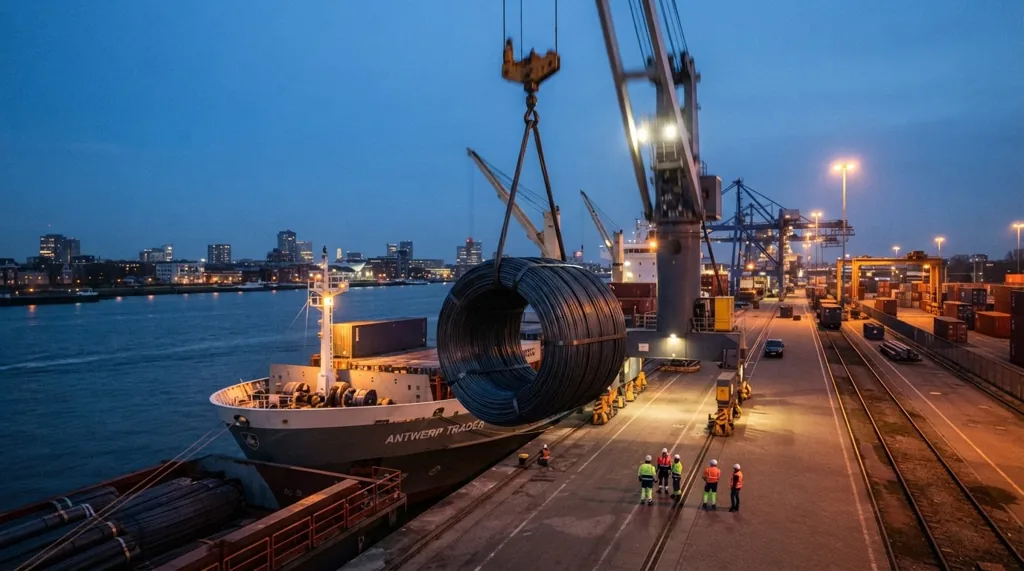
European Union opened an expiry review of its anti-dumping duties on hot-rolled steel wire rod from China on Oct. 12, 2026.
The European Commission on Oct. 12, 2026 opened an expiry review of the European Union’s anti-dumping duties on hot-rolled steel wire rod from China, starting a new investigation into whether the duties should stay1.
The review was published in the Official Journal of the European Union as notice C/2026/52442.
In short, the EU is checking whether Chinese wire rod would again flood its market at low prices if the duties ended. The current duty stays the measure in force for now, and Chinese makers and EU importers are asked to send information within days.
What is the Commission reviewing on wire rod?
An expiry review is a check the EU carries out before anti-dumping duties run out. Anti-dumping duty is an extra import tax on goods sold abroad below their normal price. The review decides whether ending the duty would bring back the low-priced imports and the harm to EU producers1.
The duties under review were set by Commission Implementing Regulation (EU) 2021/18051. That 2021 regulation itself followed an earlier expiry review, under the EU’s basic anti-dumping law, Regulation (EU) 2016/10363.
The Commission opened the new review after it published a notice that the measures would soon expire. It then received a request to keep them1.
Which steel products are covered?
The goods are steel bars and rods, hot-rolled and wound loosely in coils. In trade terms, they are bars and rods, hot-rolled, in irregularly wound coils, of iron, non-alloy steel or alloy steel1. Stainless steel is not covered1.
The notice lists 15 customs codes, called CN codes, in the EU’s tariff list1:
- Heading 7213: 7213 10 00, 7213 20 00, 7213 91 10, 7213 91 20, 7213 91 41, 7213 91 49, 7213 91 70, 7213 91 90, 7213 99 10 and 7213 99 90.
- Heading 7227: 7227 10 00, 7227 20 00, 7227 90 10, 7227 90 50 and 7227 90 95.
The codes are given for information only. A later change in tariff classification does not change what the review covers1. The product is the same one covered by the 2021 regulation, which uses the same 15 codes3.
How long have these duties been in place?
The EU first imposed anti-dumping duty on Chinese wire rod by Council Regulation (EC) No 703/20093. In 2015 the Commission renewed the duties by Implementing Regulation (EU) 2015/1846, after a first expiry review3.
Anti-dumping duty set in 2015, %
The 2015 measures set a 24% country-wide duty on the value of the goods. One group of companies, the Valin Group, received its own rate of 7.9%3.
A second expiry review began on Oct. 14, 20203. It ended with Regulation 2021/1805. In June 2021, the Commission told the parties it intended to keep the duties in force3. The review opened in October 2026 is therefore the third expiry review of these duties.
Who asked for the review, and why?
The European Steel Association, known as EUROFER, sent the request on June 30, 2026. It acted on behalf of the EU’s wire rod industry1. In the 2020 case, EUROFER spoke for EU producers making about 60% of EU wire rod output3.
EUROFER says ending the duties would likely bring back dumping and harm to EU producers1. It argues that Chinese prices and costs cannot be used because the Chinese economy has significant distortions, meaning state influence that bends prices away from market levels1.
To support this, EUROFER cited the Commission’s report on distortions in China of April 10, 2024. It also cited Chinese steel plans, including a work plan for steel growth in 2025–2026, and China’s 15th Five-Year Plan for 2026 to 20301.
How did EUROFER measure the alleged dumping?
Because China’s own prices are treated as distorted, EUROFER built a "normal value" from costs in another country. It chose Peru as the comparison country1. It then compared that value with China’s export prices to other countries1.
EUROFER used exports to third countries because there are currently no significant Chinese wire rod imports into the EU1. This comparison shows dumping, EUROFER says1.
On harm, EUROFER says Chinese plants have unused capacity. If the duties end, imports would likely rise, it argues1. It says the earlier harm to EU producers was removed mainly because the duties exist1.
What periods will the investigation examine?
The Commission will check dumping over the review investigation period from July 1, 2025 to June 30, 20261.
The periods under review
For harm to EU producers, it will look at trends from Jan. 1, 2023 to the end of that period1. In the 2020 review, the matching periods began in 2017 and 20193.
The Commission names Peru as a possible comparison country for China. It will pick the final one by looking for countries at a similar stage of development, which make and sell wire rod and have data available1. In the 2021 regulation, Peru was also chosen, over Thailand and Turkey3.
What must Chinese makers and EU importers do, and by when?
The notice sets tight deadlines, counted from publication on Oct. 12, 20261:
- Within 7 days (by Oct. 19, 2026): Chinese producers send company details for sampling through the Commission’s online system, TRON.tdi.
- Within 15 days (by Oct. 27, 2026): requests for a hearing on the opening; Chinese producers’ data on raw materials and energy; views on the comparison country.
- Within 37 days (by Nov. 18, 2026): comments on the request and on the opening of the case, and evidence on distortions in China.
- Within 65 days (by Dec. 16, 2026): facts to set costs and prices from public sources.
Deadlines from the Oct. 12, 2026 notice
| Deadline | Who | What is due |
|---|---|---|
| Oct. 19, 2026 | Chinese producers | Company details for sampling |
| Oct. 27, 2026 | Chinese producers and other parties | Raw material and energy data; hearing requests; comparison country views |
| Nov. 18, 2026 | All interested parties | Comments on the request; evidence on distortions |
| Dec. 16, 2026 | All interested parties | Public facts on costs and prices |
Sampling means the Commission may study only a selected group of companies. It picks them by the largest volume of production, sales or exports it can check in time1. Sampled producers must answer a full questionnaire within 30 days of being told they were picked1.
Comments on the sample must arrive within 3 days of the sampling decision1. Companies that agree to be sampled but are not chosen count as cooperating1.
Who is affected by the wire rod review?
Chinese producers are all invited to take part, including those that did not cooperate in the case that led to the current duties1. The Commission will also send a questionnaire to the Chinese government1.
EU importers that are not linked to Chinese producers are also invited, including those that stayed out of the earlier case1. The Commission may sample them too1.
Participation matters. In the 2020 review, no Chinese company came forward, and the Commission based its findings on "facts available"3. The 2021 regulation notes that such findings may be less favourable to the party concerned3. No importer answered the sampling form in that case either3.
What happens next for Chinese wire rod duties?
Shortly after opening the case, the Commission will add a note to the file naming the data sources it plans to use for Chinese costs. Parties then have 10 days to comment1.
The review will end with a decision on whether the duties lapse or continue. The test is whether ending them would likely lead to dumping and harm to EU producers continuing or returning1.
For a shipment today, nothing changes at the border because of this notice. The duty set by Regulation 2021/1805 is the measure currently in force1.
Key points on the EU wire rod expiry review
The table sums up the review opened on Oct. 12, 2026.
| Question | Answer |
|---|---|
| What happened? | Expiry review of anti-dumping duties opened |
| Who issued it? | European Commission |
| Which goods? | Hot-rolled wire rod in coils, not stainless |
| Which country? | China |
| Customs codes | 15 codes under headings 7213 and 7227 |
| Duties under review | Set by Regulation (EU) 2021/1805 |
| Earlier rates | 24% country-wide; 7.9% for Valin Group |
| Who asked? | EUROFER, on June 30, 2026 |
| Comparison country | Peru |
| Investigation period | July 1, 2025 to June 30, 2026 |
| First deadline | Oct. 19, 2026, sampling data |
| Comment deadline | Nov. 18, 2026 |
The next date is Oct. 19, 2026, when Chinese producers must send sampling details, followed by the 37-day comment deadline on Nov. 18, 2026. Until the Commission decides, the duty under Regulation 2021/1805 remains the measure in force on Chinese wire rod1.
Sources
- ↩ EUR-Lex – 52026XC05244 – EN – EUR-Lex https://eur-lex.europa.eu/legal-content/EN/TXT/?uri=OJ:C_202605244
- ↩ Official Journal C series daily view – EUR-Lex https://eur-lex.europa.eu/oj/daily-view/C-series/default.html?ojDate=12102026
- ↩ L_2021364EN.01001401.xml https://eur-lex.europa.eu/legal-content/EN/TXT/HTML/?uri=CELEX:32021R1805