
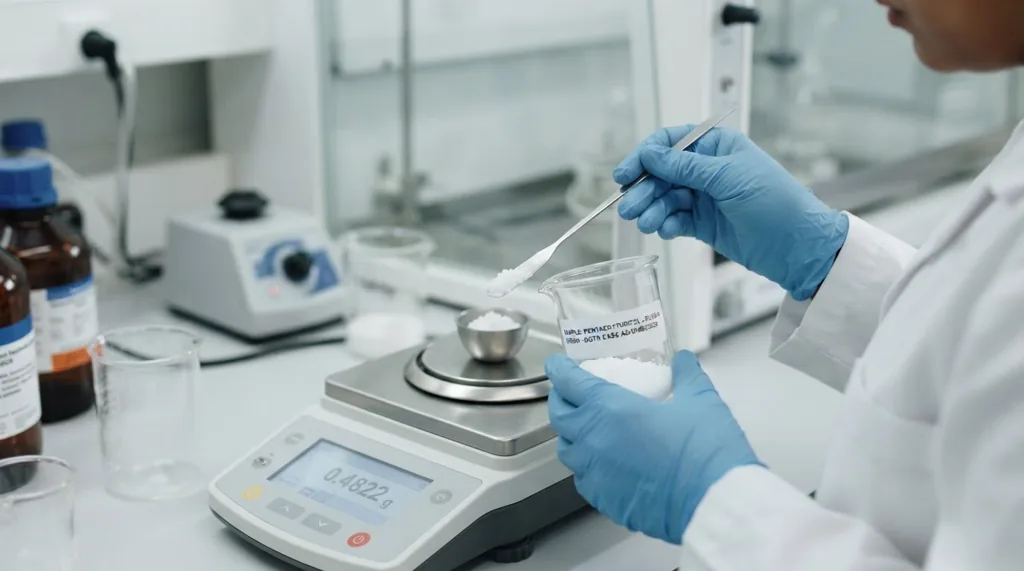
India opened an anti-dumping investigation into pentaerythritol imports from Russia on Sept. 25, 2026.
India’s Directorate General of Trade Remedies (DGTR) opened an anti-dumping investigation on Sept. 25, 2026 into imports of pentaerythritol, a chemical used to make paint resins, from Russia1.
The case number is AD/OI/062/2026. Two Indian producers asked for it, Kanoria Chemicals & Industries Limited and Perstorp Industries India Private Limited2.
In short, India is checking whether Russian pentaerythritol is sold in India below its fair price and is hurting Indian makers. No new duty applies yet, but shipments from Russia could face an extra import tax if the investigation ends with a finding of dumping.
What has DGTR started on pentaerythritol?
DGTR is the trade defence office of India’s Ministry of Commerce and Industry. Its head, the Designated Authority, signed the initiation notification, which is to be published in the Gazette of India2. The notification starts an anti-dumping investigation, a formal inquiry into whether goods are sold abroad below their normal price.
The inquiry will measure whether dumping exists, how large it is and what effect it has2. It will then recommend a duty that would be enough to remove the harm to Indian makers, if a duty is imposed2. The legal basis is Section 9A of the Customs Tariff Act, 1975, read with Rule 5 of the 1995 anti-dumping rules2.
The case appears on DGTR’s list of ongoing anti-dumping investigations with the date Sept. 25, 20263. DGTR’s case portal, SETU, lists the initiation notification on the same date, and a post-initiation intimation letter dated Oct. 6, 20261. That letter is the step where DGTR informs the parties concerned.
Which goods does the pentaerythritol case cover?
The product is pentaerythritol, excluding di-pentaerythritol2. Pentaerythritol is an organic compound with five carbon atoms and four hydroxyl groups, which is where its name comes from2. Di-pentaerythritol, a related chemical, is outside the case2.
Scope of the pentaerythritol case
| Point | What the notification says |
|---|---|
| Goods covered | Pentaerythritol |
| Goods excluded | Di-pentaerythritol |
| Grades | Technical grade and nitration grade |
| Customs code | 2905.42.90, a guide only |
| Country | Russia |
The chemical is made in two grades, technical grade and nitration grade2. The grades differ in purity, crystal size and how even the crystals are2. Nitration grade is purer and is used in the explosives industry, and it can also replace technical grade in other uses2.
Most production, about 98%, is technical grade, and imports are mainly of that grade2. Both grades are in the case, because the notification does not exclude either one.
It can be made with two technologies, electrodialysis separation or fractional crystallisation2. The applicants say the product is the same whichever technology is used2.
What is pentaerythritol used for?
Factories use pentaerythritol mainly to make other chemicals, such as alkyd resins and esters2. These products go into paints, varnishes and other surface coatings, where they help the coating dry2. They are also used as lubricants in several industries2.
The buyers of Russian shipments are therefore mostly paint, coating and lubricant makers in India. Any future duty would raise the landed cost of their raw material from Russia.
Which customs code is under review?
The goods fall under Chapter 29 of India’s customs tariff, at sub-heading 2905.42, tariff item 2905.42.902. The notification says this code is a guide only2. It does not fix the scope of the case: the product description does.
The case measures quantities in metric tons2. The applicants did not propose product control numbers, which are codes that split a product into types so that prices can be compared fairly2. Parties may comment on the product scope and propose such codes within 15 days of the start of the investigation2.
Why did Indian makers ask for the Russia case?
The applicants say Russian pentaerythritol enters India at dumped prices and has caused material injury to Indian makers2. They asked for an anti-dumping duty on the imports2.
DGTR found enough first evidence, called prima facie evidence, to open the case2. The notification lists the injury the applicants described:
- Import volumes rose from Russia, both in total and compared with Indian use and output2.
- Russian prices undercut Indian prices throughout the period studied2.
- The landed price of Russian imports was below the Indian makers’ cost of sales2.
- Indian makers sold below their own cost and could not raise prices to cover full costs2.
- Their capacity use fell, even though output and sales rose after new capacity started2.
- They had financial losses, cash losses and a negative return on capital in every year studied, and their stocks rose2.
These are claims by the applicants that DGTR accepted for starting the case. They are not final findings.
How was the dumping margin estimated?
A dumping margin is the gap between the normal price of a product and the price at which it is exported. The applicants said they could not find checkable data on prices inside Russia, or on Russian export prices to other countries2.
So DGTR built a constructed normal value for the start of the case2. It used the best estimates of production costs in India, plus selling and general costs and a reasonable profit2.
For the export price, DGTR used the CIF price in import data kept by DG Systems2. CIF means the price including cost, insurance and freight to India. It then took off ocean freight, marine insurance, port charges and credit costs to reach a factory-gate price2.
Comparing the two at factory level showed a margin above the minimum level and significant, the notification says2. It does not publish the figure.
Who are the Indian producers in the case?
The applicants are Kanoria Chemicals & Industries Limited and Perstorp Industries India Private Limited2. The only other Indian maker named is Asian Paints Limited2.
The applicants say Asian Paints makes the chemical mainly for its own use, and also buys it through imports and from them2. Asian Paints neither supported nor opposed the request2.
The two applicants make 100% of Indian output if Asian Paints is left out, and more than 50% if it is counted2. They state that they are not linked to any Russian maker, exporter or importer, and have not imported the goods from Russia2. DGTR accepted that they speak for the domestic industry2.
How does the pentaerythritol case link to the earlier duties?
This is not India’s first pentaerythritol case. DGTR opened an investigation into imports from China, Saudi Arabia and Taiwan in May 20232. Its case page shows an initiation notification on May 16, 2023 and final findings on Feb. 20, 20244.
India’s pentaerythritol cases
The central government then imposed anti-dumping duty on those three sources by Notification No. 08/2024-Customs (ADD) of May 16, 20242. Imports from Russia carry no anti-dumping duty at present2.
The new case looks only at Russia2. Shipments from China, Saudi Arabia and Taiwan remain under the 2024 measure, which this case does not change.
What periods and deadlines apply?
The period of investigation runs from April 1, 2025 to March 31, 2026, a span of 12 months2. DGTR will judge injury over a longer span covering 2022-23, 2023-24, 2024-25 and that period2.
Time to respond in the Russia case, days
All filings must go through the SETU portal under case number AD/OI/062/20262. DGTR may ignore filings sent by email or other means2. The main deadlines are:
- 37 days to file information and questionnaire answers, counted from the day DGTR circulates the public version of the application on SETU or sends it to Russia’s diplomatic representative2.
- 15 days from the start of the case for comments on product scope and product codes, running at the same time2.
- 7 days from circulation of public versions to comment on other parties’ confidentiality claims2.
DGTR will add 15 days if it later changes the product scope or product codes2. Further extensions are granted only in exceptional cases2.
What must Russian exporters and Indian importers do?
DGTR is writing to known Russian makers and exporters, to Russia’s government through its embassy in India, and to known Indian importers and users2. Any other party may also take part by registering on SETU2.
Each party filing secret business data must also file a public version, marked on every page2. Papers in a language other than English or Hindi need a true translation2. Data files must be in Excel with linked calculations2.
A party that does not supply information in time, or blocks the inquiry, may be declared non-cooperative2. DGTR can then decide on the facts it has2. For a Russian exporter, that can mean a higher duty recommendation than its own data would support.
Key points on India’s pentaerythritol case against Russia
The investigation is at its first stage, and no duty applies yet.
| Question | Answer |
|---|---|
| What changed? | Anti-dumping investigation opened |
| Who acted? | DGTR, India’s trade defence office |
| Case number | AD/OI/062/2026 |
| Which goods? | Pentaerythritol, excluding di-pentaerythritol |
| Customs code | 2905.42.90 |
| Which country? | Russia |
| Who asked? | Kanoria Chemicals and Perstorp Industries India |
| Start date | Sept. 25, 2026 |
| Letter to parties | Oct. 6, 2026 |
| Period of investigation | April 1, 2025 to March 31, 2026 |
| Duty on Russia now | None |
| Filing deadline | 37 days from circulation of the application |
The next step is the 37-day window for questionnaire answers on SETU. Until DGTR issues findings and the government acts, Russian pentaerythritol enters India without anti-dumping duty2.
Sources
- ↩ Notifications | SETU https://setu.dgtr.gov.in/Notifications
- ↩ Initiation Notification – Copolymer Polyol of hydroxyl value >= 23.5 – China PR https://dgtr.gov.in/sites/default/files/2026-09/English%20Initiation%20Penta.pdf
- ↩ Anti-Dumping Ongoing Investigation | Directorate General of Trade Remedies, MOCI, GOI https://www.dgtr.gov.in/en/anti-dumping-ongoing-investigation
- ↩ Anti-dumping investigation concerning imports of “Pentaerythritol” originating in or exported from China PR, Saudi Arabia, and Taiwan. | Directorate General of Trade Remedies, MOCI, GOI https://www.dgtr.gov.in/en/anti-dumping-cases/anti-dumping-investigation-concerning-imports-pentaerythritol-originating-or