
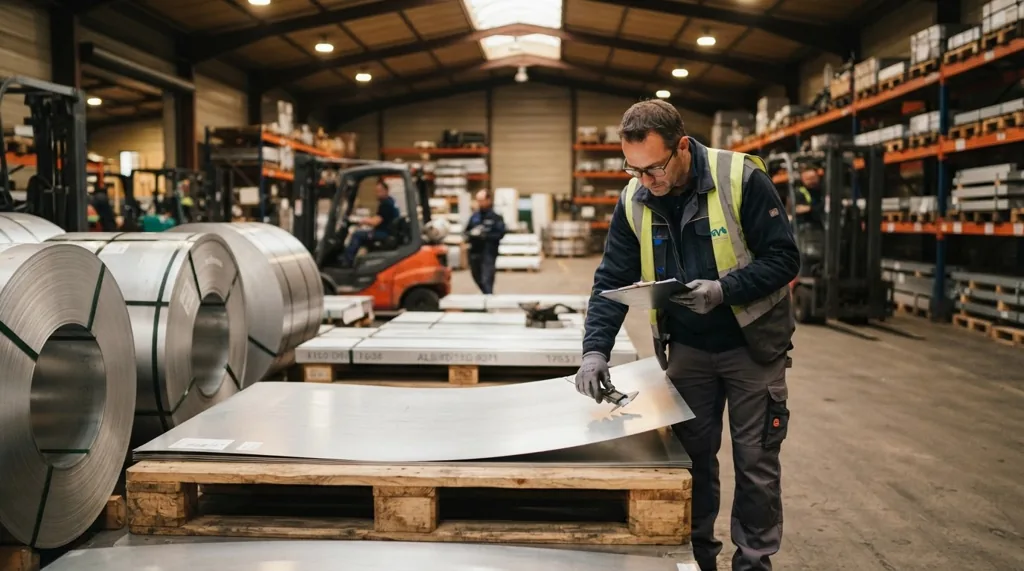
European Union opened an expiry review on 8 October 2026 of its 14.3% to 24.6% anti-dumping duties on Chinese aluminium flat-rolled products.
The European Commission opened an expiry review on Oct. 8, 2026, of its anti-dumping duties on aluminium flat-rolled products from China, publishing the notice on Oct. 9, 20261.
The duties are extra import taxes of 14.3% to 24.6%, in place since 20211. An anti-dumping duty is an extra import tax on goods sold abroad below their normal price.
In short, the EU is checking whether the duties on Chinese aluminium sheet, plate, coil and thin strip should continue. For now, the duties set in 2021 are the measures in force, and Chinese shipments of these goods still pay them at the EU border1.
What is the EU reviewing on Chinese aluminium?
An expiry review is a check that the EU runs when a duty is close to its end date. The Commission asks one question: would dumping and harm to EU producers come back if the duty ended?1
The review began after a notice of impending expiry, a public warning that the duties were close to their end. After that warning, the Commission received a request to review the measures1. The case number on the Commission’s trade defence website is R876, listed as an expiry review under Article 11(2)2.
The legal basis is Regulation (EU) 2016/1036, the EU’s main law on dumped imports from countries outside the EU1. The notice was published in the Official Journal of the European Union as C/2026/51831.
Who asked for the review of the aluminium duties?
European Aluminium, the trade group for EU aluminium makers, sent the request on June 10, 20261. It acted on behalf of the EU industry that makes these products1.
An open version of the request is in the case file. Interested parties can read it there, along with an analysis of how many EU producers support the request1.
Which aluminium products does the review cover?
The review covers flat aluminium, alloyed or not, that is not backed and has no inner layers of other material1. It includes three groups:
- Coils, strips, cut sheets and circles with a thickness of 0.2 mm up to 6 mm.
- Plates thicker than 6 mm.
- Thin coils and strips from 0.03 mm up to under 0.2 mm.
These goods currently fall under parts of customs codes in headings 7606 and 7607. The listed codes include CN 7606 11 50, 7606 12 99, 7606 91 00, 7606 92 00, 7607 11 90 and 7607 19 901. The notice also lists 30 detailed TARIC codes, the EU’s 10-digit import codes. It says these codes are given for information only1.
Which aluminium goods are left out?
Four kinds of goods are excluded from the review and the duties1:
- Drink can material: body stock, end stock and tab stock for beverage cans.
- Two thin-foil codes: goods under TARIC codes 7607 11 90 44 and 7607 11 90 71.
- Car body panels: alloyed aluminium from 0.2 mm to 6 mm thick, for use as body panels in the car industry.
- Aircraft parts: alloyed aluminium at least 0.8 mm thick, for making aircraft parts.
Rules for duty-free aluminium for composite panels
| Requirement | Standard / Details |
|---|---|
| Form | Tension levelled or hot-rolled coils, mill finish |
| Width | 800 mm up to 2,050 mm |
| Thickness | 0.20 mm up to 0.5 mm, plus or minus 0.01 mm |
| Alloy and temper | 5005 or 3105; H14, H16, H24 or H26 |
| Flatness | Wave height no more than 3 in 1,000 mm |
A further group of goods does not pay the duty. This is aluminium imported to make aluminium composite panels1. To qualify, the goods must meet a technical list:
- tension levelled or hot-rolled coils, with a mill finish;
- widths from 800 mm up to 2,050 mm;
- thicknesses from 0.20 mm up to 0.5 mm, within plus or minus 0.01 mm;
- alloys 5005 or 3105, in tempers H14, H16, H24 or H26;
- a wave height of no more than 3 in 1,000 mm.
What duties apply to Chinese aluminium now?
The current duties come from Commission Implementing Regulation (EU) 2021/1784 of Oct. 8, 20213. The rates range from 14.3% to 24.6% and were set at the level needed to remove the harm to EU makers1.
From first case to review
The path to these duties was not straight. The Commission opened the first investigation on Aug. 14, 20203. It set a provisional duty on April 12, 2021, under Implementing Regulation (EU) 2021/5823.
The final duties were then suspended at the moment they were imposed in 2021, by Implementing Decision (EU) 2021/17881. In 2022, Implementing Decision (EU) 2022/1178 put them back in place1. Since then, Chinese shipments of these goods have paid the duty when they enter the EU.
Why does European Aluminium say the duties are still needed?
The industry group says that ending the duties would likely bring back dumping and harm to EU producers1. It makes two main claims.
First, it says prices and costs in China cannot be trusted for the calculation. It points to significant distortions, meaning state influence that pushes prices away from market levels1. It cites a Commission report on China’s economy dated April 10, 20241. It also refers to state-owned aluminium companies, provincial plans that set targets for aluminium makers, and China’s 14th and 15th Five-Year Plans1.
Because of this, the group built a "normal value" from costs in another country. It proposed Türkiye as that comparison country1. Comparing this value with Chinese export prices shows dumping, it says1.
Second, it says imports would rise if the duties ended. It cites China’s large spare capacity, the appeal of the EU market, and duties in other countries that could push Chinese goods toward the EU1. It says the harm to EU makers ended mainly because of the duties1.
How will the Commission run the aluminium review?
The Commission found enough evidence to open the review after consulting the committee set up under the EU’s anti-dumping law1. It will look at two periods:
- Dumping: from July 1, 2025, to June 30, 2026, the review investigation period.
- Harm to EU makers: from Jan. 1, 2023, to June 30, 2026.
Because many companies are involved, the Commission may pick a sample, a smaller group of companies to study closely1. This applies to Chinese producers, to EU importers not linked to Chinese makers, and to EU producers1. The Commission has already picked a provisional sample of EU producers1.
Companies chosen for a sample must send a full questionnaire within 30 days of being told1. Comments on any sample choice are due within 3 days of the decision1.
The Commission will also send a questionnaire to the Chinese government about the claimed distortions1. It names Türkiye as the possible comparison country for China1.
What must importers and Chinese producers do, and by when?
All deadlines run from publication on Oct. 9, 20261. The main steps are:
- Within 7 days: Chinese producers send company details for sampling through TRON, the Commission’s online system. Unlinked EU importers make themselves known with the details in the notice’s annex. EU producers comment on the provisional sample1.
- Within 15 days: requests for a hearing on the opening of the case. Chinese producers report the materials and energy they use. Parties comment on the input codes and propose comparison countries1.
- Within 37 days: comments on the request and on the opening of the review. Information on the EU interest is also due1.
- Within 65 days: factual information from public sources to set costs and prices1.
Deadlines after the Oct. 9, 2026 notice, days
Counted from Oct. 9, 2026, the 7-day limit falls around Oct. 16, and the 37-day limit around Nov. 15, 2026.
The review also looks at the EU interest. If dumping and harm are likely to return, the Commission will still check that keeping the duties is not against the EU’s wider interest1. Users of the aluminium, importers, trade unions and consumer groups can send evidence on this1.
The review affects several groups in different ways. Importers of Chinese aluminium sheet and coil face the 2021 duties at the border today. Chinese mills, including those that did not take part in the 2021 case, are invited to take part1. EU users can give their views through the user questionnaire1. In the 2021 case, users included makers of car heat exchangers3.
Key points on the EU aluminium flat-rolled products review
The table sums up the main facts of the review.
| Question | Answer |
|---|---|
| What happened? | The EU opened an expiry review of anti-dumping duties |
| Who issued it? | The European Commission |
| Which goods? | Aluminium flat-rolled products: sheet, plate, coil, strip |
| From which country? | China |
| Current duty rates | 14.3% to 24.6% |
| Law behind the duties | Implementing Regulation (EU) 2021/1784 |
| Who asked for the review? | European Aluminium, on June 10, 2026 |
| Main exclusions | Drink can stock, car body panels, aircraft parts |
| Review case number | R876 |
| Dumping period checked | July 1, 2025, to June 30, 2026 |
| Notice published | Oct. 9, 2026 |
| Main comment deadline | 37 days after publication |
The first deadline falls 7 days after the Oct. 9, 2026 notice, when Chinese producers and EU importers must come forward for sampling1. Until the Commission decides, Chinese aluminium flat-rolled products remain under the 2021 duties at the EU border.
Sources
- ↩ C_202605183EN.000101.fmx.xml https://eur-lex.europa.eu/legal-content/EN/TXT/HTML/?uri=OJ:C_202605183
- ↩ Trade defence investigations https://tron.trade.ec.europa.eu/investigations/ongoing
- ↩ Implementing regulation – 2021/1784 – EN – EUR-Lex https://eur-lex.europa.eu/legal-content/EN/TXT/?uri=CELEX:32021R1784