
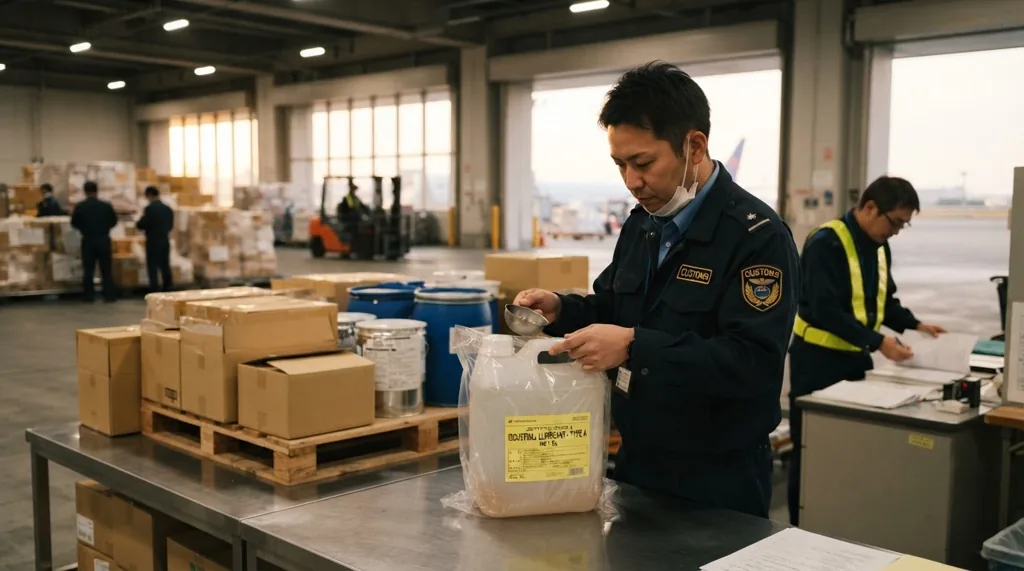
Japan revised its customs notice for chemical imports on Oct. 2, 2026, ahead of bans on four chemical groups and products using them from Nov. 22, 2026.
Japan’s Ministry of Economy, Trade and Industry (METI) on Oct. 2, 2026, revised its notice on customs clearance for chemical imports under the Chemical Substances Control Law, ahead of a ban on four groups of persistent chemicals and products that use them, which starts Nov. 22, 20261.
The notice sets out what importers must show at the border when they bring chemicals into Japan2. It follows a Cabinet order that adds long-chain PFCAs, related substances, chlorpyrifos and medium-chain chlorinated paraffins to Japan’s list of the most tightly controlled chemicals1.
In short, from Nov. 22, 2026, Japan will treat these four chemical groups as banned, and products such as lubricants, paints and some treated clothing that use them may not be imported. Shipments of chemicals will also need the right entries at customs to show that none of them is inside.
What did METI change on Oct. 2?
METI’s chemical safety office posted the revised notice on its page for the Chemical Substances Control Law, known in Japan as the Kashinho3. The notice covers customs clearance and related procedures for chemicals under the law3.
The revised notice is dated Oct. 2, 2026 and is published as a PDF on METI’s import procedures page2. The page also offers three forms that go with it2. One covers new chemicals imported for testing and research or as laboratory reagents2. A second covers new chemicals imported under the small-quantity and low-volume routes2. A third is for foreign manufacturers2.
METI also publishes an English version of the customs notice on the same page2. The notice explains how the law’s rules are checked when a shipment is declared to Japan Customs4.
Why is Japan updating the chemical customs notice?
The update follows a change to the law’s Enforcement Order, the Cabinet order that lists which chemicals and products the law controls1. The Cabinet approved that order on May 19, 2026, and METI announced it jointly with the health and environment ministries1.
The order names four groups as Class I Specified Chemical Substances, the law’s strictest category1. These are chemicals that do not break down easily, build up in living things and harm people or top predators over the long term1. For this class, making and importing them needs permission and is in principle banned, their use is limited, and listed products that contain them may not be imported1.
The four groups were added to Annex A of the Stockholm Convention on persistent organic pollutants at its 12th meeting in April and May 20255. Annex A is the treaty’s list of chemicals to be eliminated5. Japan’s chemical review council then concluded in June 2025 that all four should become Class I substances5.
Which chemicals become banned on Nov. 22?
The Cabinet order covers four groups1:
- Long-chain PFCAs and their salts: perfluoroalkane acids with 9 to 21 carbon atoms5.
- Long-chain PFCA related substances: compounds that can turn into long-chain PFCAs through natural chemical change, as set by a ministerial ordinance5.
- Chlorpyrifos: named in full as O,O-diethyl O-(3,5,6-trichloro-2-pyridyl) phosphorothioate5.
- Medium-chain chlorinated paraffins (MCCPs): straight-chain chloroalkanes with 14 to 17 carbon atoms and a chlorine content of 45% or more by weight5.
METI’s council found no need for any exempt uses5. It concluded that making, importing and using these chemicals should be banned, except for testing and research5.
The ban on use matters for factories as well as traders5. METI warned in February that making another chemical from one of these substances, or using one to make a product, may count as "use"5.
Which imported products will be blocked?
Beyond the chemicals themselves, the order lists finished goods that may not be imported when they contain one of the new substances1. For chlorpyrifos, the order names insect-protection products for wood1.
For long-chain PFCAs, related substances and MCCPs, the order names "lubricating oil" and other products1. METI’s February notice set out the product list it proposed for each group5.
For MCCPs, the list covered5:
- plasticisers for resins;
- additives that make fabric, resin or rubber flame-resistant;
- lubricating oils, cutting oils and hydraulic oils;
- paints;
- adhesives and sealing fillers;
- water repellents and textile protectants.
For long-chain PFCAs and related substances, the list covered professional photographic film, lubricating oils, paints, water and oil repellents, adhesives and sealing fillers, and waxes5. It also covered fabric, clothing and floor coverings treated to repel water or oil5.
Fire extinguishers, extinguishing agents and fire-fighting foam that use long-chain PFCAs are handled differently1. For now, the order sets technical handling standards for them, rules the government sets on how they must be handled1.
How do customs checks on chemicals work?
The Chemical Substances Control Law requires importers to complete steps before they bring in controlled chemicals or new chemicals4. Japan’s Customs Law then makes sure no such chemical enters without those steps4.
To check this, METI asks importers to give, for each ingredient, the official reference number published in the government gazette4. This includes impurities4. A chemical with no such Kashinho number counts as a new chemical, even if it has a CAS number, the international chemical identifier4. A new chemical needs review before it is imported4.
Importers must look up these numbers themselves, for example in the NITE-CHRIP database run by the National Institute of Technology and Evaluation2. METI’s chemical safety office does not run a search service2.
The steps at the border work like this4:
- The importer identifies every ingredient in the shipment, including impurities.
- The importer finds each ingredient’s Kashinho reference number.
- The importer writes those numbers on the import declaration or invoice.
- Customs checks that no new or banned chemical enters without the steps the law requires.
The ingredient percentages do not need to be written at customs4. But importers must know them, because they report import volumes to the government each year4.
What about impurities and research samples?
Impurities below 1% by weight normally need no prior step4. Class I substances are the exception: they may not be present even as an impurity below 1%4. A substance added on purpose is never treated as an impurity, whatever its share4.
Chemical import rules at Japanese customs
| Rule | What it means |
|---|---|
| Ingredient numbers | Kashinho number for each ingredient, including impurities |
| No Kashinho number | Treated as a new chemical, reviewed before import |
| Ordinary impurities | No prior step below 1% by weight |
| Class I substances | Not allowed even below 1% |
| Added on purpose | Never treated as an impurity |
This makes the Nov. 22 date important for chemical mixtures. Once the four groups join Class I, a mixture that carries even a trace of them will face the strictest rule4.
Imports of Class I substances for testing and research remain possible2. METI’s page directs these importers to Form 1, the form for chemicals used in research or as reagents2. Products named as "essential uses" follow a separate page2.
How does the trade ministry handle banned products?
A second METI office, its trade control division, also covers these goods6. Its page states that products using Class I substances are banned from import under Article 24 of the Chemical Substances Control Law6. As a result, import approval is in principle not granted6.
The ban on products applies to those using chemicals listed in Annex A or Annex B of the Stockholm Convention6. The four new groups were added to Annex A5. METI’s trade control page was last updated June 9, 20266.
Who is affected by the new chemical rules?
Chemical importers must check every ingredient of each shipment against the new Class I list. Since Class I substances are not allowed even as traces, suppliers’ ingredient data becomes more important4.
Importers of finished goods such as paints, lubricants, adhesives, waxes and water-repellent textiles are also affected. If such a product contains one of the new substances, it may not be imported from Nov. 221.
Foreign makers that supply Japan have their own form under the notice2.
Factories in Japan that use these chemicals to make other goods also face the ban on use5.
When do the new rules start?
The Cabinet order was promulgated on May 22, 20261. Its main parts take effect Nov. 22, 2026, six months later1. Some transition steps took effect on promulgation or take effect at the six-month mark1.
From Cabinet order to ban
METI had said in February that the order would take effect around autumn 20265. It also planned a separate ministerial ordinance to define long-chain PFCA related substances5. METI published the results of public comment on a ministerial ordinance under the Enforcement Order on Sept. 18, 20263.
Key points on Japan’s chemical import rules
The table sums up the change.
| Question | Answer |
|---|---|
| What changed? | Customs notice for chemical imports revised |
| Who issued it? | METI, Japan’s trade and industry ministry |
| When was it revised? | Oct. 2, 2026 |
| Which law? | Chemical Substances Control Law |
| Which chemicals join Class I? | Long-chain PFCAs, related substances, chlorpyrifos, MCCPs |
| What is banned? | Making, importing and using them, except research |
| Which products are blocked? | Lubricants, paints, wood insect-protection products, others |
| Trace limit? | No Class I traces, even below 1% |
| What goes on the declaration? | Kashinho number for each ingredient |
| Who must act? | Importers of chemicals and listed products |
| When do bans start? | Nov. 22, 2026 |
From Nov. 22, 2026, a shipment of paint, lubricant or treated textile that contains one of the four chemical groups may not enter Japan1.
Sources
- ↩ 「化学物質の審査及び製造等の規制に関する法律施行令の一部を改正する政令」が閣議決定されました(METI/経済産業省) https://www.meti.go.jp/press/2026/05/20260519001/20260519001.html
- ↩ 化学物質の輸入通関手続(METI/経済産業省) https://www.meti.go.jp/policy/chemical_management/kasinhou/todoke/import.html
- ↩ 化学物質の審査及び製造等の規制に関する法律(化審法) (METI/経済産業省) https://www.meti.go.jp/policy/chemical_management/kasinhou/index.html
- ↩ 輸入通関手続について(METI/経済産業省) https://www.meti.go.jp/policy/chemical_management/kasinhou/qa/cscl_10.html
- ↩ oshirase_260202.pdf https://www.meti.go.jp/policy/chemical_management/kasinhou/oshirase_260202.pdf
- ↩ 第一種特定化学物質使用製品の輸入 (METI/経済産業省) https://www.meti.go.jp/policy/external_economy/trade_control/03_import/13_kagaku/kagakuhin.html