
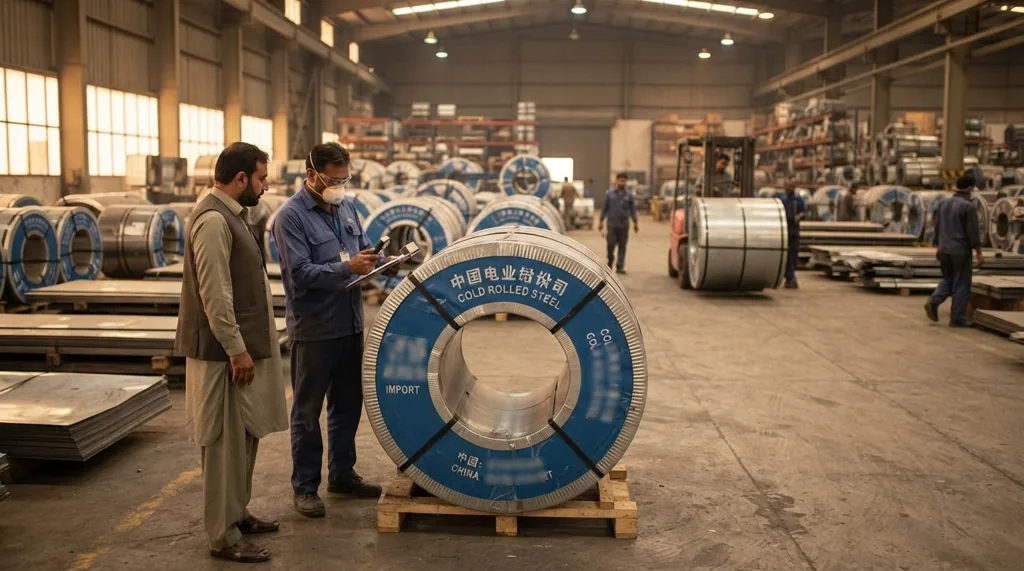
Pakistan’s National Tariff Commission decided on Oct. 10, 2026, to keep anti-dumping duties of 13.17% to 19.04% on Chinese cold-rolled steel.
Pakistan’s National Tariff Commission (NTC) decided on Oct. 10, 2026, to keep anti-dumping duties of 13.17% to 19.04% on Chinese cold-rolled steel coils and sheets1.
The commission published its notice closing the second "sunset review" of these duties on Oct. 13, 20262. A sunset review is a check, made when duties are due to expire, of whether they are still needed.
In short, Chinese cold-rolled steel will keep paying an extra import tax at Pakistan’s border. The rate range stays the same as before, at 13.17% to 19.04% of the goods’ value1.
What has the NTC decided on Chinese cold-rolled steel?
The NTC is Pakistan’s trade remedies body. It sets anti-dumping duties, which are extra import taxes on goods sold abroad below their normal price. Its list of finished reviews shows the second review of the duties on Chinese cold-rolled coils and sheets as concluded on Oct. 10, 20261.
The same list gives the outcome as duties of 13.17% to 19.04% for China1. That is the same range Pakistan has charged on this steel since the first duties3. The decision therefore keeps the existing tax in place rather than raising or cutting it.
The commission posted the "Notice of Conclusion of Second Sunset Review" on its news page on Oct. 13, 20262. The notice covers cold-rolled steel coils and sheets "originating in and/or exported from" China2. This means the duty applies to Chinese-made steel and to steel shipped from China.
How long have these duties applied?
The duties are now more than 10 years old. The NTC first imposed duties of 13.17% to 19.04% on Chinese and Ukrainian cold-rolled steel with effect from Jan. 13, 2016, for five years3.
Ten years of duties on Chinese cold-rolled steel
Local steel makers then asked for a first sunset review. The NTC started it on Jan. 8, 2021, and closed it on Jan. 7, 20221. In that decision, it kept the duties on China for another five years from Jan. 13, 20213. It ended the duties on Ukraine at once, because it saw no likely return of Ukrainian imports3.
That five-year period ran until January 2026. The NTC started the second sunset review on Jan. 10, 2026, just before the period ended1. The review took about nine months to complete.
Why does Pakistan keep taxing this steel?
The full 2026 notice was not readable in the documents on file. The commission’s earlier decision, from January 2022, shows the test it applies in a sunset review3.
In 2022, the NTC found a "strong likelihood" that Chinese dumping would continue if the duties ended3. It said dumped imports had fallen sharply after the 2016 duties. This, it said, had helped local production, sales and prices3.
It also judged that local makers would likely suffer serious harm without the duties. It listed falls in production, use of factory capacity, sales, market share, profits and productivity3. The NTC reached the same type of decision, to continue the duties, in the 2026 review1.
Who asked for the protection?
Two Karachi steel makers have driven these cases. Aisha Steel Mills Limited and International Steels Limited applied for the first sunset review in 20213. Both make cold-rolled coils and sheets in Pakistan.
The same two companies applied in March 2025 for a separate case against suspected avoidance of the duties4. They said Chinese exporters were changing the product slightly to escape the tax4. They told the NTC that the local industry was not getting the benefit of the duties and was still being harmed4.
Which steel products does the duty cover?
The product, as defined in the 2022 decision, is flat-rolled iron or non-alloy steel, cold-rolled (cold-reduced)3. It is between 0.15 mm and 3.00 mm thick and up to 1,250 mm wide. It is not clad, plated or coated, and it can be prime or secondary quality3.
The steel covered by the duty
| Feature | Covered product |
|---|---|
| Material | Flat-rolled iron or non-alloy steel, cold-rolled |
| Thickness | 0.15 mm to 3.00 mm |
| Width | Up to 1,250 mm |
| Surface | Not clad, plated or coated |
| Tariff codes | 16 codes in heading 7209 |
The steel may arrive in rolls or as sheets cut to length3. Pakistan’s customs tariff lists it under 16 codes in heading 72093. These run from 7209.1510 to 7209.1899 and from 7209.2510 to 7209.28903.
This steel goes into many everyday goods. The NTC lists car parts, inner body parts, doors, cabinets, pipes, tubes, refrigerators, washing machines, water heaters (geysers) and ovens3.
Which grades are left out?
The 2022 decision excluded some products from the duty3. These were cold-rolled sheets used for the outer skins of four-wheel vehicles, in a list of named car-industry grades3.
The excluded grades include, among others:
- Japanese-standard car grades such as JAC, JSC, SPC and JEH-270
- stainless grades such as SUS 304 and several SUS 400-series grades
- high-carbon grades SAE1050, SAE1070 and SAE1078
- Tin Mill Black Plate, an uncoated base steel for tin plate, of 0.30 mm or less, under code 7209.1891
These grades are not charged the duty when they come from China3. The 2026 notice was not readable on file, so any change to this list could not be checked.
What about wider steel coils?
In 2022, the NTC capped the product at 1,250 mm wide4. Chinese exporters then began shipping coils wider than 1,250 mm instead, according to the local makers’ complaint4.
The NTC opened an anti-circumvention investigation, a case on whether exporters are dodging a duty, on May 23, 20251. It looked at imports from Jan. 1, 2021, to Dec. 31, 20244. It said wider coils did not seem to change the steel’s basic features or uses4.
The NTC closed this case on Feb. 20, 2026, with a duty rate of 19.04%1. This shows the commission is also willing to tax product changes that avoid the duty.
How is the duty collected at the border?
The 2022 decision explains how the duty works in practice3. The duty is "ad valorem", meaning a percentage of the value of the goods. Customs will not release the steel into Pakistan until the importer pays it3.
The duty is charged on top of all other import taxes and duties3. Customs collects it in the same way as customs duty under the Customs Act, 19693. The money goes into a special NTC account at the Federal Treasury Office in Islamabad3.
There is one important exemption. Steel used as an input for goods made only for export is not charged the duty3. The goods must be covered by a customs duty exemption scheme for exports under the Customs Act, 19693.
How do the company rates work?
The NTC sets a separate rate for each named Chinese producer that took part in the case. In the 2022 decision, the rates were3:
- 19.04% for Shougang Casey Steel Company Ltd.
- 19.04% for Shougang Jingtang United Iron & Steel Co. Ltd.
- 16.27% for Beijing Shougang Cold Rolling Company Ltd.
- 13.17% for Handan Iron & Steel Group Han-Bao Co. Ltd.
- 19.04% for Maanshan Iron & Steel Company Ltd.
- 19.04% for all other Chinese exporters
Duty by Chinese producer in the 2022 decision, %
The 2026 review keeps the same overall range of 13.17% to 19.04%1. A shipment’s rate therefore depends on which Chinese company made or exported the steel. A company not named in the decision pays the "all others" rate.
Who is affected by the decision?
Pakistani importers of Chinese cold-rolled steel keep paying up to 19.04% on top of normal duties1. Makers of household appliances, car parts, pipes and furniture who buy this steel face the same cost.
Chinese steel mills keep a price disadvantage in Pakistan against local producers. Local makers such as Aisha Steel Mills and International Steels keep the protection they asked for3.
Exporters in Pakistan who use the steel in export goods can still avoid the duty through an export scheme3.
What other cold-rolled steel cases are open?
China is not the only supplier facing these duties. The NTC set a duty of 13.94% on cold-rolled coils and sheets from Canada and Russia in a review closed on March 15, 20251.
On Aug. 19, 2026, the NTC began a sunset review of duties on cold-rolled steel from four more sources1. These are Chinese Taipei, the European Union, the Republic of Korea and Vietnam1. That review is still in progress1.
Key points on Pakistan’s cold-rolled steel duties
The table sums up the decision on Chinese cold-rolled steel.
| Question | Answer |
|---|---|
| Who decided? | National Tariff Commission (NTC) of Pakistan |
| What was decided? | Anti-dumping duties on Chinese steel continue |
| Which goods? | Cold-rolled steel coils and sheets |
| Which country? | China |
| Duty rate | 13.17% to 19.04% |
| Review started | Jan. 10, 2026 |
| Review concluded | Oct. 10, 2026 |
| Notice published | Oct. 13, 2026 |
| Tariff heading | 7209 |
| Exemption | Steel used in goods made only for export |
| First duties | From Jan. 13, 2016 |
| Related case | Wider coils taxed at 19.04% since Feb. 20, 2026 |
Shipments of Chinese cold-rolled steel into Pakistan will keep paying the duty before customs releases them. The next decision on related cases is the open review of cold-rolled steel from Chinese Taipei, the European Union, Korea and Vietnam1.
Sources
- ↩ Review Investigations – NTC – National Tariff Commission, Pakistan https://www.ntc.gov.pk/review-investigations/
- ↩ News & Updates – NTC – National Tariff Commission, Pakistan https://www.ntc.gov.pk/category/news-updates/
- ↩ ADC No https://www.ntc.gov.pk/wp-content/uploads/2022/01/ADC-35-Final-Notice_of_Conclusion-sd-.pdf
- ↩ ADC-35-Notice-of-Initiation-CRC-Circum.pdf https://www.ntc.gov.pk/wp-content/uploads/2025/05/ADC-35-Notice-of-Initiation-CRC-Circum.pdf