
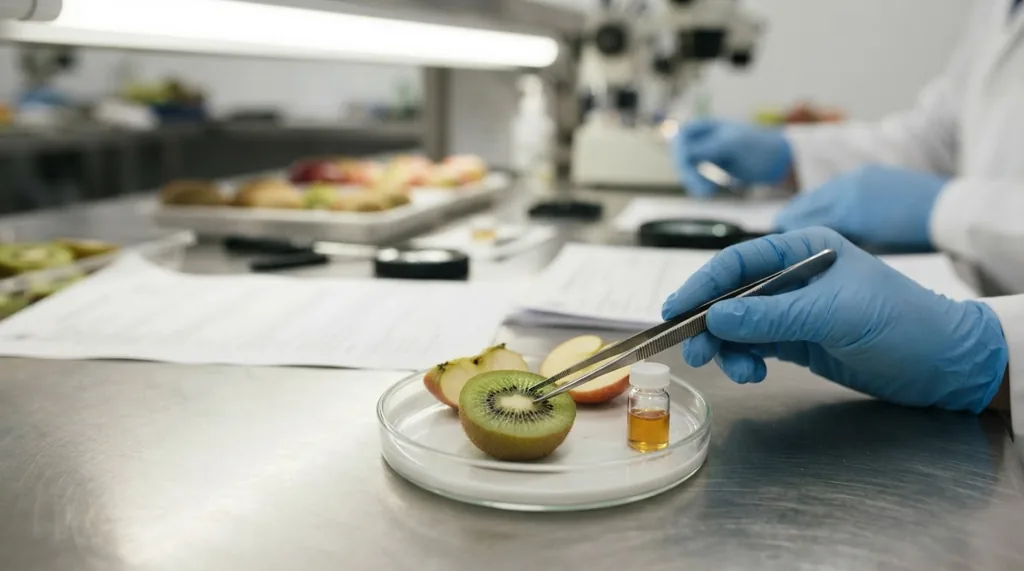
India sets low-duty import quotas for New Zealand apples, kiwifruit, albumins and Mānuka honey from Oct. 20, 2026.
India’s Directorate General of Foreign Trade has set low-duty import quotas for New Zealand apples, kiwifruit, albumins and Mānuka honey from Oct. 20, 2026.
The Directorate General of Foreign Trade (DGFT), India’s foreign trade authority, issued the rules in an October 2026 public notice1. They put into practice the tariff-rate quotas in India’s free trade agreement (FTA) with New Zealand1.
In short, a set amount of each of the four goods can enter India each year at a lower duty. A shipment gets that duty only if the importer holds a DGFT quota permit linked to a New Zealand export certificate.
This site reported on Oct. 14 the origin rules that decide which goods count as made in New Zealand. The new step is the quota for these four goods, with the in-quota duty, the yearly amounts and the permit process. The quotas sit alongside Ministry of Finance Notification No. 32/2026-Customs, dated Oct. 16, 2026, which gives the trade deal’s duty cuts1.
What is a tariff-rate quota for New Zealand goods?
A tariff-rate quota, or TRQ, is a fixed amount of goods that may enter at a lower duty. Once that amount is used up, further shipments do not get the lower quota rate.
The DGFT notice amends paragraph 2.92 and Appendix 2A of the Handbook of Procedures, 2023, India’s rulebook for import and export procedures1. It acts under paragraphs 1.03 and 2.04 of the Foreign Trade Policy, 20231. The quotas apply with effect from Oct. 20, 20261.
New Zealand’s Ministry of Foreign Affairs and Trade says both countries have ratified the agreement2. It says the deal enters into force on Oct. 20, 20262.
Which New Zealand goods get a quota?
The notice lists four goods, each with its customs code, quota duty and yearly amount1:
- Apples (code 0808.10.00): in-quota duty of 25%.
- Kiwifruit (code 0810.50.00): 0% duty when the price including freight and insurance is above US$1.80 per kg.
- Albumins (codes 3502.11.00, 3502.19.00, 3502.20.00 and 3502.90.00): in-quota duty of 11%. Albumins are proteins such as egg white, used in food making.
- Mānuka honey (part of code 0409.00.00): only honey certified by New Zealand’s Ministry for Primary Industries (MPI), its food and farm regulator.
In-quota duty by product
| Product | In-quota duty | Condition |
|---|---|---|
| Apples (0808.10.00) | 25% | Within the yearly quota |
| Kiwifruit (0810.50.00) | 0% | CIF price above US$1.80 per kg |
| Albumins (3502) | 11% | Within the yearly quota |
The kiwifruit price test uses the CIF price, the cost of the goods plus insurance and freight to India1. Kiwifruit priced at or below US$1.80 per kg does not get the zero rate under the quota.
All other goods fall outside these quotas. Their treatment under the trade deal is set by the Ministry of Finance notification1.
How large are the quotas each year?
The amounts are in metric tonnes and grow over time1. For two goods, the first year has no quota at all.
Apple quota by year, tonnes
For apples, the quota is nil in Year 11. It is 35,000 tonnes in Year 2, 37,500 in Year 3, 40,000 in Year 4 and 42,500 in Year 51. From Year 6 onwards it is 45,000 tonnes a year1.
For kiwifruit, the quota is also nil in Year 11. It then rises from 8,000 tonnes to 9,150, 11,500 and 13,250 tonnes1. From Year 6 onwards it is 15,000 tonnes a year1.
For albumins, the quota starts at 200 tonnes in Year 11. It rises to 1,500, 2,000 and 2,500 tonnes, then to 3,000 tonnes from Year 5 onwards1.
For Mānuka honey, the quota is 40 tonnes in Year 11. From Year 2 onwards it is 200 tonnes a year1.
When do quota years and import windows run?
The notice uses the "year" defined in Annex 2A of the trade agreement1. Year 1 runs from the entry into force to Dec. 31, 20261. Each later year is the 12 months starting on Jan. 11.
So Year 1 lasts only about 10 weeks. Only albumins and Mānuka honey have a quota in that short year. The first apple and kiwifruit quotas fall in 2027, which is Year 2.
Apples and kiwifruit also have seasonal windows1:
- Apples: imports under the quota only from April 1 to Aug. 31 each year.
- Kiwifruit: imports under the quota only from April 1 to Oct. 15 each year.
- Albumins and Mānuka honey: quota imports all year round.
A permit can be used only inside the window for its goods1. An apple shipment that arrives in September cannot use the quota rate, even with a valid permit.
How does an importer get a DGFT quota permit?
The process starts in New Zealand. New Zealand gives out the quota to its exporters or producers by issuing export certificates1. Each certificate names the item, the permitted quantity and the Indian importer chosen to receive it1.
Getting a quota permit
The steps then run in this order1:
- New Zealand’s export certificate authority sends the details to DGFT every three months, or as both sides agree.
- The Indian importer applies on the DGFT website, under Import Management System, then Tariff Rate Quota, then "Apply for TRQ".
- The application must refer to the export certificate uploaded by the New Zealand authority.
- DGFT issues the TRQ Authorisation, the quota permit, electronically and as soon as possible.
- DGFT sends the permit to the Indian Customs EDI System (ICES), India’s electronic customs system.
- Customs allows each import only when it is subtracted from the permit in ICES.
The permit shows the importer’s name and address and its Importer-Exporter Code (IEC), India’s trader registration number1. It also shows the customs notification number, the tariff item, the price slab where one applies, the quantity and the validity1.
What happens when a quota runs out?
There is no closing date for applications within a quota year1. DGFT tracks the total quantity of permits it has issued1. It issues no more permits once the quota limit is reached1.
A permit is valid only for the quota year in which DGFT issues it1. Any quantity not used before the permit expires is lost1. It does not carry over to the next year.
For an importer, the practical effect is simple. A shipment without a permit, or beyond the permit’s quantity, does not get the quota duty. The same is true for a shipment arriving outside the season window.
Who is affected by the New Zealand quotas?
Indian importers of the four goods must now plan around the permit. They need a New Zealand exporter who holds a share of the quota and names them on the export certificate1. Without that link, DGFT cannot issue the permit.
New Zealand growers and producers of apples, kiwifruit, albumins and Mānuka honey depend on their own government’s allocation1. The honey route also requires MPI certification that the product is Mānuka honey1.
Small firms are tracked separately. The application records whether the importer is registered as a micro, small or medium enterprise (MSME)1. DGFT says this is for monitoring under Annex 2A, Section C, Paragraph 7 of the agreement1.
How do the quotas fit the wider New Zealand trade deal?
The quotas cover only a few goods. The wider agreement cuts duties on many more lines through the finance ministry’s notification1.
New Zealand’s trade ministry describes the deal from its side. It says 95% of New Zealand’s current exports to India will be tariff-free or face sharply reduced tariffs2. It says tariffs end on day one for more than half of those exports, and for over 80% once fully phased in2.
The ministry puts New Zealand’s exports to India at NZ$2.03 billion in the year to December 20252. It expects tariff savings of $43 million on day one, growing to $62 million at current trade levels2.
The ministry also says India Customs will release all goods within 48 hours2. For perishable goods and express shipments, Indian customs will try to release them within 24 hours2. That matters for fresh fruit such as apples and kiwifruit.
Key points on India’s New Zealand import quotas
The table sums up the main facts.
| Question | Answer |
|---|---|
| What changed? | Low-duty import quotas for four New Zealand goods |
| Who issued it? | Directorate General of Foreign Trade (DGFT) |
| Start date | Oct. 20, 2026 |
| Goods covered | Apples, kiwifruit, albumins, Mānuka honey |
| Apple quota duty | 25% |
| Kiwifruit quota duty | 0% above US$1.80 per kg |
| Albumin quota duty | 11% |
| Year 1 quotas | 200 tonnes albumins, 40 tonnes honey |
| Full apple quota | 45,000 tonnes a year from Year 6 |
| Permit needed | TRQ Authorisation linked to New Zealand export certificate |
| Apple window | April 1 to Aug. 31 |
| Unused quota | Lapses when the permit expires |
The first quota year ends on Dec. 31, 2026, and the first apple and kiwifruit quotas open in 20271. From April 1, 2027, apples and kiwifruit can enter under the quota inside their seasonal windows1.
Sources
- ↩ PN no. 33 dated 17.10.2026.pdf https://content.dgft.gov.in/Website/dgftprod/30f7da90-cb2f-4ef6-aa9b-77cf7767702d/PN%20%20no.%2033%20dated%2017.10.2026.pdf
- ↩ Overview | New Zealand Ministry of Foreign Affairs and Trade https://www.mfat.govt.nz/en/trade/free-trade-agreements/free-trade-agreements-concluded-but-not-in-force/new-zealand-india-free-trade-agreement/overview