
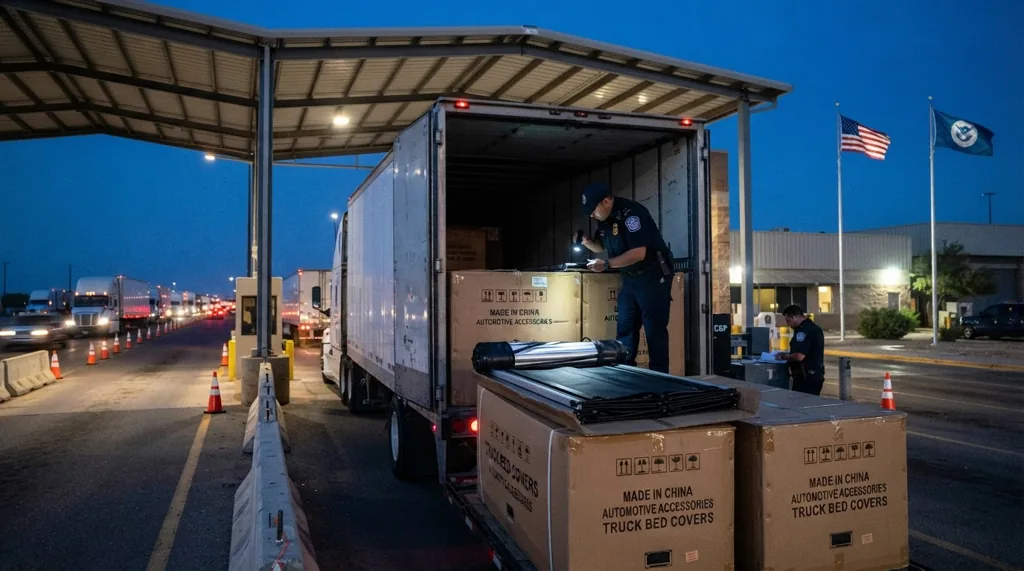
United States sets final anti-subsidy duties of 11.60% to 142.11% on Chinese truck bed covers, applicable from Oct. 19, 2026.
The U.S. Department of Commerce has set final anti-subsidy duty rates on truck bed covers from China, in a notice applicable from Oct. 19, 2026.
The final rates range from 11.60% to 142.11% of the goods’ value, depending on the Chinese company1. Most rates are much higher than the provisional rates Commerce set in July2.
In short, a U.S. importer of Chinese truck bed covers keeps paying a cash deposit at the border. After the final rates take effect, that deposit will be larger for most shippers.
What did Commerce decide on truck bed covers?
Commerce published its final decision in the Federal Register, the U.S. government’s daily journal of official notices. The notice finds that China gives subsidies to producers and exporters of truck bed covers1. A subsidy here means money or another benefit from a public body that helps a specific group of companies.
The duty that answers such subsidies is a countervailing duty, an extra import tax that cancels out a foreign government’s help to its makers. Commerce studied subsidies paid during calendar year 2025, from Jan. 1 to Dec. 31, 20251.
The final notice is dated Oct. 13, 2026, and is applicable from Oct. 19, 20261. Scot Fullerton, Acting Deputy Assistant Secretary for Antidumping and Countervailing Duty Operations, signed it1.
Why did Commerce act on Chinese truck bed covers?
The case began with a complaint from a U.S. maker. On Feb. 25, 2026, Commerce received a petition from RealTruck, a domestic producer of truck bed covers3. RealTruck is based in Ann Arbor, Michigan, according to the U.S. International Trade Commission (ITC)4.
RealTruck said the Chinese government was paying subsidies to producers of truck bed covers in China3. It said these imports were hurting U.S. makers or threatening to hurt them3. It pointed to a large rise in imports, lost market share, lower prices, lost sales and weaker financial results3.
Commerce found that the petition had enough support from the U.S. industry3. It opened the investigation in a notice published on March 20, 20263. Commerce agreed to investigate 24 alleged subsidy programs3. The petition named 30 Chinese companies as producers or exporters of the covers3.
Which companies get which subsidy rates?
Commerce examined two Chinese companies in detail. These were Changzhou Sunwood International Trading Co., Ltd. (Sunwood) and Hangzhou Golden Sun Auto Parts Co., Ltd. (Golden Sun)1. Commerce staff checked their records on site in September 20261.
Final anti-subsidy duty by exporter, %
The final rates are a percentage of the value of the goods1:
- Sunwood: 77.17%, calculated from its own data.
- Golden Sun: 11.60%, calculated from its own data.
- Six other named exporters: 142.11% each.
- All other Chinese producers and exporters: 43.43%.
The six companies with the top rate are Century Distribution Systems (Shenzhen) Ltd, Foshan Baitai Auto Accessories Co, Shenzhen Haishang Wanyun Supply Chain Management Co., Ltd, Shenzhen Longhua Supply Chain Co., Ltd, Shenzhen Maichuang International and Shenzhen Qianhai Yahee E-Commerce Co., Ltd1. Their rate rests on "facts available with adverse inferences"1. In plain words, Commerce used the least favourable information on file because the companies did not cooperate. The notice says these were companies that did not answer its questionnaire on sales quantity and value1.
The rate for all other companies is a weighted average of the Sunwood and Golden Sun rates1. A Chinese exporter not named in the table pays this 43.43% rate.
How did the rates change since July?
Commerce set provisional rates on July 31, 20262. The final notice raised every rate1. The notice says Commerce changed its calculations for both examined companies, for all other companies and for the top rate1.
Provisional and final rates
| Exporter | July 31, 2026 | Final |
|---|---|---|
| Sunwood | 30.38% | 77.17% |
| Golden Sun | 8.72% | 11.60% |
| Six non-cooperating exporters | 100.95% | 142.11% |
| All other firms | 20.25% | 43.43% |
The changes are large:
- Sunwood rose from 30.38% to 77.17%2.
- Golden Sun rose from 8.72% to 11.60%2.
- The top rate for the six non-cooperating exporters rose from 100.95% to 142.11%2.
- The rate for all other companies rose from 20.25% to 43.43%2.
The final notice lists the issues argued by the companies and the U.S. industry1. Several were about the price benchmarks Commerce used for materials the companies bought. These included aluminium shapes (aluminum extrusions), polypropylene plastic and a moulding compound1. Other issues were land supplied by the state, a tax program for small firms, electricity costs and loans to Golden Sun1. The full reasons are in a separate decision memo that the notice does not reproduce.
Which truck bed covers are covered?
The duties cover truck bed covers, which are protective shields that span the open top of a pickup truck’s cargo area1. They can be made of aluminium, steel, fibreglass, carbon fibre, plastic or water-resistant fabric1. Once installed, they measure 45 to 75 inches wide and 55 to 100 inches long1.
The notice names four common types1:
- Folding covers, with two or more hinged panels.
- Roll-up covers, made of soft material with crossbars or of rigid slats.
- One-piece covers, rigid lids that open from the tailgate end.
- Retractable covers, which slide into a canister and may have a motor.
Electric models with key fobs, Bluetooth links or LED lights are also covered1. Fitting hardware is covered when it is shipped and invoiced with the cover. This includes rails, latches, clamps, bolts, seals, locks, struts and motors1. Hardware shipped on its own is also covered if it enters as a mounting or installation kit for a truck bed cover1.
Two groups of goods are left out. Truck caps, also called camper shells, toppers or canopies, are excluded1. These raise the truck bed by at least 12 inches and form a closed, lockable box. Goods already covered by the 2011 U.S. duty orders on Chinese aluminium extrusions are also excluded1.
The covers normally enter under tariff code 8708.29.5160 of the U.S. tariff schedule1. The written product description decides coverage, not the code1. Commerce noted that this code is a broad "basket" line that also holds other goods3.
How are duties collected at the border?
Collection started with the provisional decision. Commerce told U.S. Customs and Border Protection (CBP) to take cash deposits on covered goods entered on or after July 31, 20261. A cash deposit is money the importer pays at entry as security for the final duty.
Commerce also told CBP to suspend liquidation for these shipments1. Liquidation is the moment customs fixes the final duty on an import. While it is suspended, the final amount owed stays open.
At the provisional stage, the deposit followed the rate of the producer or exporter2. If the producer and exporter both had their own rates, the higher rate applied2. All other shippers paid the all-others rate2.
The final rates do not change deposits by themselves. If the ITC finds injury, Commerce will issue a duty order and require deposits at the final rates1. So a shipment from Sunwood would then need a deposit of 77.17% of its value, not 30.38%.
What does the separate dumping case add?
The same goods face a second case. RealTruck also filed an anti-dumping petition, a complaint that goods are sold in the United States below their normal price3. On Oct. 1, 2026, Commerce published a provisional finding that Chinese truck bed covers were sold below fair value5.
That notice set provisional dumping rates from 46.95% to 107.58%5. Cash deposits in that case are slightly lower, after an offset for some subsidies5. For example, the deposit rate for Golden Sun is 51.17%, and the rate for the China-wide group is 107.41%5.
An importer may therefore owe deposits under both cases on one shipment. The final dumping decision has been postponed at Golden Sun’s request5. It is due no later than 135 days after the October notice was published5.
When will the truck bed cover duties become final?
The next step belongs to the ITC, the U.S. agency that decides whether imports harm a domestic industry. Commerce will tell the ITC of its final decision1. The ITC will decide within 45 days whether U.S. makers are harmed or threatened with harm1.
Next dates in the ITC review
The ITC held a public hearing on the case on Oct. 15, 20264. Parties must file their final written briefs by Oct. 22, 20264. The ITC will release remaining information to parties on Nov. 4, 2026, and final comments are due by Nov. 6, 20264.
There are two possible results1:
- If the ITC finds injury, Commerce issues a countervailing duty order. CBP then collects deposits at the final rates.
- If the ITC finds no injury, the case ends. All deposits paid and bonds posted are refunded or cancelled.
Commerce will also share its calculations with the parties within five days1. A separate dispute about which products are covered is still open. Comments on that question are due after the final decision, so Commerce has not changed the product description yet1.
Key points on truck bed cover duties
The table sums up the final decision.
| Question | Answer |
|---|---|
| What changed? | Final anti-subsidy duty rates set |
| Who issued it? | U.S. Department of Commerce |
| Which goods? | Truck bed covers from China |
| Tariff code | 8708.29.5160 |
| Sunwood rate | 77.17% |
| Golden Sun rate | 11.60% |
| Six non-cooperating exporters | 142.11% |
| All other Chinese firms | 43.43% |
| What is excluded? | Truck caps and aluminium extrusions under 2011 orders |
| Who pays? | U.S. importers, through cash deposits |
| Applicable from | Oct. 19, 2026 |
| Next step | ITC injury vote within 45 days |
Cash deposits have applied since July 31, 2026, at the lower provisional rates1. If the ITC finds injury within 45 days, most importers will pay much higher deposits on Chinese truck bed covers1.
Sources
- ↩ Federal Register :: Truck Bed Covers From the People’s Republic of China: Final Affirmative Countervailing Duty Determination https://www.federalregister.gov/documents/2026/10/19/2026-21295/truck-bed-covers-from-the-peoples-republic-of-china-final-affirmative-countervailing-duty
- ↩ Federal Register :: Truck Bed Covers From China: Preliminary Affirmative Countervailing Duty Determination https://www.federalregister.gov/documents/2026/07/31/2026-15559/truck-bed-covers-from-china-preliminary-affirmative-countervailing-duty-determination
- ↩ Federal Register :: Truck Bed Covers From the People’s Republic of China: Initiation of Countervailing Duty Investigation https://www.federalregister.gov/documents/2026/03/20/2026-05536/truck-bed-covers-from-the-peoples-republic-of-china-initiation-of-countervailing-duty-investigation
- ↩ Federal Register :: Truck Bed Covers From China; Scheduling of the Final Phase of Countervailing Duty and Antidumping Duty Investigations https://www.federalregister.gov/documents/2026/08/10/2026-16195/truck-bed-covers-from-china-scheduling-of-the-final-phase-of-countervailing-duty-and-antidumping
- ↩ Federal Register :: Truck Bed Covers From the People’s Republic of China: Preliminary Affirmative Determination of Sales at Less Than Fair Value, Postponement of Final Determination, and Extension of Provisional Measures https://www.federalregister.gov/documents/2026/10/01/2026-20163/truck-bed-covers-from-the-peoples-republic-of-china-preliminary-affirmative-determination-of-sales