
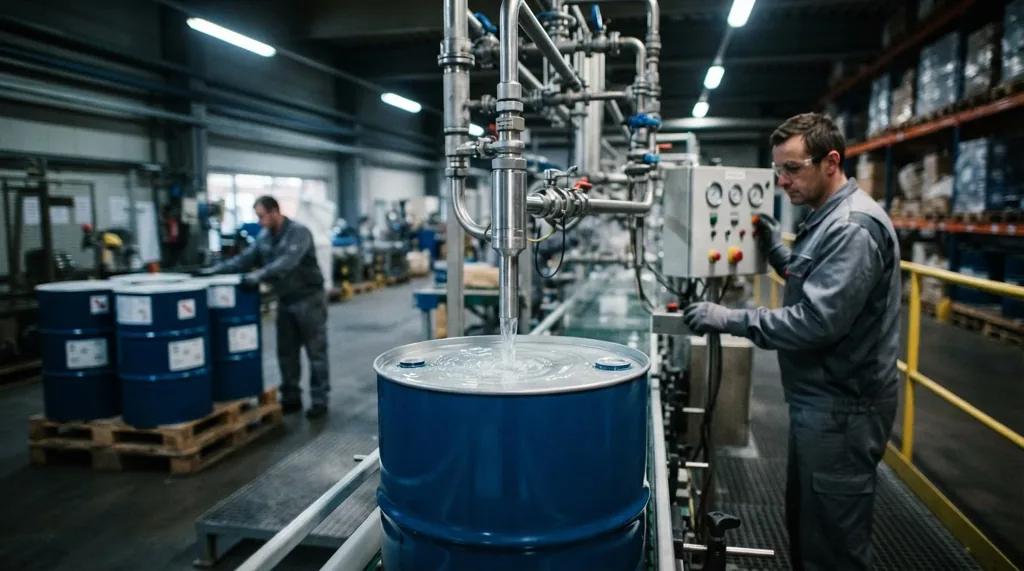
European Union opened an anti-dumping investigation into Chinese furfuryl alcohol on Oct. 16, 2026, with possible duties by June 2027.
The European Commission opened an anti-dumping investigation into furfuryl alcohol imported from China on Oct. 16, 20261.
The notice of initiation was published that day in the Official Journal of the European Union1. An anti-dumping investigation checks whether foreign goods are sold in the European Union (EU) below their normal price and whether this harms EU makers.
In short, no new duty applies yet, and shipments of furfuryl alcohol from China clear customs as before. But the Commission could set provisional duties by June 16, 2027, so buyers now face a price risk on future orders2.
What is furfuryl alcohol and which goods are covered?
Furfuryl alcohol is a chemical with the formula C4H3O-CH2OH1. The notice calls it "FA" and identifies it by its Chemical Abstracts Service (CAS) number, CAS 98-00-01. A CAS number is a unique code that chemists use to name one substance.
At the border, the goods fall under CN code ex 2932 13 00, with TARIC code 2932 13 00 301. The CN code is the EU’s product code for customs, and TARIC is its more detailed EU tariff code. The "ex" means only part of that code is covered.
The Commission says the codes are given for information only1. The product description in the notice decides what is covered, not the code. Only furfuryl alcohol that originates in China is under investigation1.
Who asked the Commission for the investigation?
Two companies lodged the complaint on Sept. 2, 20261. They are:
- TransFurans Chemicals BV, referred to in the notice as TFC.
- International Furan Chemicals BV, referred to in the notice as IFC.
The Commission accepted that the complaint was made by the EU industry for furfuryl alcohol1. It names TransFurans Chemicals BV as the known EU producer that will receive its questionnaire3.
The complainants say that the volume of Chinese imports is significant1. They also say that falling import prices pushed down the prices charged by EU makers. According to the complaint, this caused "substantial adverse effects" on their finances1.
Why does the complaint say Chinese prices cannot be used?
Normally, dumping is measured by comparing the export price with the price in the home market. The complainants argue that this comparison does not work for China1. They say that prices and costs there are bent by "significant distortions", meaning heavy state influence on the economy.
To support this, they used a Commission report on distortions in China’s economy, dated April 10, 20241. They pointed to state presence in the chemicals sector. They also pointed to distorted costs for land, energy, capital, raw materials and labour1.
The complainants also cited Chinese plans and laws. These include the 14th and 15th Five-Year Plans and an action plan for non-grain bio-based materials1. They also cited guidance from Henan province and China’s laws on state-owned assets and companies1.
The Commission found enough evidence to start the case on this basis1. The EU anti-dumping law, Regulation (EU) 2016/1036, allows this method1.
How will the dumping margin be measured?
The dumping margin is the gap between the fair price and the export price. Here, the fair price, called the normal value, will be built from costs taken from a country without such distortions1.
The complaint proposes South Africa as the comparison country1. The Commission also names South Africa as a possible choice1. It will look for a country with a similar level of development to China, with production of furfuryl alcohol and with data that is easy to find.
Both prices are compared at the factory gate, called the "ex-works" level1. The complainants say the margins found this way are significant1. The notice does not publish a figure for them.
Which period will the Commission examine?
The investigation of dumping and harm covers July 1, 2025 to June 30, 20261. The Commission calls this the investigation period.
To judge trends in the harm to EU makers, it will look further back. That period runs from Jan. 1, 2023 to the end of the investigation period1. Import volumes, prices and the EU industry’s results across these years will shape the findings.
What must Chinese exporters and EU importers do?
The Commission may pick a sample of companies to study instead of all of them1. This is called sampling, and it applies to Chinese exporters and to EU importers that are not linked to them.
Days allowed after the Oct. 16 notice, by task
For Chinese exporters, the steps are:
- Send company details through TRON, the Commission’s online trade defence system, within 7 days of publication1.
- Send details of raw materials and energy used in production within 15 days1.
- If sampled, return a full questionnaire within 30 days of being told1.
Exporters that agree to be sampled but are not chosen count as cooperating1. Their duty, if any, will not exceed the weighted average dumping margin of the sampled companies1. They may also ask for their own margin by returning the questionnaire within 30 days1.
Importers not linked to Chinese exporters must send the company information listed in the notice’s annex within 7 days3. If chosen for the sample, they must return a questionnaire within 30 days of being told3. Users of furfuryl alcohol can also send information through a separate users’ questionnaire3.
Which deadlines follow the Oct. 16 notice?
Most deadlines count from the publication date, Oct. 16, 20261. Missing them can leave a company outside the case.
Deadlines counted from the Oct. 16, 2026 notice
| Deadline | Who | What is due |
|---|---|---|
| Oct. 23, 2026 | Exporters, importers, other EU producers | Sampling details or contact |
| Oct. 26, 2026 | All interested parties | Comments on products covered |
| Oct. 31, 2026 | Chinese producers and others | Hearing requests, input data, comparison country |
| Nov. 22, 2026 | All interested parties | Comments on complaint and EU interest |
| Dec. 20, 2026 | All interested parties | Public cost and price facts |
The main deadlines are:
- 7 days (Oct. 23, 2026): sampling details from exporters and importers, and contact from other EU producers3.
- 10 days (Oct. 26, 2026): comments on which products the case covers1.
- 15 days (Oct. 31, 2026): requests for a hearing, input data from Chinese producers, and proposals for a comparison country1.
- 37 days (Nov. 22, 2026): comments on the complaint, views on the distortion method, and information on the EU interest3.
- 65 days (Dec. 20, 2026): factual information on costs and prices from public sources1.
Hearings requested within 15 days will normally take place within 60 days of publication3.
Could the EU decide against duties?
Yes. Even if dumping and harm are found, the Commission must ask whether duties would go against the wider EU interest3. This test looks at more than the complaining producers.
EU producers, importers, users, trade unions and consumer groups can all send views3. They must show a real link between their work and furfuryl alcohol. Their information counts only if facts support it when it is sent3.
The EU law also says duties should be lower than the dumping margin when a lower rate would remove the harm4. Cases must end where dumping or harm is very small4.
When could duties on Chinese furfuryl alcohol start?
The Commission’s case page, for case AD763, gives an indicative timetable2. It says only the deadlines in the law and the notice are binding.
Indicative case timetable
The timetable shows these key dates2:
- Verification visits: between Dec. 31, 2026 and Feb. 15, 2027, to check companies’ answers.
- Early notice of planned provisional duties: May 18, 2027.
- Provisional duties: no later than June 16, 2027.
- Definitive duties or end of the case: no later than Dec. 15, 2027.
Provisional duties, if imposed, can last up to 6 months in an anti-dumping case2. Definitive duties are normally set for 5 years2. A review can be asked for one year after they start, at the earliest2.
The EU law says cases should normally end within 12 months, and never after more than 15 months4. It also allows customs to register imports during the case4. Registration would let duties be charged later on goods already shipped.
Key points on the furfuryl alcohol investigation
The table sums up the main facts of the case.
| Question | Answer |
|---|---|
| What happened? | EU opened an anti-dumping investigation |
| Who acted? | European Commission |
| Which goods? | Furfuryl alcohol, CAS 98-00-0 |
| Customs code | CN ex 2932 13 00, TARIC 2932 13 00 30 |
| Which country? | China |
| Who complained? | TransFurans Chemicals BV and International Furan Chemicals BV |
| Notice published | Oct. 16, 2026 |
| Investigation period | July 1, 2025 to June 30, 2026 |
| Comparison country proposed | South Africa |
| First deadline | Oct. 23, 2026, for sampling details |
| Provisional duties by | June 16, 2027 |
| Final decision by | Dec. 15, 2027 |
No duty applies to furfuryl alcohol from China today. The first test comes on Oct. 23, 2026, when exporters and importers must send sampling details to the Commission1.
Sources
- ↩ EUR-Lex – 52026XC05408 – EN – EUR-Lex https://eur-lex.europa.eu/eli/C/2026/5408/oj/eng
- ↩ Trade defence investigations https://tron.trade.ec.europa.eu/investigations/case-view?caseId=2912
- ↩ C_202605408EN.000101.fmx.xml https://eur-lex.europa.eu/legal-content/EN/TXT/HTML/?uri=OJ:C_202605408
- ↩ Regulation – 2016/1036 – EN – EUR-Lex https://eur-lex.europa.eu/eli/reg/2016/1036/oj/eng