
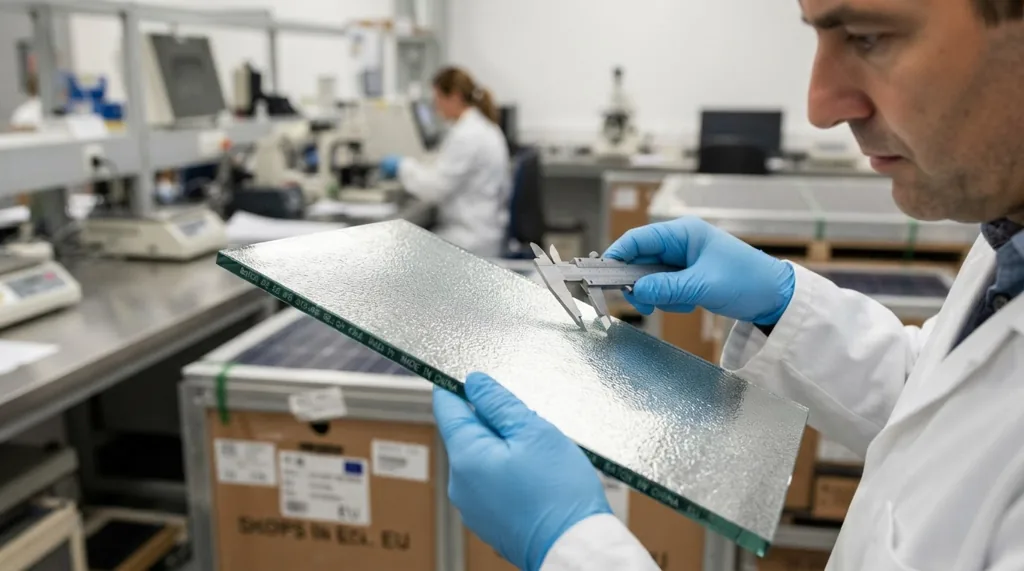
European Union removes its anti-dumping duty of up to 75.4% on Chinese solar glass, in a regulation published Oct. 21, 2026.
The European Commission has repealed its anti-dumping duty on solar glass from China, in a regulation published on Oct. 21, 2026.
The decision is Commission Implementing Regulation (EU) 2026/2314 of Oct. 19, 2026, published in the Official Journal of the European Union1. It ends an extra import tax that has applied to Chinese solar glass since 2014.
In short, solar glass from China will no longer carry the extra anti-dumping charge at the European Union (EU) border. On the same day, a second regulation also repealed the separate anti-subsidy duty on the same glass2.
What is changing for Chinese solar glass?
An anti-dumping duty is an extra import tax on goods sold abroad below their normal price. The EU first set this duty on Chinese solar glass in Implementing Regulation (EU) No 470/20141. It changed the duty level in 2015 and extended it for five more years in 20201.
Until now, individual company rates ran from 17.5% to 75.4%1. All other Chinese companies paid a country-wide rate of 67.1%1. The new regulation repeals this duty after an expiry review, a check on whether a duty is still needed when it is due to end1.
Is the anti-subsidy duty also going?
Yes. A countervailing duty is a different extra tax, aimed at goods made with help from foreign government subsidies. The Commission set one on Chinese solar glass in May 2014 and extended it in 20202.
The two duties on Chinese solar glass
| Question | Anti-dumping duty | Anti-subsidy duty |
|---|---|---|
| Company rates | 17.5% to 75.4% | 3.2% to 17.1% |
| Rate for all others | 67.1% | 17.1% |
| Repealed by | Regulation (EU) 2026/2314 | Regulation (EU) 2026/2310 |
Its rates ran from 3.2% to 17.1%, with a country-wide rate of 17.1%2. Commission Implementing Regulation (EU) 2026/2310, also dated Oct. 19, 2026, repeals the countervailing duties on the same goods2. With both regulations, both trade defence charges on this glass come off together.
Which solar glass do the repeals cover?
The goods are tempered flat glass made from soda-lime glass with very little iron. The regulation defines them by five technical tests1:
- Iron content: less than 300 parts per million.
- Light passing through: solar transmittance of more than 88%.
- Heat resistance: up to 250 °C, measured under standard EN 12150.
- Thermal shock: resistance to a 150 K temperature change, also under EN 12150.
- Strength: 90 N/mm2 or more, measured under standard EN 1288-3.
Glass that meets these tests was covered whatever its use1. That includes solar panels, flat solar water heaters, furniture and greenhouses1.
The glass may be patterned or plain, clear or diffuse, drilled or printed with ceramic colours1. It often has an anti-reflective coating, or thin layers for self-cleaning or hardness1.
Which customs codes are affected?
The glass falls under part of Combined Nomenclature (CN) code ex 7007 19 80, the EU’s goods code list1. The detailed TARIC codes, the EU’s integrated tariff codes, are 7007 19 80 12, 7007 19 80 18, 7007 19 80 80 and 7007 19 80 851.
Only glass that originates in China was covered1. Importers and customs brokers will recognise these codes on past entries that carried the duty.
Why did the Commission review the solar glass duties?
The duties were due to expire after five years. After a notice of upcoming expiry, two companies asked for a review on April 18, 20251. They were Interfloat Corporation and GMB Glasmanufaktur Brandenburg GmbH, together called the Interfloat Group1.
They argued that dumping would continue and that harm to EU glass makers would return without the duty1. The Commission opened the review on July 22, 20251. The investigation covered sales from July 1, 2024 to June 30, 20251. For trends in harm, it looked back to Jan. 1, 20221.
What did the investigation find about EU makers?
The EU industry was small. The two sampled groups were AGC Glass Europe and the Interfloat Group, with GMB1. Together they made about 70% of EU production and sales1.
Both producers stopped production in early 20251. GMB filed for insolvency in November 2025 and twice cancelled planned Commission visits at short notice1. AGC could not receive the Commission’s team because its production had stopped1.
As a result, much of the information was never sent, and the Commission could not check it1. The applicants also failed to submit a key industry-wide questionnaire despite several requests1.
How much Chinese glass reached the EU market?
Chinese solar glass still arrived during the review period. Its share of the EU market was about 3%, according to Eurostat, the EU statistics office1. That compares with 30.5% during the original investigation and 9% at the last expiry review1.
Chinese solar glass share of the EU market, %
No Chinese exporting producer took part in the review1. China’s government did not answer the Commission’s questionnaire or its diplomatic note of Nov. 5, 20251.
Who took part in the solar glass review?
Users of the glass were more active than producers. Three users answered questionnaires: Soli Tek, SOLVIS and Bisol1. Bisol’s reply was very incomplete, and the company did not answer follow-up questions1.
Solar Heat Europe, a group for companies in solar heating, had a hearing with the Commission on May 11, 20261. One importer, Sunerg Solar Energy, did not answer its questionnaire1.
What changes for importers and buyers?
For EU importers, the change is direct. Customs will no longer charge the anti-dumping duty or the countervailing duty on this Chinese glass once the repeals apply1. The anti-subsidy repeal covers the same four customs codes2.
Makers of solar panels, solar water heaters and greenhouses in the EU buy this glass. They can now source it from China without rates that reached 75.4% for some suppliers1. Chinese exporters can price their glass to EU buyers without the extra tax.
What were the final steps before the repeal?
The Commission told all parties on Aug. 28, 2026 that it planned to repeal the duties1. It gave them time to comment. No comments came in, and no party asked for a hearing1.
The solar glass review, step by step
The Commission’s case page lists this review as case R8393. It shows Sept. 7, 2026 as the last date for comments on the final disclosure3. It gave Oct. 20, 2026 as the indicative date to end the review3.
Key points on the EU solar glass duty repeal
The table sums up the main facts from the article.
| Question | Answer |
|---|---|
| What changed? | Anti-dumping duty on solar glass repealed |
| Who issued it? | The European Commission |
| Which regulation? | Implementing Regulation (EU) 2026/2314 |
| Date of the regulation | Oct. 19, 2026 |
| Published | Oct. 21, 2026 |
| Which goods? | Tempered low-iron solar glass |
| Origin covered | China |
| Customs code | ex 7007 19 80 |
| Old anti-dumping rates | 17.5% to 75.4%, 67.1% for others |
| Anti-subsidy duty | Also repealed, by Regulation 2026/2310 |
| EU market share of Chinese glass | About 3% |
Both regulations appeared in the Official Journal on Oct. 21, 20262. Together they end the extra duties on Chinese solar glass that began in 2014.
Sources
- ↩ Implementing regulation – EU – 2026/2314 – EN – EUR-Lex https://eur-lex.europa.eu/eli/reg_impl/2026/2314/oj
- ↩ Implementing regulation – EU – 2026/2310 – EN – EUR-Lex https://eur-lex.europa.eu/eli/reg_impl/2026/2310/oj
- ↩ Trade defence investigations https://tron.trade.ec.europa.eu/investigations/case-view?caseId=2806