
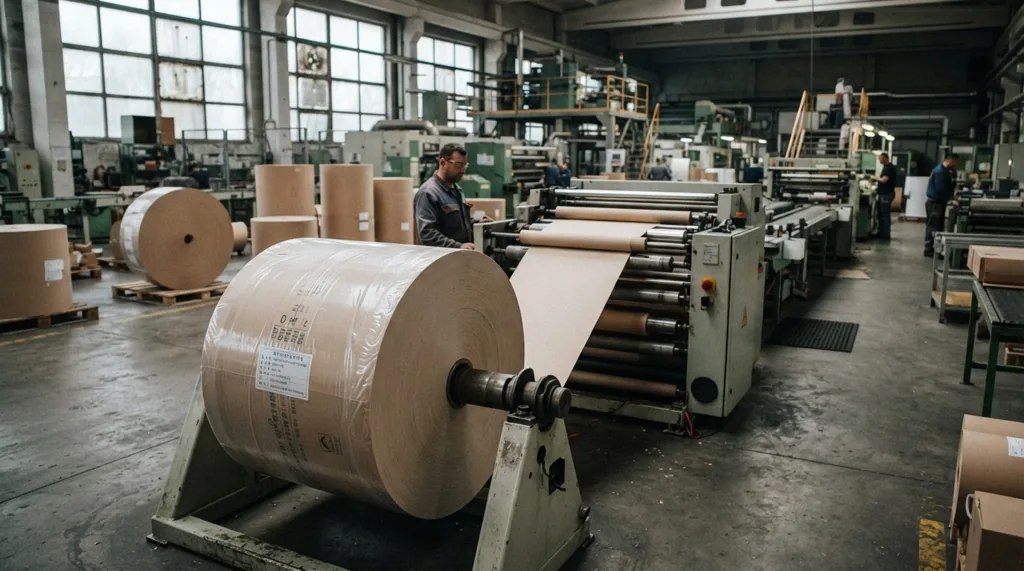
European Union keeps its 15.8% extra import tax on Korean heavyweight thermal paper rolls, in a regulation published Oct. 20, 2026.
The European Commission has extended its anti-dumping duty on heavyweight thermal paper from South Korea, in a regulation dated Oct. 19, 2026.
The decision is Commission Implementing Regulation (EU) 2026/2311, published in the Official Journal of the European Union on Oct. 20, 20261. It follows an expiry review, a check on whether a duty should continue when it reaches its end date.
In short, rolls of heavy thermal paper made in Korea will keep paying an extra import tax when they enter the European Union (EU). The duty in force before the review was 15.8%, and the Commission said it intended to keep it1.
What is the duty on Korean thermal paper?
An anti-dumping duty is an extra import tax on goods sold abroad below their normal price. The EU first put this duty on Korean heavyweight thermal paper in Implementing Regulation (EU) 2020/15241. The rate in force when the review ended was 15.8%1.
On June 30, 2026, the Commission told the parties the main facts behind its plan. It said it intended to maintain the anti-dumping duties in force1. The new regulation imposes a definitive duty, a final duty rather than a temporary one, after that review2.
The text of the regulation available for this report gives the reasons and the findings. Its operative articles were not part of the text read, so this report does not state a new end date.
Which thermal paper goods does the duty cover?
The duty covers one kind of specialty paper. Heat from a printer forms the image on it, so it needs no ink1. It is used mainly for self-adhesive labels on packaging, and also for tickets and tags1.
What a roll must be to pay the duty
| Feature | Condition |
|---|---|
| Paper weight | Above 65 g/m2 |
| Roll size | At least 20 cm wide, 50 kg or more, 40 cm diameter or more |
| Coating | Heat-sensitive coating on one or both sides |
| Origin | Republic of Korea |
The paper must meet all of these points to fall under the duty1:
- Weight above 65 g/m2, meaning more than 65 grams per square metre of paper.
- Large rolls only, at least 20 cm wide, weighing 50 kg or more, with a diameter of 40 cm or more. The trade calls these "jumbo rolls".
- A heat-sensitive coating on one or both sides. This is a mix of dye and a developer that forms an image when heated.
- With or without a base coat or a top coat.
So the duty hits the big parent rolls that converters cut into labels and tickets. Small finished till rolls do not match this description.
Which customs codes are affected?
Customs classifies the paper under three Combined Nomenclature (CN) codes, the EU’s tariff list1. Only part of each code is covered, which the EU marks with "ex":
- ex 4809 90 00, under TARIC code 4809 90 00 20.
- ex 4811 59 00, under TARIC code 4811 59 00 20.
- ex 4811 90 00, under TARIC code 4811 90 00 20.
TARIC is the EU’s detailed customs tariff database. The 2025 review notice says these codes are given for information only3. The product description decides whether a roll pays the duty, not the code alone.
The duty applies to paper that originates in the Republic of Korea1. Thermal paper from other countries is not part of this measure.
Why did the Commission keep the duty?
The European Thermal Paper Association (ETPA), the group of EU makers, asked for the review on July 16, 20253. It said that ending the duty would likely bring more dumping and fresh harm to EU producers3.
The Commission opened the review on Oct. 17, 20251. It studied prices from July 1, 2024 to June 30, 2025. For trends in the market, it looked back to Jan. 1, 20221.
No Korean producer cooperated with the investigation1. The Commission therefore used "facts available", a rule that lets it rely on other data. These included company websites, the industry’s request and official import statistics1.
How large was the price gap?
The Commission built an estimate of the normal price in Korea from production costs. These were pulp, chemicals, labour, energy and factory costs, plus a margin for sales costs and profit1. This gave a factory-gate price of EUR 2,060 per tonne1.
It then took the price of Korean paper arriving in the EU from Eurostat, the EU’s statistics office. After removing transport and insurance costs, the export price at the factory was EUR 1,827.70 per tonne1.
The gap between the two prices was 11.4% of the price at the EU border1. The Commission said the real margin could be higher, because it chose not to make cuts that would have lowered the export price further1. It concluded that dumping continued during the review period1.
How much Korean paper still reaches the EU?
Korean shipments have fallen sharply since the first case. In the original investigation period, from July 2018 to June 2019, imports were 18,500 to 20,500 tonnes1. In the review period they were 2,036 tonnes1.
Korean heavyweight thermal paper sent to the EU, tonnes
Korea’s share of the EU market dropped from 10 to 11% to 2.5%1. The volume fell by more than 80%1.
Even with the duty, yearly exports to the EU often passed 4,000 tonnes. They reached 7,740 tonnes in 20231. The Commission called these volumes "non-negligible"1.
Who makes the paper in Korea?
The regulation names Hansol Paper as the only Korean exporting producer in both investigation periods1. It describes Hansol Paper as by far the largest Korean maker of this paper1. One other Korean producer has a capacity of 15,000 tonnes a year, according to the industry’s request1.
The Commission said Korean capacity is large. Estimates for the division that includes this paper range from 275,000 to 355,000 tonnes a year1. Korea made some 240,000 tonnes of thermal paper in 20211.
The Korean home market for heavyweight thermal paper is small, at about 23,100 tonnes in 20211. Capacity is at least five times bigger than Korean use, the Commission found1. It also noted that Hansol Paper has said it wants to grow its thermal paper business1.
Why does the EU market matter to Korean makers?
The Commission said the EU is the largest single market for heavyweight thermal paper1. World use was estimated at around 776,000 tonnes in 20261. Europe and North America together use more than half of it1.
EU buyers pay more for phenol-free grades, a more expensive paper. The EU, along with Switzerland, Japan, South Korea and some US states, bans home use of cheaper grades that contain BPA, a chemical1. In the United States, duties on Hansol Paper’s thermal paper were recently reviewed to 0%1.
The Commission found that Hansol Paper still shows its products at label fairs in the EU1. It said this shows the company could raise sales quickly if the duty ended1. It concluded there was a strong likelihood that dumping would continue without the duty1.
Who is affected by the decision?
EU importers of Korean jumbo rolls keep paying the duty on top of normal customs charges. No unrelated importer came forward to take part in the review1.
EU label and ticket converters that buy Korean parent rolls face the same cost as before. The Commission noted that the EU hosts a wide range of these converters, some working worldwide1.
EU paper makers keep the protection they asked for. Nine EU producers made the paper during the period studied1. The Commission checked data at three of them: Jujo Thermal Oy in Finland, and Kanzan Spezialpapiere GmbH and Koehler Paper SE in Germany1. Total EU output in the review period was around 158,241 tonnes1.
Korean exporters keep the same cost at the EU border. Because none cooperated, none received a separate rate in this review1.
What were the key dates in the review?
The review followed a clear path, set by the 2025 notice and the final regulation3:
- July 16, 2025: ETPA filed its request for review3.
- Oct. 17, 2025: the Commission opened the expiry review1.
- Oct. 30, 2025: the sample of three EU producers was confirmed1.
- Nov. 14, 2025: deadline for Korea’s mission to the EU to comment on the use of facts available1.
- June 30, 2026: the Commission shared its findings with the parties1.
- Oct. 19, 2026: the Commission adopted Regulation 2026/23111.
- Oct. 20, 2026: the regulation was published in the Official Journal1.
How the review unfolded
Only the industry group sent comments on the final findings. No other party responded1.
Key points on Korean heavyweight thermal paper
The table sums up the decision.
| Question | Answer |
|---|---|
| What changed? | Anti-dumping duty kept after expiry review |
| Who issued it? | European Commission |
| Legal act | Implementing Regulation (EU) 2026/2311 |
| Date adopted | Oct. 19, 2026 |
| Date published | Oct. 20, 2026 |
| Which goods? | Heavyweight thermal paper in jumbo rolls |
| Origin | Republic of Korea |
| Duty rate in force | 15.8% |
| Customs codes | ex 4809 90 00, ex 4811 59 00, ex 4811 90 00 |
| Dumping margin found | 11.4% |
| Who asked for review? | European Thermal Paper Association |
| Main Korean exporter | Hansol Paper |
With the regulation published on Oct. 20, 2026, Korean jumbo rolls of heavyweight thermal paper keep paying the duty at the EU border1. Importers and converters buying these rolls carry the same extra cost as before.
Sources
- ↩ L_202602311EN.000101.fmx.xml https://eur-lex.europa.eu/legal-content/EN/TXT/HTML/?uri=OJ:L_202602311
- ↩ Implementing regulation – EU – 2026/2311 – EN – EUR-Lex https://eur-lex.europa.eu/eli/reg_impl/2026/2311/oj
- ↩ EUR-Lex – 52025XC05537 – EN – EUR-Lex https://eur-lex.europa.eu/eli/C/2025/5537/oj/eng