
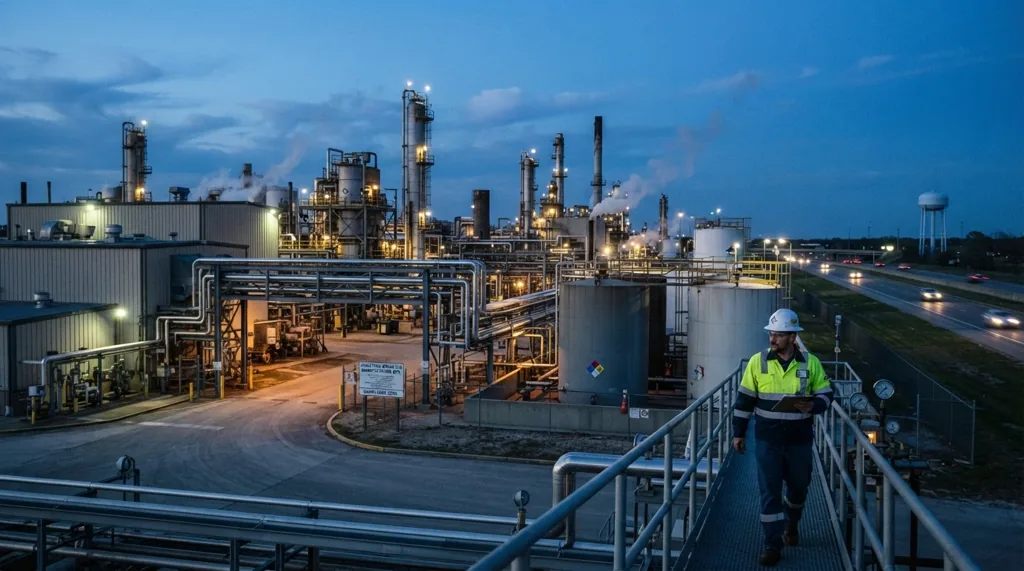
United States of America has extended compliance deadlines for Trichloroethylene (TCE) restrictions under the Toxic Substances Control Act, allowing businesses additional time to meet regulatory requirements.
The United States Environmental Protection Agency (EPA) proposed on Oct. 14, 2026, to delay several bans on the industrial chemical trichloroethylene until Dec. 31, 20271.
Trichloroethylene (TCE) is a chlorinated solvent used to make other chemicals, refrigerants and battery parts. The proposal was published in the Federal Register, and the public can comment until Nov. 13, 20261.
In short, some chemical plants could keep processing and using TCE for about one more year. Makers of one refrigerant could also keep using larger amounts of TCE for about six more months.
What is EPA changing for trichloroethylene?
The proposed rule moves three sets of deadlines from the 2024 TCE rule and a 2025 follow-up rule2. It does not cancel any ban. It only changes when each ban starts.
TCE deadlines, current and proposed
| Requirement | Current date |
|---|---|
| Ban on processing TCE and processing aids | Dec. 18, 2026 |
| Ban on related wastewater disposal | Dec. 18, 2026 |
| HFC-134a makers cut TCE to 75% of baseline | June 7, 2027 |
The changes are:
- Processing and processing aids: the ban on processing TCE into other chemicals, and on using it as a helper chemical in certain factories, would move from Dec. 18, 2026, to Dec. 31, 20272.
- Wastewater: the ban on sending TCE from those activities into wastewater treatment would move to the same date2.
- Refrigerant feedstock: makers of the refrigerant HFC-134a would have until Dec. 31, 2027, instead of June 7, 2027, to cut their TCE use to 75% of their baseline2.
A fourth change updates the warning text that sellers must pass down the supply chain. That text must match the new dates2.
Why does the TSCA rule matter to importers?
The rule rests on the Toxic Substances Control Act (TSCA), the main US law on chemical safety. Under this law, "manufacture" includes importing a chemical into the US customs territory2. Importers of TCE therefore follow the same rules as US producers once the chemical enters the country2.
The 2024 TCE rule bans the manufacture, import, processing and sale of TCE for all uses2. These include industrial, commercial and consumer uses. Some uses received longer phase-out periods, with worker protections in place until the bans start2.
The 2024 rule took effect on Jan. 16, 20253. EPA said it acted to prevent serious illness from uncontrolled contact with the chemical3. It also aimed to keep TCE away from consumers3.
Which factories and products are covered?
The delay covers TCE used as a processing aid, a chemical that helps make a product but is not part of the final good. The proposal lists these uses2:
- Battery making: a process solvent used in battery manufacture.
- Polymer fibers and rubber: a solvent used in spinning polymer fibers, in fluoroelastomer making and in Alcantara making.
- Caprolactam: an extraction solvent used to make caprolactam, a raw material for nylon.
- Beta-cyclodextrin: a chemical used to separate out beta-cyclodextrin during its production.
The delay also covers TCE processed as a reactant or intermediate. That means TCE used as a building block to make another chemical2.
EPA lists the types of businesses that may be affected2. They include chemical makers, storage battery makers, makers of rubber hoses and belts, and makers of wood windows and doors2. Medicinal and botanical product makers are also on the list2.
Why did EPA propose the delay?
EPA said chemical companies told it about serious problems soon after the 2024 rule2. Leftover TCE, a byproduct, is often found in chemical streams above the legal limit2. These streams travel by railcar between plants, usually plants of the same company2.
If the ban starts on Dec. 18, 2026, that transfer would stop2. Plants could not process the byproduct TCE or send it to wastewater. They would have to burn it in incinerators instead2.
EPA said this could break plant permit limits and could even close some plants2. Companies warned it would disrupt US supplies of other solvents2. These solvents include perchloroethylene, carbon tetrachloride, methylene chloride and 1,2-dichloroethane2.
EPA said it did not foresee these effects in 2024 or 20252. The 2024 rule gave two years for this deadline. EPA said an extra year at most is "as soon as practicable" and still allows a reasonable transition2.
What changes for HFC-134a refrigerant makers?
HFC-134a is a refrigerant gas, known by its chemical name 1,1,1,2-tetrafluoroethane2. It is made by processing TCE as a starting chemical. Under the 2024 rule, makers had to cut their TCE use to 75% of their baseline by June 7, 20272.
After the 2024 rule, the company Orbia Fluor & Energy Materials (Orbia) gave EPA new information2. It said military, industrial and medical users still need HFC-134a at higher rates than the rule assumed2.
Orbia has received more permits to make HFC-134a than expected under a separate refrigerant law, the AIM Act2. Demand from national security and critical infrastructure users should stay high through the early 2030s2. EPA said the June 2027 date would force makers to cut production before demand falls2. It proposes an extension of no more than 6 and a half months2.
How do the 2025 nuclear fuel and wastewater changes fit in?
This is not the first change to the 2024 rule. In September 2025, EPA issued an interim final rule, a rule that takes effect before public comment4. It took effect on Sept. 15, 20254.
That 2025 rule moved the ban on TCE used to make nuclear fuel to Sept. 15, 20284. It also moved the wastewater ban for chemical processors from Sept. 15, 2025, to Dec. 18, 20264. That matched the wastewater ban to the processing ban2.
EPA said the 2025 changes fixed oversights in the original rule4. Some plants had warned they could not meet the old dates4. The new October 2026 proposal would now move the Dec. 18, 2026, wastewater date again, to Dec. 31, 20272.
What must sellers of TCE update on safety data sheets?
The 2024 rule requires sellers to tell their customers about the TCE limits. They do this in the safety data sheet (SDS), the document that travels with a chemical and describes its hazards2. This is called downstream notification.
The deadlines to update the SDS text, June 16, 2025, and Dec. 16, 2025, have already passed2. So makers, importers and distributors may need to change their sheets again soon2. EPA proposes they get 30 days after the final rule is published to do so2.
What does the delay cost or save?
EPA said the changes would have small economic effects. They would mostly delay when costs and benefits begin2. EPA estimates present-value cost savings of $0.62 million to $0.65 million2.
EPA’s estimated cost savings, USD million
It estimates forgone health benefits of $3,795 to $7,8442. Annual cost savings would be $0.04 million to $0.06 million over 20 years2. Savings would likely grow if EPA chooses a longer extension in the final rule2.
What happens next for the TCE deadlines?
The proposal is not yet law. The current dates stay in place until EPA issues a final rule. Comments must reach EPA by Nov. 13, 20261. By Oct. 18, 2026, the docket showed 3 comments received1.
Key TCE dates
EPA said the proposed dates may change, depending on the timing of the final rule and the comments2. It is also running a separate rule review of other parts of the 2024 TCE rule2. That review covers workplace exposure controls and some industrial and commercial uses2.
The 2024 rule also faces court challenges2. Petitions for review were combined in the US Court of Appeals for the Third Circuit2. EPA has said it intends to reconsider the 2024 rule2.
Three industry groups had also asked EPA to change the rule in 2025, then withdrew their requests2. They were the American Chemistry Council, PPG Industries and a battery sector alliance with Microporous2. EPA said it may still address some of their points later2.
Key points on the TCE deadline extensions
The table sums up the proposal.
| Question | Answer |
|---|---|
| What changed? | Proposal to delay some TCE bans |
| Who issued it? | US Environmental Protection Agency |
| Under which law? | Toxic Substances Control Act |
| Which chemical? | Trichloroethylene (TCE) |
| Are importers covered? | Yes, import counts as manufacture |
| Main new date | Dec. 31, 2027 |
| Old processing ban date | Dec. 18, 2026 |
| Old HFC-134a cut date | June 7, 2027 |
| HFC-134a limit | 75% of baseline |
| Safety data sheet update | 30 days after final rule |
| Comment deadline | Nov. 13, 2026 |
Until EPA issues a final rule, the Dec. 18, 2026, processing and wastewater bans remain on the books. The comment period closes on Nov. 13, 20261.
Sources
- ↩ Federal Register :: Trichloroethylene (TCE); Regulation Under the Toxic Substances Control Act (TSCA); Compliance Date Extensions https://www.federalregister.gov/documents/2026/10/14/2026-20964/trichloroethylene-tce-regulation-under-the-toxic-substances-control-act-tsca-compliance-date
- ↩ Administrator. https://www.federalregister.gov/documents/full_text/xml/2026/10/14/2026-20964.xml
- ↩ Federal Register :: Trichloroethylene (TCE); Regulation Under the Toxic Substances Control Act (TSCA) https://www.federalregister.gov/documents/2024/12/17/2024-29274/trichloroethylene-tce-regulation-under-the-toxic-substances-control-act-tsca
- ↩ Federal Register :: Trichloroethylene; Regulation Under the Toxic Substances Control Act (TSCA); Compliance Date Extension https://www.federalregister.gov/documents/2025/09/17/2025-17948/trichloroethylene-regulation-under-the-toxic-substances-control-act-tsca-compliance-date-extension