
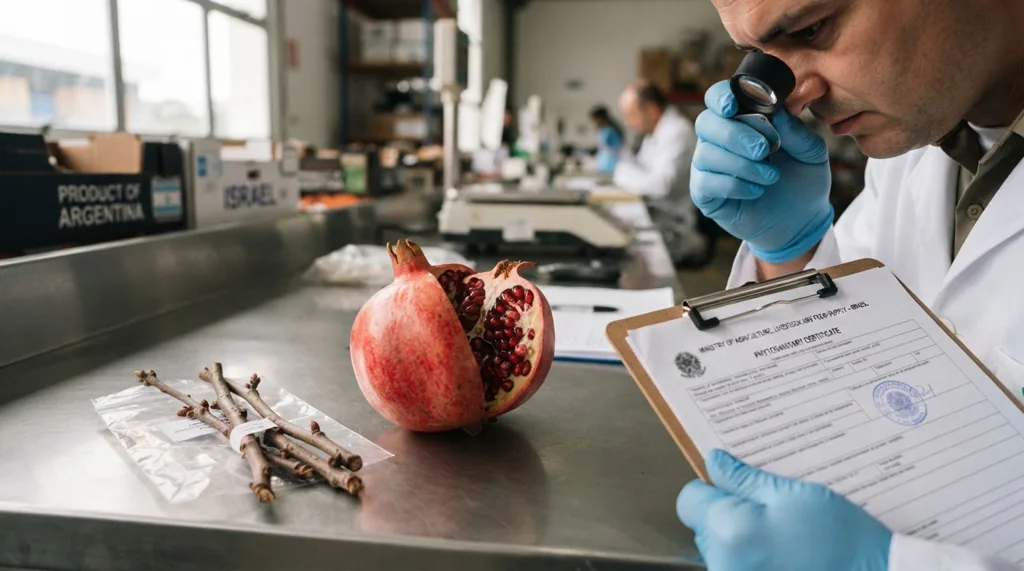
Brazil has updated phytosanitary requirements for the importation of pomegranate cuttings and fruits from Israel and Argentina, requiring accompanying phytosanitary certificates and additional declarations issued by national plant protection organizations.
Brazil’s agriculture ministry has proposed new plant-health rules for pomegranates and pomegranate seeds (arils) from Argentina, with comments open until Nov. 24, 20261.
The draft is an ordinance from the Secretariat of Animal and Plant Health and Inspection (SDA), the ministry’s plant and animal health office1. It would replace the rules Brazil has applied to Argentine pomegranates since 20162.
In short, every shipment of Argentine pomegranates or arils would need a plant-health certificate from Argentina’s plant protection agency, with written statements that the fruit is free of named pests. Brazil would inspect and sample the shipment at the border, and a shipment with a dangerous pest would be destroyed or sent back.
What is Brazil changing for Argentine pomegranates?
The draft is titled an ordinance of the SDA of the Ministry of Agriculture and Livestock, still without a number or date2. Its first article says it updates the plant-health requirements for importing pomegranate fruits and arils (Punica granatum) produced in Argentina2.
The draft treats the two products differently. Whole fruits are placed in Category 3 and arils in Category 22. The 2016 rules used the same two categories.
The new rule would also repeal Normative Instruction SDA/MAPA No. 10 of May 13, 20162. That 2016 instruction set the requirements for importing fresh pomegranates (Category 3, Class 4) and arils (Category 2, Class 10) from Argentina3. So the trade is not new: the draft rewrites the conditions under which it already runs.
Why does Brazil’s SDA want new rules?
Brazil’s WTO notification gives two goals: plant protection and protecting its territory from other damage caused by pests1. It does not mention food safety or human health1.
Brazil says the draft follows international plant-health standards. The notification names three standards of the International Plant Protection Convention: ISPM No. 1, 2 and 111. Brazil states that the draft conforms to them1.
The draft rests on Brazil’s plant-health laws, including Decree No. 24.114 of April 12, 1934, and Decree No. 5.759 of April 17, 20062. It also cites Ordinance MAPA No. 65 of March 30, 2021, and Normative Instruction MAPA No. 25 of April 7, 20202. The case file behind it is Process No. 21000.000307/2015-752.
Which pests must the certificate cover for whole fruit?
A shipment of whole pomegranates must travel with a phytosanitary certificate, an official plant-health document issued by the exporting country2. In this case it must come from Argentina’s National Plant Protection Organization (NPPO)2.
Pests named on the certificate, by product
The certificate must carry two "additional declarations", extra written statements that the NPPO adds to the standard certificate2. The first must say the shipment is free of seven pests2:
- Apomyelois ceratoniae
- Brevipalpus chilensis
- Cacoecimorpha pronubana
- Cenopalpus pulcher
- Icerya seychellarum
- Nysius ericae
- Pseudococcus calceolariae
The second declaration concerns one more pest, Lobesia botrana. Here the exporter has a choice of four routes, set out below.
How can Argentine fruit meet the Lobesia botrana rule?
The draft gives four ways for whole fruit to meet the Lobesia botrana requirement2. The certificate must state one of them:
- The shipment was treated to control Lobesia botrana, with the treatment written in the matching section of the certificate.
- The shipment was produced in an area free of Lobesia botrana, recognised by Brazil’s plant protection agency.
- The shipment was produced at a production site that Brazil’s agency recognises as free of Lobesia botrana.
- The shipment meets the work plan for Lobesia botrana signed between Brazil and Argentina.
These four routes are listed in Article 2 of the draft2. Routes 2 and 3 depend on recognition by Brazil, the importing country, not only by Argentina2. A grower outside a recognised area or site would therefore rely on a treatment or on the bilateral work plan.
What do pomegranate arils need?
Arils are the seeds taken out of the fruit. A shipment of arils must also have a phytosanitary certificate from Argentina’s NPPO2.
Whole fruit and arils under the draft
| Question | Whole fruit | Arils |
|---|---|---|
| Category | Category 3 | Category 2 |
| Certificate from Argentina’s NPPO | Required | Required |
| Additional declarations | Two | One |
| Lobesia botrana options | Four routes | Not required |
The rule for arils is shorter. The certificate needs only one additional declaration: that the shipment is free of Apomyelois ceratoniae2. The other six pests and the Lobesia botrana options apply only to whole fruit2.
Brazil’s WTO notification describes the same structure in short form. It says shipments must have a phytosanitary certificate and an additional declaration issued by Argentina’s NPPO, as detailed in the draft1. The products appear in the WTO’s record under customs heading HS 0810904.
What happens at the Brazilian border?
Every shipment faces plant-health inspection at the point of entry into Brazil2. Inspectors may also take samples for testing in official laboratories or laboratories accredited by the ministry2.
The importer pays. The draft says the costs of sending samples and of the laboratory analysis fall on the interested party2. Inspectors may let the importer hold the rest of the shipment while the checks finish, at their discretion2.
If inspectors find a quarantine pest, or a pest that could become one, the shipment will be destroyed or returned abroad2. A quarantine pest is one Brazil considers a serious threat and wants to keep out. Brazil will then inform Argentina’s NPPO2.
Could Brazil stop all pomegranate imports from Argentina?
Yes. After such a pest find, Brazil’s plant protection agency may suspend imports of pomegranate fruits and arils2. The suspension can last until Brazil reviews the pest risk analysis for the product2. A pest risk analysis is the study that judges which pests a product can carry and how to stop them.
The draft adds a general rule. A shipment that does not meet the ordinance’s requirements will not be allowed into Brazil2. A missing certificate or a missing declaration is enough to stop entry under this article.
Who is affected by the draft ordinance?
The draft names only Argentina as the country likely to be affected1. It covers the pomegranate trade from Argentina to Brazil and nothing else.
For each group, the draft changes the following:
- Argentine growers and packers must meet the pest-free statements or one of the four Lobesia botrana routes for whole fruit2.
- Argentina’s NPPO must issue each certificate with the right declarations2.
- Brazilian importers pay for sample shipping and testing, and may be left holding goods during checks2.
- Buyers in Brazil face a risk that a shipment is destroyed or returned, or that imports are suspended2.
Shipments of arils carry a lighter paperwork load than whole fruit, with one pest declaration instead of two2.
When could the pomegranate rules start?
The WTO circulated Brazil’s notification on Sept. 25, 20261. Governments and others have 60 days to comment, with a final date of Nov. 24, 20261. Comments go to Brazil’s national enquiry point at the agriculture ministry’s Secretariat of Trade and International Relations1.
The dates so far
No start date is fixed yet. The notification lists the dates of adoption, publication and entry into force as "to be determined"1. The draft itself says the ordinance will take effect on the date it is published2. The draft was electronically signed by a ministry coordinator on Sept. 22, 20262.
Until the final ordinance appears, the 2016 instruction is the rule in place. Once the new ordinance is published, it takes effect that day, with no transition period written into the draft2.
Key points on Brazil’s pomegranate import rules
The table below sums up the draft ordinance.
| Question | Answer |
|---|---|
| What is changing? | New plant-health rules for pomegranate imports |
| Who issued it? | SDA, Brazil’s agriculture ministry |
| Which goods? | Pomegranate fruits and arils |
| From where? | Argentina only |
| Customs heading | HS 081090 |
| Document needed | Phytosanitary certificate from Argentina’s NPPO |
| Pests listed for whole fruit | 7, plus Lobesia botrana |
| Pests listed for arils | Apomyelois ceratoniae |
| Who pays for testing? | The importer |
| Rule it replaces | Normative Instruction No. 10 of May 13, 2016 |
| WTO notification date | Sept. 25, 2026 |
| Comment deadline | Nov. 24, 2026 |
The next date is the Nov. 24, 2026 comment deadline1. After that, Brazil can publish the final ordinance, which takes effect the day it appears2.
Sources
- ↩ NOTIFICATION NOTIFICATION NOTIFICATION https://docs.wto.org/dol2fe/Pages/SS/directdoc.aspx?filename=q:/G/SPS/NBRA2538.pdf&Open=True
- ↩ PDF 21000.000307/2015-75 https://members.wto.org/crnattachments/2026/SPS/BRA/26_05016_00_x.pdf
- ↩ 20-16-a-21-maio-2016-alertalegislacao.pdf http://bibliotecajuridica.des.sp.gov.br/wp-content/uploads/2023/04/20-16-a-21-maio-2016-alertalegislacao.pdf
- ↩ results list https://docs.wto.org/dol2fe/Pages/FE_Search/FE_S_S006.aspx?DataSource=Cat&query=@Symbol=%22G/SPS/N/BRA/2538%22&Language=English&Context=ScriptedSearches&languageUIChanged=true