
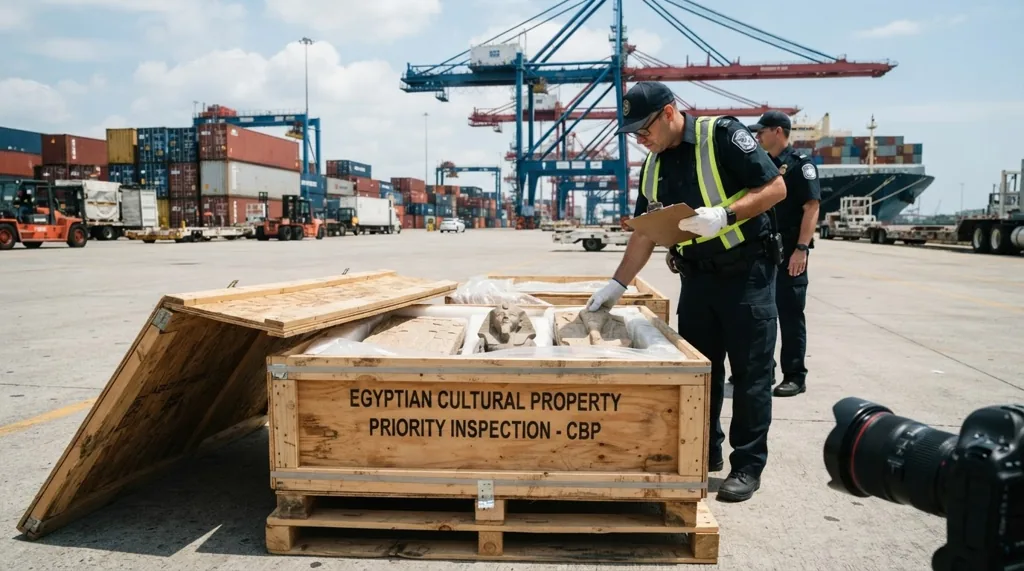
United States customs extends limits on imports of Egyptian ancient and historic objects from Nov. 30, 2026 until Nov. 30, 2031.
U.S. Customs and Border Protection (CBP) has extended its limits on imports of Egyptian antiquities and old cultural objects until Nov. 30, 2031.
The final rule, CBP Decision 26-21, was published in the Federal Register on Nov. 23, 2026, and takes effect on Nov. 30, 20261. It changes the entry for Egypt in the U.S. customs rules on cultural property1.
In short, nothing new is banned, but the old limits do not end this month. Listed ancient and historic objects from Egypt can still enter the United States only if conditions in U.S. law are met. That now applies for five more years.
What is changing for Egyptian antiquities imports?
The rule extends existing import restrictions on certain archaeological and ethnological material from Egypt1. Archaeological material means ancient objects found in the ground or at old sites. Ethnological material means objects made and used by a traditional community, such as tools, cloth or religious items.
The Egypt extension at a glance
| Point | What the rule says |
|---|---|
| Issued by | U.S. Customs and Border Protection |
| Legal reference | CBP Decision 26-21 |
| Goods | Egyptian archaeological and ethnological material |
| Takes effect | Nov. 30, 2026 |
| Limits now end | Nov. 30, 2031 |
The restrictions had been due to end on Nov. 30, 20262. They will now continue through Nov. 30, 20311. CBP is changing only the end date and the reference number in its rules. The list of restricted goods stays the same1.
CBP amended section 12.104g(a) of its regulations, the table of countries whose cultural goods face U.S. import limits1. The Egypt line now refers to CBP Decision 21-17, "extended by CBP Dec. 26-21"1.
Why did the United States and Egypt extend the limits?
The extension follows a new agreement between the two governments. On Nov. 9, 2026, the United States and Egypt signed a new bilateral agreement to extend the restrictions1. Under it, the limits stay in force for another five years1.
U.S. law allows such limits for no more than five years at a time1. They can be extended if the reasons for the first agreement still apply and there is no cause to suspend it1. The law behind them is the Convention on Cultural Property Implementation Act, which carries out a 1970 United Nations treaty against the illegal trade in cultural property1.
In 2021, the U.S. State Department found that Egypt’s cultural heritage was "in jeopardy from pillage," meaning theft from sites2. It found this both for archaeological sites and for certain ethnological objects from A.D. 1517 to 19142. The new rule does not repeat those findings. It states that the State Department made "the necessary determinations" to extend the agreement on Aug. 6, 20261.
How did the extension move through Washington?
The process took most of 2026 and followed several public steps:
- On Jan. 26, 2026, the State Department published a proposal in the Federal Register to extend the Egypt agreement3.
- The Cultural Property Advisory Committee, an expert panel that advises the State Department, met from March 3 to 5, 20264. Its agenda included the proposed extension with Egypt, along with agreements with Bolivia and Greece4.
- Written comments for that meeting were due by Feb. 20, 2026, through docket DOS-2026-01334.
- On Aug. 6, 2026, the State Department’s Assistant Secretary for Educational and Cultural Affairs approved the extension after hearing the committee1.
- On Nov. 9, 2026, the two governments signed the new agreement1.
- CBP published its rule on Nov. 23, 2026, effective Nov. 30, 20261.
From proposal to rule
The committee also held a public session on March 3, 2026, where registered speakers could comment by video4. Each step was announced in the Federal Register, the U.S. government’s daily journal of rules and notices.
Which Egyptian goods are covered?
The goods are named in a "Designated List," published in CBP Decision 21-17 in December 20211. The list covers archaeological material from about 300,000 B.C. to A.D. 17501. It also covers certain ethnological material from A.D. 1517 to 19141.
The 2021 rule sorts the archaeological goods by material2. The groups are:
- stone, metal, ceramic and clay, and wood
- faience and glass
- ivory, bone and shell
- plaster and cartonnage
- textile, basketry and rope
- leather, parchment and papyrus
- paintings, drawings, mosaics and writing
- human and animal remains
The ethnological goods are grouped in a similar way2. They include stone, metal, ceramic, wood, bone and shell objects. They also include glass and semi-precious stone, leather, parchment and paper, and textiles2.
The list gives detailed examples. Stone items include parts of buildings, such as doors, columns and prayer niches from temples, mosques and churches2. They also include statues, wall carvings, tombstones, bowls and jars, and coffins and sarcophagi2.
The list spans Egyptian history from the Paleolithic era to the Ottoman period2. It names many well-known sites, such as Giza, Saqqara, Abydos, Alexandria and Cairo2.
What does the list mean at the U.S. border?
Objects on the list can enter only when conditions in U.S. law are met1. Those conditions are set out in section 2606 of the cultural property law and section 12.104c of the CBP rules1. The rule does not repeat those conditions in its own text.
In practice, customs can stop a listed object that does not meet those conditions. The extension means this check continues for shipments of listed Egyptian objects until 2031.
The rule covers only goods that fit a category and a date range on the list. The test for each object is its material, its type and its age.
Who is affected by the Egypt extension?
The rule matters to anyone who moves old Egyptian objects into the United States. That includes:
- art and antiquities dealers who buy abroad and sell in the United States
- auction houses and galleries that receive objects from overseas sellers
- museums that buy or borrow Egyptian objects
- customs brokers who file entries for these goods
- private collectors who bring objects home
Sellers in Egypt and in other countries are also affected. Their U.S. buyers face the same entry conditions as before. A shipment that does not meet them can be held at the border.
How has the Egypt rule grown since 2016?
The first agreement took effect on Nov. 30, 20161. It covered archaeological material from about 5,200 B.C. to A.D. 15171. CBP put it into its rules in CBP Decision 16-23 on Dec. 6, 20161.
Three stages of the Egypt limits
| Question | 2016 | 2021 | 2026 |
|---|---|---|---|
| CBP decision | CBP Decision 16-23 | CBP Decision 21-17 | CBP Decision 26-21 |
| Archaeological dates | About 5,200 B.C. to A.D. 1517 | About 300,000 B.C. to A.D. 1750 | About 300,000 B.C. to A.D. 1750 |
| Ethnological material | Not covered | A.D. 1517 to 1914 | A.D. 1517 to 1914 |
A new agreement replaced it on Nov. 30, 20211. That agreement widened the archaeological dates to about 300,000 B.C. to A.D. 17501. It also added, for the first time, ethnological objects from A.D. 1517 to 19141. CBP Decision 21-17 took effect on Dec. 1, 20212.
The 2026 step is the second extension of the limits. Unlike 2021, it does not add new goods. It keeps the 2021 list and moves the end date by five years1.
Why was there no public comment on this rule?
CBP issued the rule without a draft or a public comment period1. It said the change involves a "foreign affairs function" of the United States1. For the same reason, the rule did not need a delayed start date1.
CBP also said the rule is exempt from Executive Order 12866, which requires a review of a rule’s costs and benefits1. Because no draft rule was needed, CBP did not prepare an analysis of the effect on small businesses1.
Public input came earlier, through the State Department’s proposal and the advisory committee’s meeting4.
Key points on the Egyptian antiquities import limits
The table sums up the extension.
| Question | Answer |
|---|---|
| What changed? | Import limits extended five years |
| Who issued it? | U.S. Customs and Border Protection |
| Legal reference | CBP Decision 26-21 |
| Which goods? | Egyptian archaeological and ethnological material |
| Archaeological dates | About 300,000 B.C. to A.D. 1750 |
| Ethnological dates | A.D. 1517 to 1914 |
| What is needed? | Conditions in U.S. law must be met |
| Agreement signed | Nov. 9, 2026 |
| Published | Nov. 23, 2026 |
| Takes effect | Nov. 30, 2026 |
| Limits end | Nov. 30, 2031 |
The list of goods does not change, so shipments face the same checks as before. The next date in the documents is Nov. 30, 2031, when the limits end unless they are extended again1.
Sources
- ↩ Federal Register :: Extension of Import Restrictions Imposed on Archaeological and Ethnological Material of Egypt https://www.federalregister.gov/documents/2026/11/23/2026-23795/extension-of-import-restrictions-imposed-on-archaeological-and-ethnological-material-of-egypt
- ↩ Federal Register :: Extension and Amendment of Import Restrictions on Archaeological Material and Imposition of Import Restrictions on Ethnological Material of Egypt https://www.federalregister.gov/documents/2021/12/03/2021-26348/extension-and-amendment-of-import-restrictions-on-archaeological-material-and-imposition-of-import
- ↩ Federal Register :: Proposal To Extend the Cultural Property Agreement Between the United States and Egypt https://www.federalregister.gov/documents/2026/01/26/2026-01397/proposal-to-extend-the-cultural-property-agreement-between-the-united-states-and-egypt
- ↩ Federal Register :: Cultural Property Advisory Committee; Notice of Meeting https://www.federalregister.gov/documents/2026/01/26/2026-01409/cultural-property-advisory-committee-notice-of-meeting