
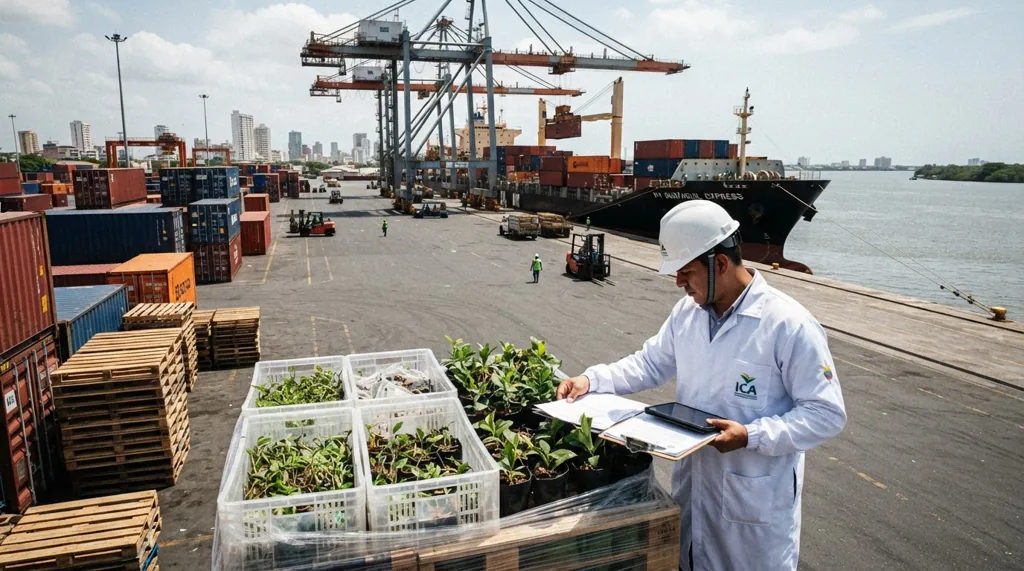
Colombia has issued multiple phytosanitary resolutions establishing import requirements for ornamental plants and propagation materials from Ecuador, Peru, China, and India for commercial use, testing, and planting purposes.
The Colombian Agricultural Institute (ICA) set plant-health import rules on Nov. 9, 2026 for lab-grown Trachelium flower plantlets from Ecuador.
The new resolution is the latest in a group of ICA rules for young plants and planting material. Since Sept. 21, 2026, the institute has also set import rules for gerbera plantlets from China, sweet william cuttings from India and avocado buds from Peru.
In short, each of these plants can now enter Colombia from the named country if the shipment meets a fixed list of conditions. Most shipments need a plant-health certificate, new labelled packaging and an inspection at the border. Some also need laboratory test results attached to every shipment.
What did ICA decide on Nov. 9, 2026?
Resolution No. 00022227, dated Nov. 9, 2026, sets the plant-health requirements for importing Trachelium caeruleum L. plants from Ecuador1. The rule covers in vitro plants, meaning young plants grown in sealed containers in a laboratory1.
The rule applies to plants that both come from Ecuador and are shipped from Ecuador. It covers three purposes: commercial use, trials and planting1. It applies to every person or company that imports these plants into Colombia1.
Juan Carlos Zambrano Arciniegas, ICA’s deputy manager for health and plant-health regulation, signed the resolution in Bogotá1. ICA notified the text to the World Trade Organization (WTO) in draft form before adopting it2.
What must a Trachelium shipment from Ecuador carry?
The Trachelium rule is the simplest in the group. It lists five conditions1:
- A plant-health certificate from Ecuador, the official paper that says the plants were inspected.
- Packaging marked with the botanical name, giving the genus and species.
- New packaging for the product.
- A statement from the importer on whether the plants are a living modified organism (LMO), a genetically changed plant. An LMO must follow Colombia’s rules for such organisms.
- A plant-health inspection at the place where the plants enter Colombia.
Conditions for Trachelium plantlets from Ecuador
| Requirement | Details |
|---|---|
| Certificate | Plant-health certificate from Ecuador |
| Labelling | Packaging marked with genus and species |
| Packaging | New packaging only |
| LMO statement | Importer states if plants are genetically changed |
| Border check | Plant-health inspection at point of entry |
Unlike the other rules in the group, the Trachelium resolution does not name specific pests. It does not ask for laboratory tests or for registered production sites1.
The final text matches the draft that ICA notified to the WTO. The draft listed the same five conditions2.
Why did ICA set these rules?
ICA says its job is to protect animal and plant health in Colombia. It aims to stop pests and diseases from entering and spreading in the country1. Under Decree 4765 of 2008, ICA must adopt the plant-health measures needed to control animal and plant health1.
From committee to resolution
ICA carries out pest risk studies before setting import conditions. Resolution ICA 8389 of 2023 sets the steps for requesting such a study1. An ICA import committee, created by Resolution ICA 13633 of 2023, then approves the conditions1.
For Trachelium from Ecuador, the import committee met on April 8, 2026 and agreed the requirements1. For the gerbera and sweet william rules, the committee met on May 27, 20263. For avocado buds from Peru, it met much earlier, on Oct. 16, 20254.
ICA also explains the role of the plant-health certificate. The plant protection agency of the exporting country issues it. It confirms that the plants were inspected or tested and are free of the pests the importing country names1.
Which other plants did ICA cover in September?
ICA issued three more import rules for planting material in September 2026. Each covers one plant from one country:
- Gerbera plantlets from China: in vitro and "ex agar" gerbera plants, for commercial use, trials or planting, in a resolution dated Sept. 21, 20263.
- Sweet william cuttings from India: rooted and unrooted cuttings of Dianthus barbatus L., for commercial use or planting, in a resolution dated Sept. 21, 20265.
- Avocado buds from Peru: buds of Persea americana Mill., for commercial use, trials or planting, in a resolution dated Sept. 23, 20264.
Linda Luz Barbosa Díaz, acting deputy manager for health and plant-health regulation, signed the gerbera and sweet william rules3. These three rules ask for much more than the Trachelium rule. They name pests and require tests or treatments before shipment.
What tests do gerbera plantlets from China need?
The certificate from China must carry an additional declaration, an extra statement written on the certificate3. It must say the plantlets came from mother plants tested with molecular biology methods. Those mother plants must have been found free of four named pests3:
- Candidatus Phytoplasma aurantifolia.
- Impatiens necrotic spot orthotospovirus.
- Tobacco rattle virus.
- Tomato black ring virus.
All test results must travel with each shipment3. The plants must also come from production sites registered and approved by China’s plant protection agency3.
At the border, ICA will inspect the shipment. It will also take a sample for the Plant Quarantine Station, ICA’s facility for checking imported plants3. Packaging must be new and marked with the genus and species. The importer must say whether the plants are an LMO3.
What tests do sweet william cuttings from India need?
The rule for sweet william cuttings from India has the longest test list among the flowers. The certificate must state that the cuttings passed molecular tests for five viruses5:
- Arabis mosaic virus.
- Beet curly top virus.
- Carnation latent virus.
- Carnation vein mottle virus.
- Pelargonium leaf curl virus.
The cuttings must also pass diagnostic tests for two diseases, Dickeya dianthicola and Alternaria nobilis5. They must be found free of the pest Spodoptera littoralis5. All test results must be attached to each shipment5.
As with gerbera, the cuttings must come from registered and approved production sites in India5. ICA will inspect each shipment at the point of entry and take a sample for the Plant Quarantine Station5. The final text keeps the same test list as the draft ICA sent to the WTO6.
What do avocado buds from Peru need?
The avocado rule is the strictest of the four. Peru’s certificate must say the shipment was inspected and found free of 11 named insects and other pests4. The list includes Ceroplastes rusci, Stenoma catenifer and Xylosandrus compactus4.
Pests named in Peru’s certificate for avocado buds
The buds must also receive a mite-killing treatment in Peru. The certificate must state the active ingredient, the dose, the method and the date4. After treatment, the shipment must be free of two mites, Eotetranychus sexmaculatus and Tuckerella pavoniformis4.
Official laboratory tests in Peru must show the buds are free of five diseases4. These include avocado sunblotch viroid, potato spindle tuber viroid and Xylella fastidiosa. All test results must be attached to each shipment4.
Other conditions cover cleanliness and packing4:
- The buds must be free of soil, leaves, flowers, fruit and other debris.
- Any packing material must be pest-free, and Peru’s plant protection agency must certify this on the certificate.
- Packaging must be new and marked with the genus and species.
- The importer must say whether the buds are an LMO.
The buds also face a plant-health inspection at the point of entry4.
Who is affected and what changes for them?
Colombian importers of these plants now have a clear list of conditions for each origin. Each rule applies to all people and companies that import the named plant from the named country1. They must also state whether the plants are a genetically changed LMO3.
Growers and exporters in Ecuador, China, India and Peru carry most of the work before shipment. For gerbera, sweet william and avocado, they must arrange laboratory tests and send the results with every shipment5. For gerbera and sweet william, their farms or nurseries must be registered with their national plant protection agency3.
Plant protection agencies in the exporting countries must write the extra declarations on each certificate. For avocado buds, Peru’s agency must also certify the treatment and the packing material4.
At the border, ICA officials act as health police inspectors under Article 65 of Law 101 of 19931. They can call on civil and military authorities for support1. ICA records every official check in a written or digital report, signed by those present, with a copy left on site3.
What happens if a shipment breaks the rules?
Breaking any condition in these resolutions can lead to penalties under Articles 156 and 157 of Law 1955 of 20191. The penalties apply without prejudice to civil or criminal action5. The resolutions do not list the amounts of fines.
In practice, a shipment that lacks the right certificate wording or test results fails the conditions at the border. Shipments of gerbera and sweet william also face sampling by the Plant Quarantine Station3.
When do the new rules start?
Each resolution takes effect on the date it is published in the Diario Oficial, Colombia’s official gazette1. The gerbera and sweet william rules carry the same clause5. The resolutions themselves do not give the gazette publication date.
ICA held a national public consultation on the texts through SUCOP, the single public consultation system of the National Planning Department1. It also notified the drafts to the WTO, the Andean Community (CAN) and the G3 trade group, because the rules affect international trade1. The WTO drafts for Trachelium and sweet william are on file2.
Key points on Colombia’s new plant import rules
The table sums up the four ICA resolutions.
| Question | Answer |
|---|---|
| Who issued the rules? | Colombian Agricultural Institute (ICA) |
| Newest rule | Resolution 00022227, Nov. 9, 2026 |
| Goods in newest rule | In vitro Trachelium plants from Ecuador |
| Other goods covered | Gerbera (China), sweet william (India), avocado buds (Peru) |
| Dates of other rules | Sept. 21 and Sept. 23, 2026 |
| Paper needed | Plant-health certificate from the exporting country |
| Extra tests | Gerbera, sweet william and avocado buds |
| Test results | Attached to each shipment |
| Border checks | Inspection at point of entry |
| Samples | Gerbera and sweet william, for Plant Quarantine Station |
| Who must act | Importers, growers, exporting countries’ agencies |
| Start date | Publication in the Diario Oficial |
For Trachelium plantlets from Ecuador, the burden is light: a certificate, new labelled packaging and a border inspection1. For gerbera, sweet william and avocado buds, every shipment must carry laboratory results, or it will not meet ICA’s conditions at the border4.
Sources
- ↩ 26_05851_00_s.pdf https://members.wto.org/crnattachments/2026/SPS/COL/26_05851_00_s.pdf
- ↩ 26_03637_00_s.pdf https://members.wto.org/crnattachments/2026/SPS/COL/26_03637_00_s.pdf
- ↩ 26_04985_00_s.pdf https://members.wto.org/crnattachments/2026/SPS/COL/26_04985_00_s.pdf
- ↩ 26_05058_00_s.pdf https://members.wto.org/crnattachments/2026/SPS/COL/26_05058_00_s.pdf
- ↩ 26_04984_00_s.pdf https://members.wto.org/crnattachments/2026/SPS/COL/26_04984_00_s.pdf
- ↩ 26_03726_00_s.pdf https://members.wto.org/crnattachments/2026/SPS/COL/26_03726_00_s.pdf