
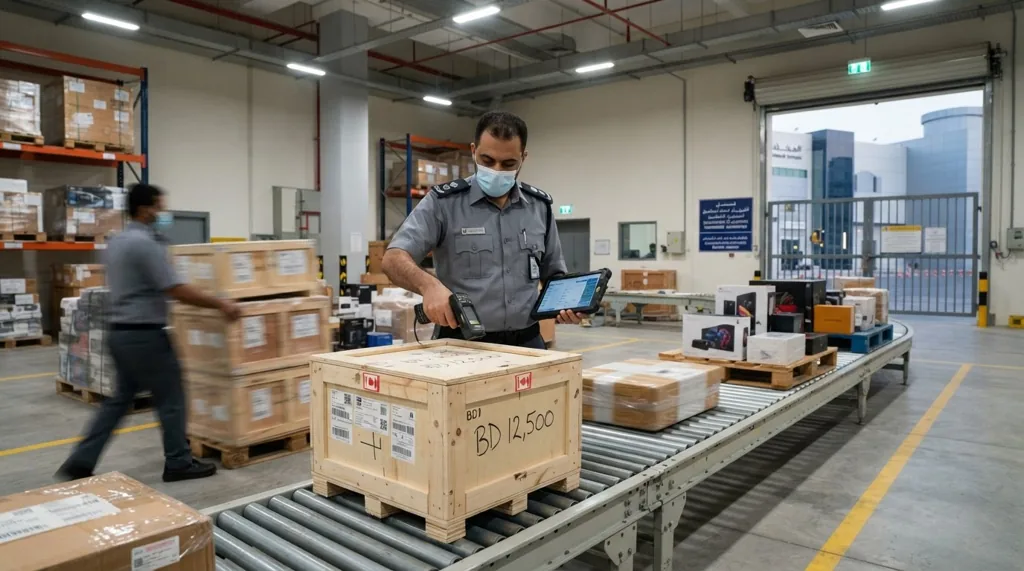
Bahrain lets licensed commercial-complex warehouses hold imports worth BD10,000 or more under duty suspension for up to three years, from Oct. 2, 2026.
Bahrain’s President of Customs has issued rules that let licensed warehouses inside commercial complexes hold imported goods worth BD10,000 or more without paying customs duty, in force from Oct. 2, 20261.
The measure is Decision No. 1 of 2026, published in Bahrain’s Official Gazette, issue 3908, on Oct. 1, 20261. It sets out the rules and conditions for storing goods in private warehouses of commercial complexes under customs duty suspension.
In short, a commercial complex in Bahrain can now run its own customs warehouse. Goods worth at least BD10,000 on arrival can sit there for up to three years before any duty is paid, but only with a customs licence and under customs supervision.
What does Bahrain’s Decision No. 1 of 2026 do?
The decision creates a new kind of storage place: the private warehouse of a commercial complex1. Owners of goods deposit their goods in this warehouse inside the complex. They can store the goods and dispose of them, with the approval of the customs clearance office.
The goods are held under duty suspension, which means the customs duty is not collected while the goods stay in the warehouse. Bahrain Customs already uses this idea in its ordinary customs warehouses, where goods may be stored without paying the customs duty that is due2.
The decision was signed by Shaikh Ahmed bin Hamad Al Khalifa, the President of Customs, on Oct. 1, 20261. Bahrain Customs Affairs sits within the Ministry of Interior2.
Which goods qualify for the commercial-complex warehouses?
Only goods of a certain value qualify. Their value on arrival in Bahrain must be BD10,000 or more1. Shipments below that value are outside the definition of this warehouse.
The decision does not list product types or tariff codes. It speaks of "different goods", and it says the warehouse must be built to receive them and keep them safe1. The goods must also meet all the conditions of the GCC Unified Customs Law, the shared customs law of the Gulf Cooperation Council states1.
Bahrain’s ordinary warehouse rules add two limits. Restricted goods need approvals and permits from the competent authorities, and goods that are banned under national law cannot be stored in a customs warehouse2.
Who runs the warehouse and who supervises it?
The decision names three parties. The operator is the body that invests in and runs the warehouse1. The supervising office is the General Directorate of Clearance and Customs Services, the part of customs that clears goods1. The customs department itself approves any longer storage period1.
The operator carries the main legal weight. It is responsible for the goods deposited with it, under the GCC Unified Customs Law and the decisions issued under it1. Towards customs, the operator takes the place of the goods owners in all their obligations for storing those goods1.
In practice, this means customs deals with the warehouse operator, not with each owner. If duty or fees fall due, customs can look to the operator.
What must an operator do before opening?
The operator must meet six conditions before the warehouse starts work1:
- Ministry approval: approval to set up the warehouse from the Ministry of Industry and Commerce.
- Customs licence: a licence from the President of Customs to invest in and run the warehouse.
- Written undertaking: a documentary undertaking, in the form the clearance office decides.
- Electronic stock system: an approved electronic system that tracks the movement of goods, with control reports that match the inputs and outputs of the customs clearance system.
- Named supervisors: an approved list of the names and details of the people who supervise the warehouse.
- Stock counts: a warehouse that can be counted, so customs can check what is inside.
Conditions before a warehouse opens
| Requirement | Standard / Details |
|---|---|
| Ministry approval | From the Ministry of Industry and Commerce |
| Customs licence | From the President of Customs |
| Written undertaking | In the form the clearance office decides |
| Electronic stock system | Reports match the customs clearance system |
| Named supervisors | Approved list of names and details |
| Stock counts | Warehouse must be possible to count |
The building itself must meet two more conditions1. It must be equipped to receive different goods and keep them safe. Its space must be large enough for the planned activity.
How long can goods stay in the warehouse?
The basic storage period is one year from the date of deposit1. The customs department can extend it when needed. The total must not exceed three years1.
Storage period under duty suspension, years
This matches the rule for Bahrain’s ordinary customs warehouses. There, goods may be stored for one year (365 days), renewable for similar periods, up to three years in total2. In those warehouses, the customs duty is collected when that period ends2.
The new decision also refers to an older Bahrain decision, No. 10 of 2003. That decision sets the time limits after which customs may sell goods1.
How are goods received, moved and split?
Each shipment is checked on arrival. The warehouse keeper must check all of its documents against the goods1. The check covers:
- the number of packages;
- the date of receipt;
- the marks and numbers shown on the packages;
- the condition of the packages on receipt.
Splitting goods in the warehouse
In all cases, goods must be moved into the warehouse under customs supervision1. This means a shipment cannot simply be driven from the port to the complex without the clearance office watching the transfer.
Goods in the warehouse may be split into smaller lots1. Three conditions apply:
- The split must not change the goods’ customs tariff heading, and must not cause a loss to the public treasury.
- The operator must tell the customs department about the split.
- The split must be written into the goods’ documents and into the records of customs and of the warehouse keeper.
Splitting lets a seller take part of a large shipment out while the rest stays under suspension. The tariff rule stops anyone from using a split to move goods into a lower-duty heading.
Who pays the duty and other costs?
The decision says all taxes, fees, costs and other expenses must be paid when the value of the goods is assessed1. This also covers any loss to the goods from loss, natural causes or force majeure, which means events outside anyone’s control1.
Because the operator stands in for the goods owners, it carries these payment duties towards customs1. An owner whose goods are lost or damaged in the warehouse does not escape the charges.
When goods leave an ordinary Bahrain customs warehouse, the steps are set out by Bahrain Customs2. The customs declaration is completed electronically by the importer, a representative or a licensed customs broker. Other due charges are paid. The goods may be inspected based on risk, and then an exit note is issued and the goods are released2.
What law does the decision rest on?
The decision is built on the GCC Unified Customs Law, which Bahrain approved by Decree-Law No. 10 of 20021. That law was amended by Decree-Law No. 45 of 2022. The decision relies in particular on Articles 74 and 75 of the law1.
It also draws on the law’s implementing regulation, issued by Decision No. 3 of 20031. A further basis is Decision No. 14 of 2003, which sets the rules for warehouses inside or outside the customs area and for storing goods under duty suspension1.
Bahrain’s ordinary customs warehouses follow rules approved by the GCC states, and each customs warehouse is notified to the other GCC states2. Goods may move between customs warehouses in GCC countries under the unified GCC customs declaration, with a cash or bank guarantee equal to the duty owed2.
When do the new warehouse rules apply?
The decision is dated Oct. 1, 2026, and appeared in the Official Gazette the same day1. It takes effect from the day after publication, which is Oct. 2, 20261.
No warehouse can use the rules until it holds the ministry approval and the customs licence.
Key points on Bahrain’s commercial-complex warehouses
The table sums up the decision.
| Question | Answer |
|---|---|
| What changed? | Commercial complexes can run duty-suspended warehouses |
| Who issued it? | Bahrain’s President of Customs |
| Which instrument? | Decision No. 1 of 2026 |
| Where published? | Official Gazette issue 3908, Oct. 1, 2026 |
| Which goods? | Goods worth BD10,000 or more on arrival |
| Basic storage period | One year from deposit |
| Longest storage period | Three years, with customs approval |
| Who needs a licence? | The warehouse operator |
| Approvals needed | Ministry of Industry and Commerce and President of Customs |
| Who is liable for duty? | The operator, in place of goods owners |
| Can goods be split? | Yes, if the tariff heading does not change |
| Start date | Oct. 2, 2026 |
The rules have applied since Oct. 2, 2026. From that date, an approved complex can hold high-value imports for up to three years before the duty falls due, as long as every shipment moves in and out under customs supervision1.
Sources
- ↩ 3908.pdf https://www.lloc.gov.bh/OG/3908.pdf
- ↩ ministry of Interior http://www.customs.gov.bh/en/warehousing-goods