
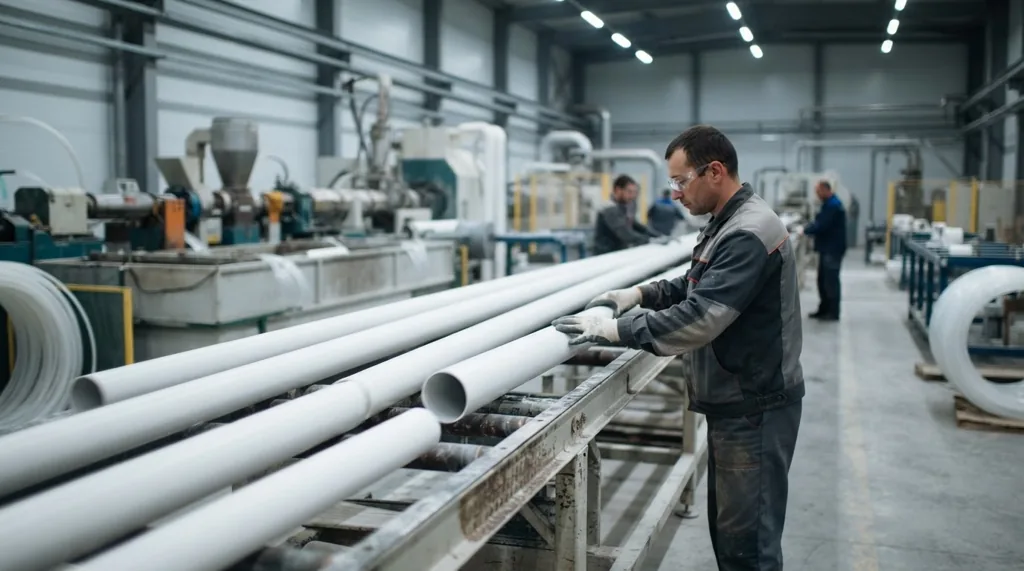
European Union customs must register imports of pure PVC plastic from China, South Korea, Mexico and Taiwan from Oct. 27, 2026.
The European Commission ordered EU customs on Oct. 26, 2026, to register imports of certain PVC plastic from China, South Korea, Mexico and Taiwan.
The order is Commission Implementing Regulation (EU) 2026/2345, dated Oct. 23, 2026, and published in the Official Journal of the European Union on Oct. 261. It enters into force the day after publication1.
In short, PVC shipments from these four places still enter the EU as before, with no new duty today. But customs will keep a record of each one, so a future anti-dumping duty could later be charged on them.
Why is the EU registering PVC imports?
Registration is linked to an anti-dumping investigation that the Commission opened on Sept. 23, 20261. An anti-dumping duty is an extra import tax on goods sold abroad below their normal price. The investigation looks at whether PVC from the four places is being sold in the EU at such low prices and harming EU makers.
The case began with a complaint lodged on Aug. 10, 2026, by the Polyvinyl chloride (PVC) Trade Committee2. The committee spoke for producers making more than 25% of EU production of the PVC in question1.
The Commission decided on registration on its own initiative, not at the request of the complainants1. Its stated purpose is to make sure that duties, if any are imposed, can be charged backwards on the registered imports1.
Which PVC products does registration cover?
Polyvinyl chloride, or PVC, is a common plastic. The order covers PVC made by two production methods, in pure form and not mixed with any other substance1:
- Suspension PVC (S-PVC), made by suspension polymerisation. This includes commodity, extender and specialty grades.
- Bulk or mass PVC (M-PVC), made by bulk polymerisation.
What the PVC registration order covers
| Point | What the order says |
|---|---|
| Goods covered | Pure S-PVC and M-PVC, not mixed with other substances |
| Goods excluded | E-PVC, made by emulsion polymerisation |
| Tariff heading | CN code ex 3904 10 00 |
| TARIC codes | 3904 10 00 15, 3904 10 00 21, 3904 10 00 80 and 3904 10 00 81 |
| Origins | China, South Korea, Mexico and Taiwan |
PVC made by emulsion polymerisation, known as E-PVC, is excluded1. Mixed PVC products are also outside the order, because it covers only the pure form.
The goods fall under Combined Nomenclature (CN) code ex 3904 10 00, the EU’s customs tariff heading1. The order lists four TARIC codes, the EU’s detailed 10-digit import codes: 3904 10 00 15, 3904 10 00 21, 3904 10 00 80 and 3904 10 00 811.
Which countries are named in the PVC case?
The order covers PVC that originates in four places1:
- China (the People’s Republic of China)
- South Korea (the Republic of Korea)
- Mexico
- Taiwan
The rule depends on where the PVC originates, not where it was shipped from. PVC from other countries is not affected by this order.
How does customs registration work?
Article 1 of the order tells customs authorities in all EU member states to take steps to register these imports1. The legal basis is Article 14(5) of Regulation (EU) 2016/1036, the EU’s basic law against dumped imports1.
In practice, the steps are:
- An importer declares PVC under one of the four TARIC codes, with origin in one of the four places.
- Customs records the shipment as a registered import.
- The goods are cleared and released as normal.
- If the EU later imposes definitive duties, it decides whether those duties can be charged on the registered shipments.
The Commission says the conditions for this backward charge will be assessed in the regulation imposing definitive duties, if any1. Any future bill would follow from the findings of the investigation1.
How high could the PVC duties be?
The order repeats figures from the complaint, for 20251. The dumping margin is the gap between the export price and the normal price. The injury level is the duty needed to remove harm to EU makers.
Injury elimination levels in the complaint, %
The complaint estimates these dumping margins1:
- China: between 84% and 273%
- South Korea: between 21% and 61%
- Mexico: 65%
- Taiwan: between 13% and 39%
It estimates these injury elimination levels: 68% for China, 53% for South Korea, 55% for Mexico and 56% for Taiwan1.
Normally, any future charge would be set at the lower of the dumping margin and the injury level1. This is the EU’s "lesser duty rule".
The Commission stresses that it cannot yet estimate the amount of any future charge1. The complaint’s figures are for information only and create no expectation about the final level1.
What changes for Chinese PVC and raw materials?
The complainants claim that raw material prices in China are distorted1. The initiation notice names calcium carbide, used in one way of making PVC2. It says calcium carbide accounts for more than 17% of production cost for PVC made by the acetylene-based process2.
According to the complaint, captive mining and licensing rules push Chinese calcium carbide prices well below world prices2. If the investigation confirms such distortions, the lesser duty rule may not apply to China1. Then any future charge could be set at the full dumping margin1.
The initiation notice also says the complainants found it inappropriate to use Chinese domestic prices and costs2. They suggested Malaysia as a representative country for building a normal value2.
What does the initiation notice say about the four countries?
The initiation notice, published Sept. 23, 2026, sets out the complaint for each place2. For South Korea and Mexico, the complaint built a normal value from manufacturing costs, selling costs and profit2. For Taiwan, it compared domestic prices with export prices2.
For South Korea and Taiwan, the complainants also claim a "particular market situation", meaning local prices are not reliable2. Their calculations on that basis showed higher margins2.
The complainants also say imports from the four places rose in volume and market share2. They report spare production capacity abroad, a coming rise in that capacity, and growing stocks2. They argue the low import prices pushed down prices charged by EU producers2.
Who is affected by PVC registration?
EU importers of S-PVC and M-PVC from the four places face the main change. Shipments entering now could later carry an anti-dumping duty, if the Commission decides to charge it backwards. That risk is part of the cost of each shipment from now on.
Customs brokers must declare these goods under the correct TARIC code and origin. That decides whether a shipment is registered.
Makers abroad in China, South Korea, Mexico and Taiwan are invited to take part in the investigation2. Because many producers may export, the Commission may choose a sample of companies to investigate2. Sampled producers must return a questionnaire within 30 days of being told they are in the sample2.
Buyers in the EU of E-PVC or of mixed PVC compounds are not covered by this order1.
When does PVC registration start and end?
The key dates in the case are:
- Aug. 10, 2026: complaint lodged2.
- Sept. 23, 2026: investigation opened1.
- Oct. 23, 2026: registration order adopted1.
- Oct. 26, 2026: order published in the Official Journal1.
- Oct. 27, 2026: order enters into force, the day after publication1.
Key dates in the PVC case
Registration expires nine months after the order enters into force1. The investigation covers the period from April 1, 2025, to March 31, 20262. Trends for the injury study are reviewed from Jan. 1, 20222.
Interested parties had 37 days from the Sept. 23 notice to comment on the complaint2. That window closes on Oct. 30, 2026.
Key points on EU registration of PVC imports
The table below sums up the registration order.
| Question | Answer |
|---|---|
| What changed? | Customs must register certain PVC imports |
| Who issued it? | European Commission |
| Legal act | Implementing Regulation (EU) 2026/2345 |
| Which goods? | Pure S-PVC and M-PVC |
| Which goods are out? | E-PVC and mixed PVC |
| Which codes? | TARIC 3904 10 00 15, 21, 80, 81 |
| Which origins? | China, South Korea, Mexico, Taiwan |
| Duty today? | None yet |
| Complaint’s dumping margins | 13% to 273% |
| Start date | Oct. 27, 2026 |
| How long? | Nine months |
| Who must act? | Customs, importers, customs brokers |
No duty is due yet on these PVC shipments. But every registered shipment from Oct. 27, 2026, could later face a backward anti-dumping charge, if the investigation leads to definitive duties.
Sources
- ↩ Implementing regulation – EU – 2026/2345 – EN – EUR-Lex https://eur-lex.europa.eu/eli/reg_impl/2026/2345/oj
- ↩ EUR-Lex – 52026XC04912 – EN – EUR-Lex http://data.europa.eu/eli/C/2026/4912/oj