
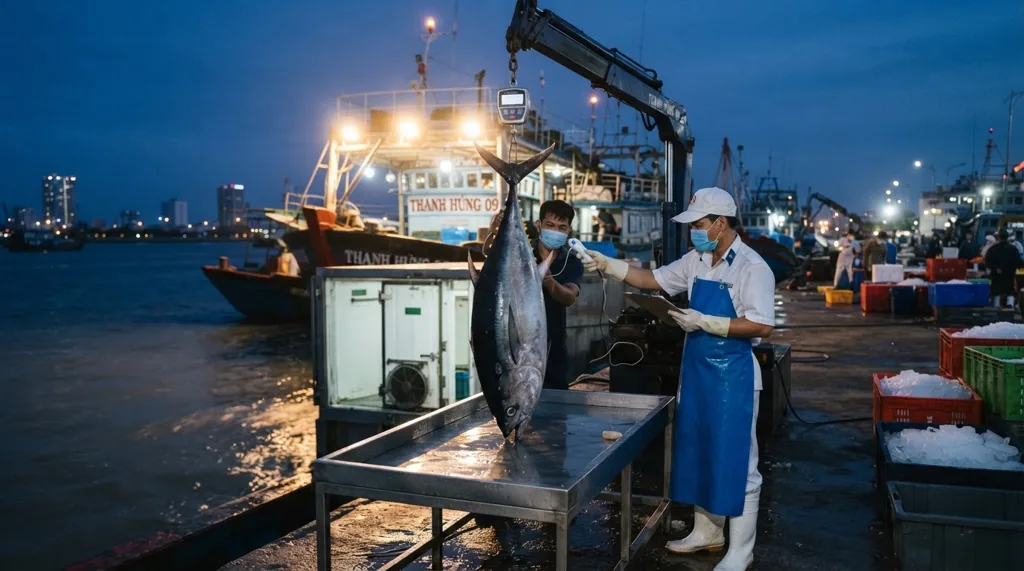
Viet Nam has implemented comprehensive inspection and control regulations for bigeye tuna imports, temporary imports, re-exports, and container vessel transit to ensure compliance with fishing and food safety standards.
Viet Nam’s Ministry of Agriculture and Environment plans to check every bigeye tuna shipment arriving by container ship, from 30 days after signing.
The plan covers bigeye tuna that is imported, temporarily imported, re-exported or carried through Viet Nam by container vessel1. Viet Nam told members of the World Trade Organization (WTO) about it on Sept. 16, 20262.
In short, an importer must send papers proving the tuna was caught legally at least 48 hours before the ship arrives. Customs will clear the fish only after fisheries officials accept those papers or inspect the container.
What has Viet Nam notified on bigeye tuna?
The measure is a draft decision of the Minister of Agriculture and Environment. It approves "Annual Plans for inspection and control" of bigeye tuna (Thunnus obesus) caught at sea and shipped into Viet Nam by container vessel1.
Viet Nam sent the plan to the WTO as notification G/SPS/N/VNM/192, dated Sept. 16, 20262. The notification is filed under the WTO agreement on food safety and animal and plant health, known as sanitary and plant-health (SPS) measures. It says the rule applies to Vietnamese organizations and individuals who import bigeye tuna and bigeye tuna products by container vessel2.
The first notice contained a typing error. Its summary named albacore tuna (Thunnus alalunga) instead of bigeye tuna2. A correction, G/SPS/N/VNM/192/Corr.1, was issued on Oct. 1, 2026. It states that the reference should read "Bigeye tuna (Thunnus obesus)" and that the scope and substance of the rule do not change3.
Why is Viet Nam checking bigeye tuna?
The plan gives two purposes. The first is to meet Viet Nam’s duties to regional fisheries management organizations, the international bodies that set catch rules for species such as tuna1. Bigeye tuna is a species managed by these bodies.
The plan lists the agreements behind those duties1:
- United Nations Convention on the Law of the Sea, dated Dec. 10, 1982.
- The Western and Central Pacific fisheries convention, which covers migratory fish stocks in that region (WCPFC).
- The United Nations Fish Stocks Agreement, through the agreement that puts it into effect.
The second purpose is to fight illegal, unreported and unregulated (IUU) fishing, meaning fish caught without a licence, over a quota or outside the rules1. The plan cites the Food and Agriculture Organization (FAO) Code of Conduct for Responsible Fisheries, its international action plan against IUU fishing and its Port State Measures Agreement1.
The decision also rests on a national action plan. Decision No. 1516/QD-TTg of Aug. 10, 2026, from the Prime Minister, sets out steps to answer recommendations the European Commission made during its fifth inspection on IUU fishing1. Viet Nam’s tuna checks therefore link directly to its fish trade with the European Union.
Which bigeye tuna shipments are covered?
The plan names two tariff codes from Circular No. 31/2022/TT-BTC of June 8, 2022, issued by the Minister of Finance1:
- 0302.34.00: bigeye tuna (Thunnus obesus).
- 0303.44.00: bigeye tuna (Thunnus obesus).
The checks apply to tuna caught at sea, not farmed fish. They cover four kinds of movement by container vessel: import, temporary import, re-export and transit through Viet Nam1. The plan also mentions border-gate transfer1.
There is one exemption. Sample shipments under 50 kg do not need the advance filing, if they are not for commercial use and will not be sold1.
What papers must a tuna importer file?
The importer must file a declaration and supporting papers with the ministry’s fisheries authority. The deadline is at least 48 hours before the shipment arrives at the port1. Officials use the file to check where the fish came from and that it was not caught illegally.
Papers for each bigeye tuna shipment
| Document / Filing | Issuer or condition |
|---|---|
| Shipment details (Form No. 22) | Filed at least 48 hours before arrival |
| Copy of the bill of lading | Shipping document from the carrier |
| Catch certificate | Competent authority of the exporting country |
| Fishing licence copy and captain’s statement | Needed when no catch certificate is available |
The file must contain1:
- Shipment details on Form No. 22 in Appendix II of Decree No. 41/2026/ND-CP of Jan. 25, 2026.
- A copy of the bill of lading, the shipping document issued by the carrier.
- A catch certificate, or another document confirming that the fish came from fishing, issued by a competent authority of the exporting country.
When no catch certificate is available, the importer must send two other papers instead. These are a copy of the fishing licence and a captain’s statement signed by the fishing vessel’s captain1.
The captain’s statement must give these details1:
- the vessel’s name and registration number, such as its IMO number, call sign, hull markings or regional fisheries registration number;
- the flag state and fishing licence number;
- the type of fishing gear;
- the fishing time and fishing area;
- the date and place where the catch was first landed.
The statement must confirm that the fish was caught under the applicable rules and conservation measures1.
How will fisheries officials check each shipment?
The Department of Fisheries and Surveillance leads the work. The Department of Customs and the National Authority for Agro-Forestry-Fishery Quality, Processing and Market Development, the ministry’s seafood quality agency, support it1. The checks run on a regular basis, not as a one-time campaign1.
How a bigeye tuna shipment is cleared
The process runs in these steps1:
- The importer files the declaration and papers at least 48 hours before arrival.
- Officials check that the information and papers are valid and legal under Clause 1, Article 51 of Decree No. 41/2026/ND-CP.
- Where data exist, officials compare the catch with each country’s quotas, fishing areas and the species it may catch.
- If the file is complete and correct, officials notify the owner within a maximum of 48 hours. They also send the result to customs on Form No. 23.KT, so clearance can go ahead.
- If there are signs of illegal fishing or illegal transfer at sea, officials notify the owner and inspect the fish inside the container.
Most shipments with clean papers should therefore get an answer within two days of a complete filing. The officials also keep the declared data to support checks after import1.
What happens if officials open the container?
A physical inspection is done by an inspector who meets the rules in Clause 10, Article 50 of Decree No. 41/2026/ND-CP. The inspector works with customs and records the results on Form No. 24.KT1. If the species cannot be identified by sight, the inspector takes samples1.
The plan lists the findings that lead to action against a shipment. They include fish that was1:
- caught by a vessel on an IUU fishing list kept by its flag state, a coastal state or a regional fisheries body;
- caught, carried or transferred at sea by a vessel without a valid fishing licence;
- caught above the catch quota set by a coastal state or a regional fisheries body;
- caught in breach of a coastal state’s rules or a regional body’s conservation measures;
- linked to a vessel that took part in or supported illegal fishing under Article 60 of the Law on Fisheries.
In any of these cases, officials notify the owner and customs, which handles the shipment under the law1. The plan does not set out the penalty itself. If the inspection finds no problem, officials tell the owner and customs to go ahead with clearance1.
Who is affected by the tuna checks?
Vietnamese importers of bigeye tuna carry the main duty. They must collect papers from their suppliers and file them on time. A late or incomplete file means the 48-hour review cannot start, so the ship’s cargo waits at the port.
Exporters and fishing fleets abroad are also affected. Their buyers in Viet Nam will need a catch certificate from the exporting country’s authority, or a licence copy and a signed captain’s statement. Vessel details, fishing areas and landing dates must be ready before the fish is loaded.
Traders who use Viet Nam for re-export or transit by container ship come under the same checks1. Processors that buy imported bigeye tuna as raw material for re-export depend on the same clearance.
How does this follow Viet Nam’s albacore tuna plan?
The bigeye plan copies a model Viet Nam has already used for another tuna. On Feb. 7, 2025, Viet Nam notified the WTO of a plan for inspection and control of albacore tuna (Thunnus alalunga) shipped by container vessel, as G/SPS/N/VNM/1664.
Viet Nam’s tuna notices to the WTO
That earlier notice used the same wording on imports, temporary imports, re-exports and transit4. The albacore name in the first bigeye notice came from this earlier text, which the Oct. 1 correction fixed3.
When do the bigeye tuna checks start?
The decision takes effect 30 days from the date of signing1. The notified text leaves the decision number and signing date blank, so the exact start date is not yet fixed1. The Deputy Minister, Vo Van Hung, is named as the signer for the Minister1.
Once the decision is in force, the Department of Fisheries and Surveillance must submit a task plan and cost estimate for approval. It must also report results to the ministry1. Any problems found during the work go back to the ministry, which may amend the plan1.
Key points on Viet Nam’s bigeye tuna checks
The table below sums up the plan.
| Question | Answer |
|---|---|
| What changes? | Every bigeye tuna shipment by container ship is checked |
| Who issued it? | Ministry of Agriculture and Environment |
| WTO notice | G/SPS/N/VNM/192, Sept. 16, 2026 |
| Correction | Corr.1, Oct. 1, 2026, albacore changed to bigeye |
| Which goods? | Tariff codes 0302.34.00 and 0303.44.00 |
| Which movements? | Import, temporary import, re-export, transit |
| Filing deadline | At least 48 hours before arrival |
| Key paper | Catch certificate, or licence and captain’s statement |
| Review time | Maximum 48 hours after a complete file |
| Exemption | Non-commercial samples under 50 kg |
| Start date | 30 days after the decision is signed |
The next step is the signing of the decision, which starts the 30-day count. From then, bigeye tuna without proof of legal catch can be held at Vietnamese ports until officials inspect it.
Sources
- ↩ 26_04988_00_e.pdf http://www.spsvietnam.gov.vn/Data/File/Notice/12303/26_04988_00_e.pdf
- ↩ G/SPS/N/VNM/192 – VĂN PHÒNG SPS VIỆT NAM http://www.spsvietnam.gov.vn/en/gspsnvnm192
- ↩ G/SPS/N/VNM/192/Corr.1 – VĂN PHÒNG SPS VIỆT NAM http://www.spsvietnam.gov.vn/en/gspsnvnm192corr.1
- ↩ G/SPS/N/VNM/166 – VĂN PHÒNG SPS VIỆT NAM http://www.spsvietnam.gov.vn/en/gspsnvnm166