
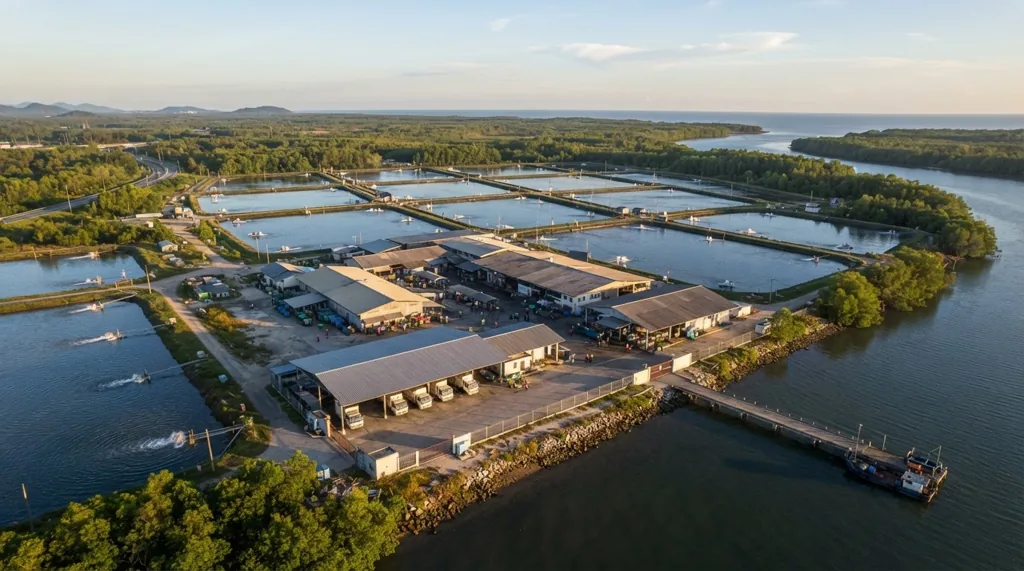
Malaysia has implemented biosecurity inspection requirements for foreign hatcheries exporting live shrimp, broodstock, and postlarvae to ensure disease-free and safe shipments.
The Department of Fisheries Malaysia (DoF) checks foreign hatcheries before they can ship live shrimp to Malaysia, under a rule set to start 1 June 20261.
The rule covers live shrimp, including breeding shrimp (broodstock) and young shrimp (post-larvae)2. It applies to every foreign hatchery that wants to export them to Malaysia1.
In short, a foreign hatchery must now pass a paper check by the DoF before Malaysia approves its live shrimp. Some hatcheries will also face a visit, in person or by video link1.
What is Malaysia changing for live shrimp imports?
Malaysia already controls imports of live aquatic animals under Section 40 of the Fisheries Act 1985 (Act 317)1. That section deals with the control of live fish. The new notice adds a check on the hatchery that produces the shrimp.
The DoF told the World Trade Organization (WTO) about the plan in a notice numbered G/SPS/N/MYS/721. The WTO notice is a sanitary and phytosanitary (SPS) notice, which covers rules on human, animal and plant health. The Vietnam SPS Office, Vietnam’s official contact point for these notices, lists the first version as dated 30 January 20263.
A revised version, G/SPS/N/MYS/72/Rev.1, followed on 16 March 20262. The office responsible is the Fisheries Biosecurity Division of the DoF2.
Why did the Department of Fisheries act?
Malaysia imports live shrimp broodstock and post-larvae to develop its shrimp farms1. The DoF says moving live aquatic animals carries high disease risks. It wants stronger checks before import to keep out animal diseases that cross borders1.
The notice gives three goals1:
- Stronger assurance that imports meet Malaysia’s aquatic animal health rules.
- Keeping out diseases that spread between countries, and stopping them from settling in Malaysia.
- Clean sources, meaning live shrimp come only from hatcheries with good disease controls.
The revised notice states the aim more simply: to make sure aquatic animals are disease-free2. It lists animal health as the only objective2.
How does the two-stage hatchery check work?
The DoF will use a step-by-step check based on risk1. The first stage is a paper review. The second stage is a hatchery visit, and only when needed.
The process runs in this order1:
- The hatchery’s country sends documents to the DoF through its own government animal health office, called the competent authority.
- The DoF reviews the documents before it gives import approval.
- If the papers are enough, the documents alone decide the case.
- If questions remain, the DoF may audit the hatchery, either remotely or in person.
The documentary audit is the main check1. The DoF may look at biosecurity plans, disease monitoring, laboratory testing, record-keeping and tracing systems, and official supervision by the competent authority1.
When will the DoF visit a foreign hatchery?
An on-site audit is not automatic and will not apply to every hatchery1. The DoF will audit a hatchery only in four cases1:
- Incomplete papers, when the documents are missing or not enough.
- Technical questions that need clarification.
- Higher risk, when a risk assessment shows a greater disease concern.
- Past record, when earlier problems justify a closer look.
When the DoF may audit a hatchery
| Trigger | Condition |
|---|---|
| Incomplete papers | Documents missing or not enough |
| Technical questions | Points that need clarification |
| Higher risk | Risk assessment shows greater disease concern |
| Past record | Earlier problems justify a closer look |
Any visit will be arranged with the competent authority of the exporting country1. It will be based on risk and kept in proportion. It will cover only what is needed to check the rules are met1.
The audit can be carried out remotely or by a physical visit1. The notice does not say who pays for a visit.
Which papers must a foreign hatchery send?
Appendix 1 of the notice lists 12 documents for the paper review1. Most must show that the hatchery and its shrimp are free of disease. The list is:
- Company papers: company profile, organisation chart and ownership documents.
- Registration: a valid registration with the competent authority.
- Hatchery plan: the latest layout, including quarantine areas.
- Good Aquaculture Practices (GAP) certificate: a valid certificate of good farming practice from the competent authority.
- SPF test report: a report showing the shrimp are specific pathogen free (SPF), meaning free of named diseases, from a laboratory accredited to ISO 17025 or equal, covering the most recent year.
- Disease test report: tests for diseases listed by the World Organisation for Animal Health (WOAH), from an accredited laboratory, for the most recent year, using WOAH methods.
- Health certificate: a copy from the country of origin for the latest broodstock or seed import, if any.
- Biosecurity policy: the company’s disease-control policy for the hatchery.
- Disease-free zone letter: confirmation from the competent authority that the hatchery is in a WOAH disease-free zone.
- Pre-export procedure: the written standard operating procedure (SOP) for handling broodstock and young shrimp before export.
- Health procedure: the SOP for shrimp health checks, sampling and disposal of dead shrimp.
- Photos: pictures or a catalogue of the hatchery, inside and outside.
Documents not in English must be sent in the original language with an English translation1.
Which diseases worry Malaysia?
The DoF’s import page lists the shrimp diseases it is concerned about, all listed by WOAH4. They include white spot syndrome virus, yellow head virus genotype 1 and Taura syndrome virus4. The list also names acute hepatopancreatic necrosis disease, a disease that damages the shrimp’s digestive gland4.
For white shrimp (Penaeus vannamei) and tiger shrimp (Penaeus monodon), the list adds decapod iridescent virus 1 and infectious myonecrosis virus4. It also covers diseases of giant freshwater prawns (Macrobrachium rosenbergii) and crayfish4.
How long does a hatchery approval last?
An approval under the new rule will be valid for 5 years1. Approvals given before the notice keep their place. They are not covered by the new rule while they stay within their original 5-year period1.
The DoF currently lists three foreign hatcheries approved to supply SPF shrimp breeders to Malaysia4:
- Benchmark Genetics USA, Inc. in the United States, for white shrimp.
- Moana Ninh Thuan Co. Ltd. in Vietnam, for tiger shrimp.
- YHLF Biotech (Thailand) Co. Ltd. in Thailand, for white shrimp.
What other limits apply to shrimp breeders?
The hatchery check sits beside existing limits on how many breeders may enter Malaysia. These come from Aquaculture Directive No. 1/2024 (Amendment)4.
Breeders allowed per 1 ton of production tank
Imports of white shrimp breeders are banned except with the permission of the Director General of Fisheries4. The limit is 6 shrimps per 1 ton of production tank4. Tiger shrimp breeders face the same ban, with a limit of 2 shrimps per 1 ton of production tank4.
The DoF page also lists the forms Malaysian importers use. These include the application form for approval to import and transport live shrimp (Form BPUH-01) and a checklist (Form BPUH-03)4.
Who is affected by the shrimp hatchery rule?
The rule applies to all trading partners on equal terms1. The revised WTO notice marks all trading partners as likely to be affected2.
Foreign hatcheries carry most of the work. They must prepare the 12 documents, keep a year of laboratory reports, and translate papers into English. Some must also host an audit.
Government animal health offices abroad also gain a role. All papers go to the DoF through them, and they must issue several of the certificates1. Malaysian shrimp farms that buy broodstock or post-larvae abroad can only buy from hatcheries that pass the check.
The DoF promises the process will avoid undue delay and unnecessary trade disruption1. It says it will ask only for the information it needs, and will act openly and predictably1.
When do the new shrimp rules take effect?
The notice says the measure was scheduled to take effect on 1 June 20261. This followed a 60-day comment period under WTO rules1.
Key dates for the hatchery checks
The revised WTO notice set these dates2:
- Final date for comments: 15 May 2026.
- Proposed adoption and publication: 1 May 2026.
- Proposed entry into force: 1 June 2026.
Malaysia says the rule matches the WOAH Aquatic Animal Health Code2. The notice cites Section 5 of that code and its Chapters 5.3 and 5.91.
What happens after the rule starts?
Malaysia will watch how the rule works and may review it1. Reviews may follow new science, WOAH updates, practical experience, or technical talks with trading partners1.
Malaysia also says it is open to technical talks1. It will consider equivalence, meaning it may accept another country’s own controls as equal, when the exporting country shows this clearly1.
Key points on Malaysia’s live shrimp hatchery checks
The table sums up the main facts of the rule.
| Question | Answer |
|---|---|
| What changed? | Foreign hatcheries face checks before export |
| Who issued it? | Department of Fisheries Malaysia |
| Which goods? | Live shrimp, broodstock and post-larvae |
| WTO notice | G/SPS/N/MYS/72 and Rev.1 |
| Legal basis | Section 40, Fisheries Act 1985 |
| Main check | Review of 12 documents |
| Hatchery visit? | Only when needed, remote or physical |
| Approval period | 5 years |
| Who sends papers? | Exporting country’s competent authority |
| Comment deadline | 15 May 2026 |
| Start date | 1 June 2026 |
Malaysian farms can now buy live shrimp only from foreign hatcheries the DoF has approved, and each approval lasts 5 years1. Hatcheries approved earlier keep their status until their original 5-year period ends1.
Sources
- ↩ 26_01401_00_e.pdf https://members.wto.org/crnattachments/2026/SPS/MYS/26_01401_00_e.pdf
- ↩ NOTIFICATION http://www.spsvietnam.gov.vn/Data/File/Notice/11714/NMYS72Rev.1.pdf
- ↩ G/SPS/N/MYS/72 – VĂN PHÒNG SPS VIỆT NAM http://www.spsvietnam.gov.vn/en/gspsnmys72
- ↩ Application For Live Adult Shrimp Import Approval Into The Country – Department of Fisheries Malaysia Official Portal https://www.dof.gov.my/en/services/import-export/application-for-live-adult-shrimp-import-approval-into-the-country/