
United States applies duties of 129.73% and 134.75% on Chinese van-type trailers and parts from Oct. 28, 2026.
The U.S. Department of Commerce has issued final duty orders on Chinese van-type trailers and their parts, applying from Oct. 28, 20261.
The orders combine two separate charges. One is an anti-dumping duty, an extra import tax on goods sold abroad below their normal price. The other is a countervailing duty, an extra tax that cancels out foreign government subsidies1.
In short, a Chinese van trailer or trailer part now carries two cash deposits at the U.S. border. Together they are larger than the value of the goods.
What are the new orders on Chinese trailers?
Commerce published its final findings on Aug. 31, 20261. One found that the trailers were sold in the United States below fair value. The other found that Chinese producers and exporters received subsidies that the law allows the United States to offset.
The U.S. International Trade Commission (ITC), the federal body that judges harm to American industry, voted on Sept. 25, 20262. It found that a U.S. industry is materially injured by imports of van-type trailers and subassemblies from China. Four commissioners voted yes, and two did not take part in the vote.
On Oct. 15, 2026, the ITC formally notified Commerce of its final findings1. Commerce then issued the two orders, in a notice dated Oct. 22, 2026. The notice was filed for public inspection on Oct. 27, 2026, with a publication date of Oct. 28, 20261.
The orders carry case numbers A-570-219 for the anti-dumping duty and C-570-218 for the subsidy duty1. The ITC said in its release that the result of its vote would be exactly these two orders2.
How high are the duties on van-type trailers?
The anti-dumping order sets one rate for every Chinese producer and exporter. Commerce calls this group the "China-wide entity". Its dumping margin is 130.86% of the value of the goods1.
Duty rates on Chinese van-type trailers, %
The cash deposit that importers actually pay for dumping is slightly lower, at 129.73%1. Commerce cut the rate by the amount of export subsidies that the second order already covers. This avoids charging the same subsidy twice.
The subsidy order sets a rate of 134.75% for all companies1. It names 20 Chinese companies and also applies the same rate to "all others"1. The two rates are added together at the border, so a shipment pays well over twice its value in deposits.
The dumping rate was not calculated from company sales data. Commerce based it on "facts available with adverse inferences"3. This means Commerce used the least favourable information on file because Chinese producers did not take part fully. For this case, the rate came only from the petition filed by U.S. makers3.
Why did Commerce act on these trailers?
Commerce found that Chinese van trailers were being sold in the United States at less than fair value3. It examined sales from April 1, 2025, through Sept. 30, 20253. It made no changes to its dumping calculation between the preliminary and final stages3.
In the subsidy case, Commerce examined the 2024 calendar year4. It found that Chinese producers received government help that it can offset with duties. A subsidy here means a financial contribution from an authority that gives a benefit to a specific company or group4.
The main Chinese company examined in the subsidy case left the investigation. CIMC Baowell Industries and Qingdao CIMC Reefer Trailer withdrew their participation on June 5, 20264. Commerce therefore did not check their records on site. It set their rate from the least favourable facts on file, and used that same rate for all other companies4.
The ITC vote was the final legal step2. Under U.S. law, Commerce can issue the orders only when the ITC finds harm to an American industry. The ITC’s public report on the case will be available on its website by Nov. 5, 20262.
Which companies does the subsidy order name?
The subsidy order lists 20 entries. Each one carries the same 134.75% subsidy rate, based on the least favourable facts on file1. The named companies are:
- CIMC Baowell Industries Co., Ltd. and Qingdao CIMC Reefer Trailer Co., Ltd.
- Chusheng Vehicle Group Co., Ltd.
- CRRC Urban Traffic Co., Ltd.
- CSCTRUCK Limited
- Henan Huayu Jujiu Vehicle Co., Ltd.
- Henan Reddin Trading Co., Ltd.
- Henan Ulike Industry Co., Ltd.
- Hubei ChuSheng Commercial Truck
- Hubei Chusheng Vehicles Co., Ltd. Sales Office
- Hubei Chusheng Vehicle Co., Ltd.
- Jinan Shacman Truck Co., Ltd.
- Qihang Automobile Co., Ltd.
- Qingdao Genron International Trade Co., Ltd.
- Qingdao Quest Vehicles Equipment Co., Ltd.
- Shannxi Automobile Holding Group
- Shandong Fuyan Special Purpose Vehicles Manufacturing Co., Ltd.
- Shandong Luen Auto Co., Ltd.
- Shandong Shodailer Automobile Manufacturing Co., Ltd.
- Shandong Tengyun Special Vehicles Manufacturing Co., Ltd.
- Xiagong Chusheng (Hubei) Special Purpose Vehicle Manufacturing Co., Ltd.
A company not on this list pays the same rate under the "all others" line1. No Chinese company has its own lower dumping rate either. So every Chinese source faces the same combined charge.
Which trailers and parts are covered?
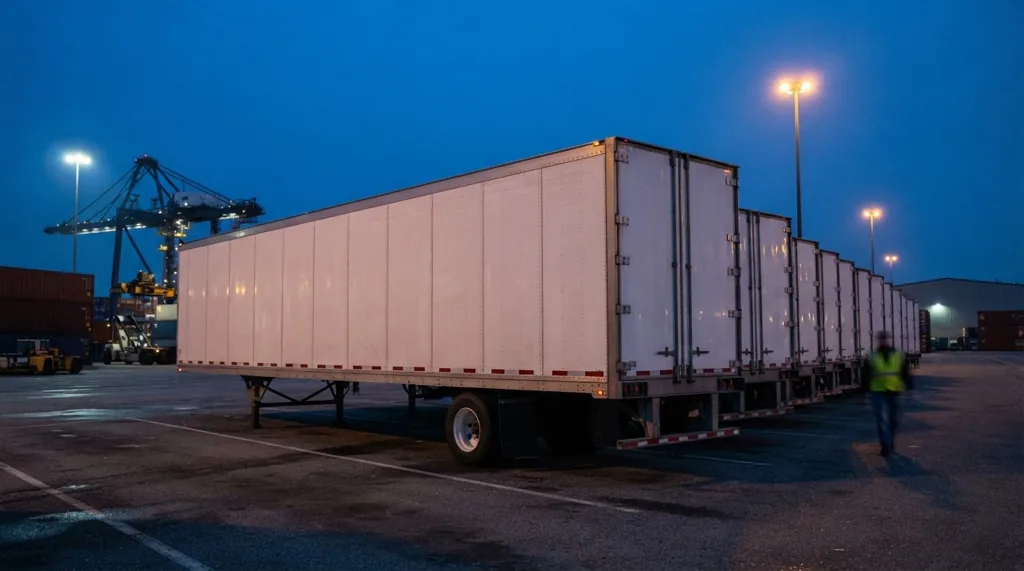
The orders cover van-type trailers, the box trailers towed behind a truck for carrying goods1. They are usually closed rectangular boxes with a front wall, side walls, rear doors, a floor and a roof. They include trailers with or without a refrigeration unit1.
What the trailer orders cover
| Point | Rule |
|---|---|
| Goods | Van-type trailers and subassemblies from China |
| Weight | Gross vehicle weight rating above 26,000 pounds |
| Parts on same load | Covered when on the same bill of lading |
| Processing elsewhere | Does not remove goods from the orders |
| Excluded | Parts under the 2021 Chinese chassis orders |
Only heavy trailers are covered. The trailer must have a gross vehicle weight rating above 26,000 pounds1. The number of axles does not matter.
Parts of these trailers, called subassemblies, are also covered1. The list includes:
- frames and subframes, with the cross pieces and rails that hold the wheels
- wall and roof panels, with or without insulation
- rear door frames and doors, including swing doors and roll-up doors
- rear impact guards, a guard tube with uprights under the rear frame
- coupler assemblies, the front part that connects to the truck
- running gear, meaning axles, suspension, brakes, wheels and tires
- landing gear, two landing legs with braces and a crank handle
These parts are covered whether they arrive alone or together, finished or unfinished1. A trailer missing one of these parts is still covered.
Are parts shipped with a trailer also caught?
Yes. Other components are covered when they arrive on the same bill of lading, the shipping document for one load, as a trailer or subassembly1. Examples include brake assemblies, bare axles, wheels, tires, wiring, lighting, lift gates and refrigeration units.
Extra work does not remove goods from the orders1. Cutting, drilling, painting, coating or assembly in China or in a third country does not change their status. Adding other components does not change it either.
One group of goods is left out. Parts already covered by the 2021 U.S. duty orders on Chinese chassis and their subassemblies are excluded1. Those parts stay under their earlier orders instead.
Which tariff codes apply?
Finished and unfinished trailers usually enter under three codes of the Harmonized Tariff Schedule of the United States (HTSUS), the U.S. customs tariff list. These are 8716.39.0040, 8716.39.0090 and 8716.90.50601.
Parts may also enter under six other codes: 7308.30.5050, 7308.90.9590, 7326.90.8688, 8708.29.1500, 8708.99.8180 and 8716.90.50101. The codes are a guide for customs only. The written description of the goods decides what is covered1.
What about trailers shipped through Canada?
Commerce set special case numbers for Chinese parts that come in through Canada. Importers report these entries under number A-122-219 for dumping3. Subsidy entries go under number C-122-2184.
For a trailer built in Canada with Chinese parts, only the Chinese parts pay the China duties3. Components on the same bill of lading as those Chinese parts also pay3. The rest of the trailer does not.
A third-country exporter not named in the dumping order pays the rate of its Chinese supplier3. In practice, that is the China-wide rate.
When do importers pay the deposits?
U.S. Customs and Border Protection (CBP), the border agency, collects the deposits. Importers pay them at the same time as their normal customs duties1. The deposits restart on the day the ITC’s final ruling is published in the Federal Register1.
Key dates in the trailer cases
Deposits first started earlier in the cases. The subsidy deposits began on June 5, 2026, with Commerce’s preliminary subsidy finding4. The dumping deposits began on June 15, 2026, with its preliminary dumping finding3.
These early deposits could legally last only four months1. The subsidy period ended on Oct. 2, 2026, and the dumping period ended on Oct. 12, 20261.
Shipments in the gap after those dates get relief. Subsidy duties will not be charged on goods entered from Oct. 3, 2026, until the day before the ITC ruling is published1. Dumping duties will not be charged on goods entered from Oct. 16, 2026, over the same gap1.
What happens to goods already imported?
Liquidation is the final settlement of duty on an import entry. CBP will keep entries open, or "suspended", until Commerce tells it the final amount1. The orders stay in force until further notice.
Final duties will be set later, entry by entry, on Commerce’s instructions1. The dumping duty equals the gap between the normal price and the U.S. export price. The subsidy duty is based on the subsidy rates in the order1.
Commerce will also create a contact list for future scope rulings and evasion checks1. Parties who want to join must file a notice within 30 days of the order’s publication1.
Key points on the van-type trailer orders
The table sums up the main facts of the two orders.
| Question | Answer |
|---|---|
| What changed? | Final anti-dumping and subsidy duty orders |
| Who issued it? | U.S. Department of Commerce |
| Which goods? | Van-type trailers and their parts from China |
| Weight limit | Above 26,000 pounds gross vehicle weight rating |
| Dumping margin | 130.86% for all Chinese producers |
| Dumping cash deposit | 129.73% |
| Subsidy rate | 134.75% for all companies |
| Who pays? | U.S. importers, at entry |
| ITC vote | Sept. 25, 2026 |
| Order publication | Oct. 28, 2026 |
| Main tariff codes | 8716.39.0040, 8716.39.0090, 8716.90.5060 |
| Next date | ITC report by Nov. 5, 2026 |
The ITC’s full public report on the case is due by Nov. 5, 20262. Until then, each Chinese van trailer entering the United States carries combined deposits of more than twice its value.
Sources
- ↩ 2026-21929.pdf https://public-inspection.federalregister.gov/2026-21929.pdf
- ↩ Van-Type Trailers and Subassemblies from China Injure U.S. Industry, Says USITC | United States International Trade Commission https://www.usitc.gov/press_room/news_release/2026/er0925_69280.htm
- ↩ Federal Register :: Van-Type Trailers and Subassemblies Thereof From the People’s Republic of China: Final Affirmative Determination of Sales at Less Than Fair Value https://www.federalregister.gov/documents/2026/08/31/2026-17750/van-type-trailers-and-subassemblies-thereof-from-the-peoples-republic-of-china-final-affirmative
- ↩ Federal Register :: Van-Type Trailers and Subassemblies Thereof From the People’s Republic of China: Final Affirmative Countervailing Duty Determination https://www.federalregister.gov/documents/2026/08/31/2026-17749/van-type-trailers-and-subassemblies-thereof-from-the-peoples-republic-of-china-final-affirmative