
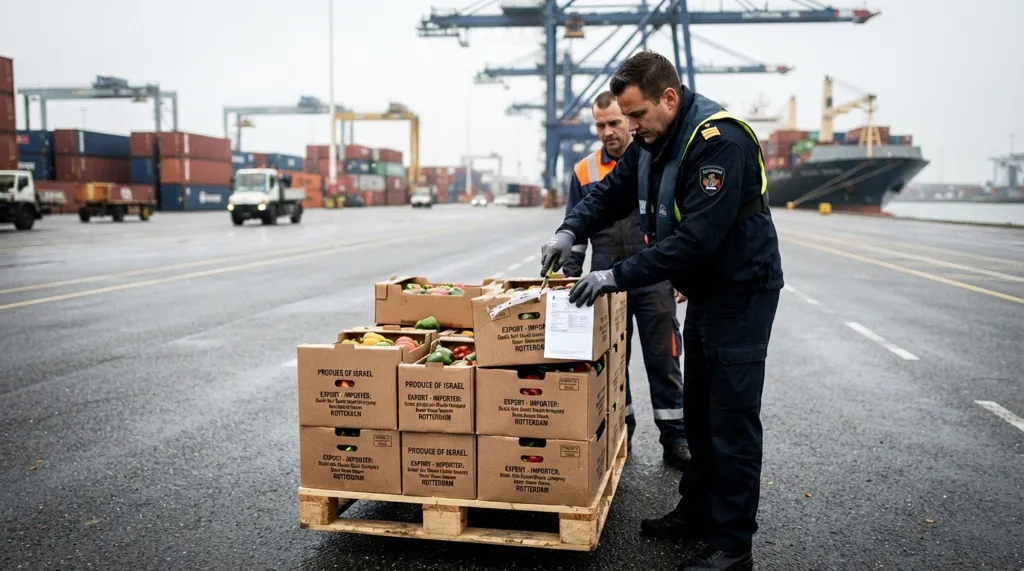
The Netherlands has banned importing, buying and selling goods from unlawful Israeli settlements since Sept. 22, 2026.
The Netherlands has banned the import, purchase and sale of goods from unlawful Israeli settlements, with the ban in force since Sept. 22, 2026.
The rule is a temporary sanctions decree, a government order made under the Dutch Sanctions Act 19771. Dutch Customs enforces it at the border and asks importers of Israeli goods for a new declaration on every shipment2.
In short, goods made in the settlements can no longer be sold in the Netherlands. A shipment from Israel must now carry a code stating that the goods do not come from a settlement, and customs can ask for proof.
What does the Dutch settlement goods decree ban?
The decree was signed on July 13, 2026 and published in the Bulletin of Acts and Decrees, the official gazette for Dutch laws, on July 21, 20263. It appears there as Staatsblad 2026, 2224. Its full name is the Temporary sanctions decree on unlawful settlements in the territories occupied by Israel1.
The five bans in the decree
| Ban | What it forbids |
|---|---|
| Import | Bringing settlement goods into Dutch territory |
| Purchase | Buying settlement goods, directly or indirectly |
| Sale | Selling or offering settlement goods on the EU market |
| Go-between services | Negotiating or arranging deals, also for other EU countries |
| Getting around the rules | Any action meant to avoid the other bans |
The decree sets out five separate bans in its second chapter3. Dutch Customs lists them in plain terms on its information page2. From Sept. 22, 2026, no person or company may:
- import settlement goods into Dutch territory
- buy settlement goods, directly or indirectly
- sell or offer settlement goods on the European Union (EU) market
- act as a go-between, by negotiating or arranging deals in these goods
- try to get around any of these bans
The ban on go-between services is wide. It covers deals in which the goods would be imported, bought or sold in another EU country rather than in the Netherlands1. A Dutch trading company that arranges a sale of settlement goods to a buyer in another EU country can therefore break the rule.
Why did the Dutch government act on settlement goods?
The explanatory note attached to the decree gives the government’s reasons. It states that the Israeli occupation of the Palestinian territories and the Syrian Golan Heights is unlawful, and so are the settlements there3.
The note points to an advisory opinion of the International Court of Justice (ICJ) of July 19, 20243. That opinion said United Nations member states must take steps to prevent trade or investment that helps keep the unlawful situation in place. In September 2024, the United Nations General Assembly adopted Resolution ES-10/24, which called on all states to take such steps3.
That resolution gave Israel 12 months to end the occupation. The note says this period ran out on Sept. 18, 20253. It adds that United Nations figures show settlement building has grown sharply under the current Israeli government3.
The Netherlands first asked for measures at EU level, because trade policy is mainly a matter for the EU3. Before an informal meeting of EU foreign ministers on Aug. 29 and 30, 2025, the Netherlands and Sweden sent a joint letter with proposals3. The note says there was not enough support in the EU, so the government chose a national ban instead3.
Which goods count as settlement goods?
The decree covers goods that are wholly or partly obtained or produced in an unlawful settlement1. This means a product with only some settlement content can fall under the ban. Dutch Customs makes the same point: supporting papers should show where the goods "and/or parts thereof" come from2.
The settlements are not named in the decree itself. Instead, the decree points to the EU postcode list1. The European Commission keeps this list of places and their postcodes. Goods from these places cannot get lower EU tariffs under the EU-Israel trade deal1. Dutch Customs tells traders to use this list to check whether a place is an unlawful settlement2.
Goods that do qualify for those lower tariffs are outside the decree1. The EU-Israel Association Agreement is the trade deal between the EU and Israel, signed on Nov. 20, 19953. Dutch Customs adds that the decree does not change trade with Israel inside its internationally recognised 1967 borders2.
What must importers of Israeli goods declare?
An importer who brings goods of Israeli origin into the Netherlands to sell in the EU must give a statement. It must say that the goods do not come from an unlawful settlement1. The statement goes to officials named by the minister under the Sanctions Act1.
In practice, Dutch Customs collects this statement through a document code on the customs declaration2. There are two codes, depending on the kind of origin the goods have:
- Code 1700 is for goods of non-preferential origin, meaning goods that do not claim the lower tariffs of a trade deal. The code declares that they do not come from the settlements2.
- Code Y864 is for goods of preferential origin, meaning goods that use the lower tariffs of the EU-Israel deal. The code declares that they do not come from an Israeli settlement2.
Dutch Customs also refers traders to a 2015 notice from the European Commission2. That notice sets out the correct origin labels for goods from the settlements and from Palestinian areas outside them2.
What proof can Dutch Customs ask for?
During an inspection, an importer must be able to prove that the goods do not come from a settlement2. Dutch Customs asks importers to keep the papers carefully in their records2. It lists these examples of proof:
- Origin documents, such as certificates or supplier declarations, that state the postcode or place where the goods or their parts come from
- Invoices, contracts and transport papers that state the production site
- Extra declarations from the maker or supplier confirming that production takes place in Israel inside the 1967 borders, also called the Green Line
Papers that can prove goods are not from a settlement
| Document | What it must show |
|---|---|
| Customs declaration code | Code 1700 or Code Y864 |
| Origin documents | Postcode or place where the goods or their parts come from |
| Invoices, contracts, transport papers | The production site |
| Maker or supplier declaration | Production in Israel inside the 1967 borders |
Some importers will be asked for more. Dutch Customs expects extra supporting papers with declarations from importers who regularly import from Israel2. The same applies to those who import larger quantities from Israel, or who regularly buy from the same Israeli supplier2.
Can settlement goods still pass through Dutch ports?
Yes, in two cases. Goods from the settlements may enter the Netherlands if they are not released for sale in the Netherlands2. Dutch Customs allows two routes:
- The goods move straight on to another EU member state under customs transit, the procedure for moving goods under customs control without paying duty.
- The goods are stored in a customs warehouse, and may then go on in transit to another member state.
The decree builds this in through its definition of bringing goods into Dutch territory. That definition leaves out customs transit under the Union Customs Code, the main EU customs law1.
Dutch Customs explains what companies may still do with these goods in transit2. A company may:
- unload containers
- submit customs declarations
- store goods in a customs warehouse
- carry goods by truck to another EU member state
However, a company may not provide go-between trading services for these goods2. Logistics firms and customs brokers can therefore handle transit shipments, but cannot help arrange the sale.
How will the Netherlands enforce the ban?
Breaking the decree is a criminal matter. Dutch Customs warns that anyone who fails to follow it may be liable to prosecution2. The Council of State is the government’s top legal adviser. It notes that Customs and the Fiscal Intelligence and Investigation Service (FIOD) will enforce the decree4. Their special investigators work under the authority of the Public Prosecution Service4.
The Council of State also recorded doubts from these same bodies. FIOD, the prosecutors and Customs said it is hard in practice to check where a product comes from4. Goods could also reach the Netherlands through another EU country4.
Goods moving freely inside the EU are not routinely checked at Dutch borders4. The bans on buying and selling are meant to close that gap4. A shop or wholesaler that sells settlement goods bought in another EU country can break the law even without importing them.
The Council of State accepted the government’s case for the decree. It still advised the government to explain better how enforcement would work4. It also asked why there was no public internet consultation on the draft4.
How long will the settlement goods ban last?
The decree took effect two months after the date of the gazette that published it3. With publication on July 21, 2026, the Foreign Minister confirmed the start date of Sept. 22, 20264.
Key dates of the settlement goods ban
The measure is temporary. The official legal database shows that the decree expires on Sept. 22, 20291. That gives a run of three years unless the government changes it.
Parliament had a chance to step in. Under the Sanctions Act, one fifth of the Senate could ask for the decree to be confirmed by a law4. Because of the summer recess, the deadline for that request was extended to Sept. 30, 20264. The decree is listed as in force from Sept. 22, 2026 to the present1.
The decree does not apply in Aruba, Curaçao and Sint Maarten, the Caribbean countries of the Kingdom4. The Council of State noted that those countries have their own legal powers for such measures4.
Key points on the Dutch settlement goods ban
The table below sums up the main facts of the decree.
| Question | Answer |
|---|---|
| What changed? | Ban on importing, buying and selling settlement goods |
| Who issued it? | Dutch government, on the Foreign Minister’s proposal |
| Legal reference | Staatsblad 2026, 222 |
| Which goods? | Goods wholly or partly made in unlawful settlements |
| How are settlements identified? | EU postcode list |
| Which goods are out? | Goods eligible for EU-Israel lower tariffs |
| What must importers declare? | Code 1700 or Code Y864 |
| Is transit allowed? | Yes, customs transit or customs warehouse |
| Who enforces it? | Dutch Customs and FIOD |
| Penalty | Criminal prosecution |
| Start date | Sept. 22, 2026 |
| End date | Sept. 22, 2029 |
Every shipment of Israeli goods entering the Dutch market now needs Code 1700 or Code Y864 and papers that show the place of production. The ban runs until Sept. 22, 2029, unless the government changes it before then1.
Sources
- ↩ wetten.nl – Regeling – Tijdelijk sanctiebesluit onrechtmatige nederzettingen in de door Israël bezette gebieden – BWBR0052870 https://wetten.overheid.nl/BWBR0052870
- ↩ Temporary sanctions decree unlawful settlements in territories occupied by Israel | Dutch Customs https://www.douane.nl/en/themes/import-and-export/import/temporary-sanctions-decree-unlawful-settlements-in-territories-occupied-by-israel/
- ↩ Staatsblad 2026, 222 | Overheid.nl > Officiële bekendmakingen https://www.officielebekendmakingen.nl/stb-2026-222.html
- ↩ Eerste Kamer der Staten-Generaal https://www.eerstekamer.nl/brief_in/20260721/mededeling_inzake_publicatie/f=/vmzecdj72azk.pdf