
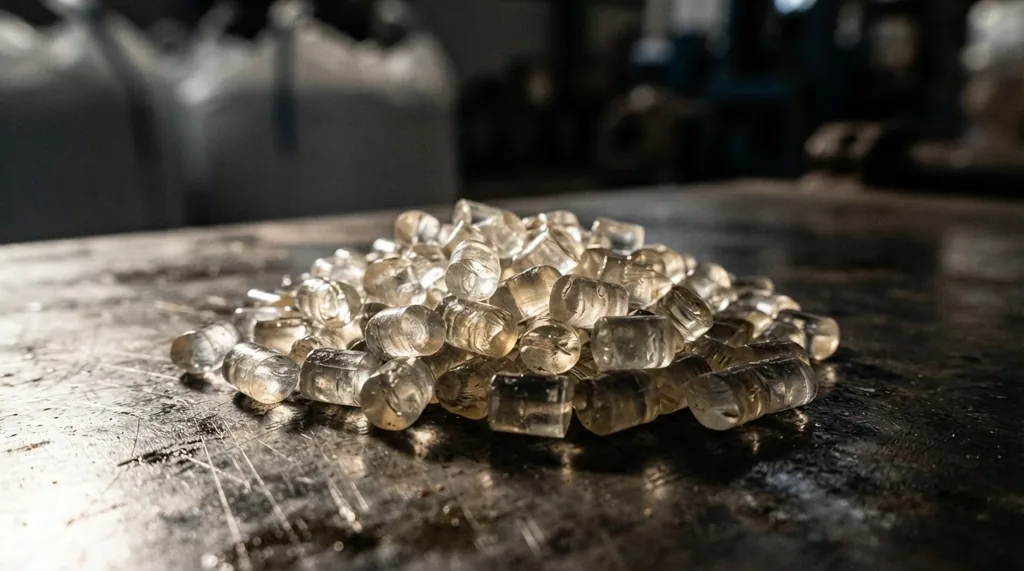
United Kingdom trade investigators propose a 65% duty on PET plastic imports above quarterly quotas, with quotas starting 1 December 2026.
The UK Trade Remedies Authority proposed on Oct. 23, 2026, a 65% duty on bottle plastic imports above quarterly quotas.
The Trade Remedies Authority (TRA) is the UK body that investigates whether imports harm British producers. Its proposal covers virgin and recycled polyethylene terephthalate (PET), the plastic used for drinks bottles, food packaging and clothing fabrics1.
In short, each supplying country or group would get a fixed amount of PET each quarter at the normal duty. Once that amount is used up, further shipments would pay an extra 65% duty.
What is the TRA proposing for PET imports?
The TRA published a provisional affirmative determination (PAD) on Oct. 23, 20262. A PAD is an early finding that sets out the TRA’s case before any final decision.
The TRA found that PET imports grew in large amounts and caused serious harm to UK producers. It recommends a tariff rate quota, a system in which a set amount of goods enters at a lower duty and anything above it pays more2.
The TRA recommends an out-of-quota duty of 65%2. It also recommends a total in-quota amount of 192,963 tonnes2. The quota would be split between the European Union (EU), Mexico, Indonesia, Vietnam and all other suppliers.
The recommendation goes to the Secretary of State for Business, Innovation, Science and Trade, the UK trade minister. The duty only starts if the minister accepts it and publishes a formal notice2.
What is a safeguard measure on PET?
A safeguard is an emergency and temporary limit on imports. It responds to a sudden rise in imports that seriously harms producers at home1.
Unlike an anti-dumping duty, a safeguard does not target unfair prices from one country. If imposed, it applies to imports from all over the world, with some exceptions such as certain developing countries1.
Safeguards are one of three types of trade remedies allowed under World Trade Organization (WTO) rules1. The other two answer goods sold below their normal price and goods that receive unfair government support.
This PET case is the first new safeguard case the TRA has opened since it was set up after the UK left the EU in 20211.
Which PET goods does the proposal cover?
The goods are PET resin, the small pellets or chips that factories melt to make bottles, trays and fibres. The measure covers two kinds2:
- Virgin PET (vPET), made new from oil-based chemicals.
- Recycled PET (rPET), made from used plastic.
What the PET proposal covers
| Point | Proposal |
|---|---|
| Goods | Virgin PET and recycled PET resin |
| Thickness limit | Viscosity number of 74 ml/g or higher |
| Commodity codes | 3907 6100 and 3907 6900, for information only |
| Out-of-quota duty | 65% |
| Exempt | Developing countries listed in Annex 2 of the PAD |
Both kinds are covered only if they have a viscosity number of 74 ml/g or higher2. Viscosity number is a lab measure of how thick the plastic is when dissolved or melted.
The goods currently fall under UK commodity codes 3907 6100 and 3907 69002. The TRA says these codes are given only for information. The written product description decides what is covered, not the code alone.
Several companies asked the TRA to leave recycled PET out of the case. They argued it uses different raw materials, is made in a different way and sells at different prices2. Some also said the applicant does not make recycled PET.
The TRA did not agree at this stage. It found that imported recycled and virgin PET share the same basic structure, have closely similar features and compete in the same UK market2. Recycled PET therefore stays inside the proposal.
How big are the quotas for each supplier?
The TRA proposes quarterly quotas for each supplier. The first two quarters run from 1 December 2026 to 28 February 2027 and from 1 March 2027 to 31 May 20272.
Proposed PET quota, 1 Dec 2026 to 28 Feb 2027, tonnes
The EU gets 77.6% of the quota. Mexico gets 5.4%, Indonesia 3.7% and Vietnam 3.1%. All other countries share a "residual" quota of 10.2%2.
In tonnes, the proposed quotas for the first quarter are2:
- European Union: 36,926.83 tonnes, rising to 37,747.43 tonnes in the second quarter.
- Mexico: 2,571.70 tonnes, then 2,628.85 tonnes.
- Indonesia: 1,779.59 tonnes, then 1,819.13 tonnes.
- Vietnam: 1,475.27 tonnes, then 1,508.06 tonnes.
- All other countries (residual): 4,826.57 tonnes, then 4,933.82 tonnes.
Suppliers outside the named group share the residual quota. That means many countries compete for a small amount each quarter. Their late shipments face the highest chance of paying the 65% duty.
The PAD contains a list of developing countries that are exempt from the measure, in its Annex 22. It also lists exemptions under the UK’s Economic Partnership Agreements with some developing regions, in Annex 32.
Why did the TRA act on PET imports?
The case began with a request from Alpek Polyester UK, a polyester maker based in Redcar1. The company filed its application on June 19, 20262. It says it is the only UK maker of virgin PET, and no one challenged that claim2.
The TRA looked at the years 2021 to 20252. Customs data from HM Revenue and Customs (HMRC), the UK tax and customs agency, showed PET imports rose 68% over that period2.
Imports did not rise every year. They dipped between 2022 and 2023 but stayed above the 2021 level. They then rose sharply between 2024 and 20252.
At the same time, UK production fell. On the TRA’s index, with 2021 set at 100, UK output dropped to 59 by 20252. Imports compared with UK production rose from 100 to 284 on the same kind of index2.
The TRA said the size of the rise, and the fact that imports stayed high, showed a significant increase2. It also found the rise caused serious harm to UK producers.
In 2025, total UK imports of PET were worth over £300 million1.
Who is affected by the PET safeguard?
UK importers and buyers of bottle-grade PET would face the largest change. Bottle makers, food packaging firms and textile users buy this resin1. Once a supplier’s quarterly quota is full, their next shipment from that source would cost 65% more in duty.
Makers and exporters abroad would compete for limited quota space. EU suppliers hold most of it. Suppliers in countries without their own share would draw on the residual quota.
UK recycled PET makers are also counted as UK producers in the case. The PAD names Clean Tech UK (Plastipak), Esterpet (Biffa) and Jayplas2. None of them registered an interest or sent information to the TRA2.
Customs brokers would need to track which country quota a shipment falls under. A shipment declared after its quota is full would carry the higher duty.
How would the PET quota and duty work?
If the minister accepts the recommendation, the steps would run in this order2:
- The Secretary of State publishes a Taxation Notice, a formal notice that puts the duty into force.
- The quotas open for each quarter, starting with the period from 1 December 2026.
- PET shipments enter at the in-quota rate until a supplier’s quarterly amount is used up.
- Shipments above that amount pay the 65% out-of-quota duty.
- The provisional measure ends after 200 days, or earlier if a final measure replaces it.
The 200 days would count from the day after the Taxation Notice is published2. The measure would end sooner if a definitive measure, the final long-term decision, is put in place first2.
The TRA says this temporary measure is needed to stop serious harm that would be hard to repair during the investigation2. It also says the measure passes its economic interest test, a check on whether a measure is good for the UK economy as a whole2.
When can companies comment on the PET proposal?
Companies and other parties can comment on the PAD until 23:59 GMT on 22 November 20262. Comments go through the Trade Remedies Service, the TRA’s online case system.
Key dates in the PET case
Each comment must come with a non-confidential version. That version is placed on the public file for other parties to read2.
The TRA will answer comments in its Statement of Intended Final Determination, the next report in the case2. It may consider late comments but does not have to if they would cause delay.
The case file holds a bundle of 52 registration files3. Taiwan’s government sent a submission on Oct. 21, 20263. The UK also notified the WTO’s Committee on Safeguards when it opened the case on Aug. 5, 20264.
Key points on the UK PET safeguard
The main facts of the proposal are below.
| Question | Answer |
|---|---|
| What changed? | TRA proposed a temporary safeguard |
| Who issued it? | UK Trade Remedies Authority |
| Which goods? | Virgin and recycled PET resin, 74 ml/g or higher |
| Commodity codes | 3907 6100 and 3907 6900 |
| Out-of-quota duty | 65% |
| Total in-quota amount | 192,963 tonnes |
| Largest quota share | European Union, 77.6% |
| First quota quarter | 1 December 2026 to 28 February 2027 |
| Comment deadline | 22 November 2026 |
| Who decides? | The UK trade minister (Secretary of State) |
| How long? | Up to 200 days |
The duty is not yet in force. Comments close on 22 November 2026, and the proposed first quota quarter begins on 1 December 2026 if the minister accepts the recommendation.
Sources
- ↩ TRA opens new safeguard investigation into PET – GOV.UK https://www.gov.uk/government/news/tra-opens-new-safeguard-investigation-into-pet
- ↩ CD-01801_SG0094, Provisional Affirmative Determination, PET Safeguard.pdf https://trav.gov.vn/data/00195410-a87c-4a80-989d-83a83a4e020d/userfiles/files/CD-01801_SG0094,%20Provisional%20Affirmative%20Determination,%20PET%20Safeguard.pdf
- ↩ Trade Remedies Authority | SG0094 https://public-file.trade-remedies.service.gov.uk/case/sg0094
- ↩ WTO | 2026 News items – United Kingdom launches safeguard investigation on polyethylene terephthalate https://www.wto.org/english/news_e/news26_e/safe_gbr_05aug26_472_e.htm