
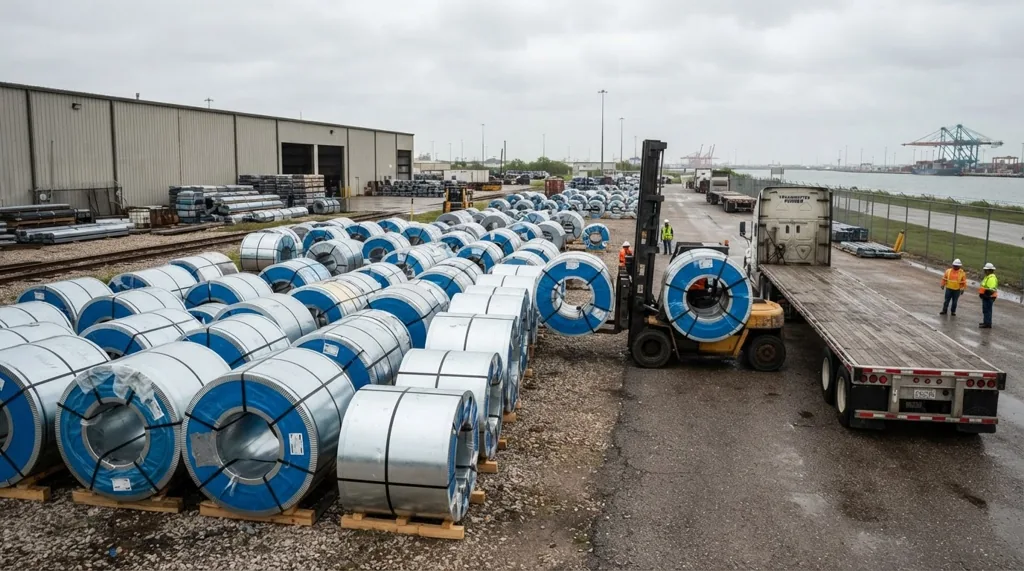
United States lowers anti-dumping rates on Mexican coated steel to 14.54% for Galvasid and 14.29% for others from Oct. 29, 2026.
The U.S. Commerce Department has cut anti-dumping rates on Mexican zinc- and aluminium-coated steel after a court ruling, applicable from Oct. 29, 2026.
The change follows a final judgment by the U.S. Court of International Trade (CIT) on Oct. 19, 20261. Commerce lowered the dumping margin for the Mexican producer Galvasid S.A. de C.V. to 14.54% and the rate for all other Mexican producers and exporters to 14.29%1.
In short, Mexican coated steel from Galvasid and from most other Mexican makers now carries a lower anti-dumping rate. The cash deposit that importers pay at the border will change once Commerce sends new instructions to U.S. customs.
What changed for Mexican coated steel?
An anti-dumping duty is an extra import tax on goods sold abroad below their normal price. The United States has applied one to corrosion-resistant steel from Mexico since its order of December 20252. The notice published on Nov. 2, 2026 amends that order and the final finding behind it1.
Dumping rates, before and after the court ruling
| Producer | December 2025 order | From Oct. 29, 2026 |
|---|---|---|
| Galvasid | 24.09% | 14.54% |
| All other producers | 17.42% | 14.29% |
| Ternium Mexico and Tenigal | 14.17% | Unchanged in this notice |
The amendment touches two rates only. Galvasid’s margin is now 14.54%, and the rate for all other producers and exporters is now 14.29%1. Both rates are lower than the ones set in December 2025.
Commerce issued the change through its International Trade Administration, the agency that runs U.S. trade remedy cases1. The case number is A-201-8633.
How far did the Galvasid and all-others rates fall?
In its December 2025 order, Commerce set Galvasid’s dumping rate, together with its related company Perfiles LM, S.A. de C.V., at 24.09%2. The all-others rate was 17.42%2. These figures were themselves a small correction of the August 2025 final finding, which had set 24.05% and 17.40%4.
Anti-dumping rates on Mexican coated steel, %
The new figures bring Galvasid down by 9.55 percentage points, from 24.09% to 14.54%. The all-others rate falls by 3.13 points, from 17.42% to 14.29%1.
The notice names "Galvasid S.A. De C.V." alone in its table1. The earlier order listed Galvasid and Perfiles LM together as one exporter2. The new notice does not say whether Perfiles LM keeps the joint listing.
Why did Commerce change the rates?
Galvasid challenged the August 2025 final finding at the CIT1. On July 24, 2026, the court sent the decision back to Commerce for a second look1.
From court challenge to new rates
The court told Commerce to recalculate Galvasid’s margin without a penalty. Commerce had used "adverse facts available", which means it filled a gap in a company’s data with figures that work against that company1. The gap was Galvasid’s failure to report freight and insurance income on U.S. sales separately1.
In its reworked decision of Sept. 22, 2026, Commerce reversed that finding1. It removed an adjustment it had made to Galvasid’s reported U.S. selling price. It also recalculated the rate for all other companies1. The court accepted the reworked decision in its final judgment of Oct. 19, 20261.
Why does the all-others rate move too?
The all-others rate applies to Mexican makers that Commerce did not examine one by one. Under U.S. law, Commerce sets it as a weighted average of the margins of the companies it did examine4. Zero rates, very small rates and rates based wholly on penalty data are left out4.
In the Mexican case, Commerce examined two producer groups: Galvasid with Perfiles LM, and Ternium Mexico with Tenigal4. A lower Galvasid margin therefore pulls down the average, and so the all-others rate drops as well.
The notice does not change the rate for Ternium Mexico S.A. de C.V. and Tenigal, S. de R.L. de C.V.1. In the December 2025 order, that group had a dumping rate of 14.17% and a cash deposit rate of 1.07%2.
Which steel products does the order cover?
The order covers flat-rolled steel coated with metals that stop rust, such as zinc, aluminium, or zinc-, aluminium-, nickel- or iron-based alloys4. This is often called galvanized or coated sheet steel. The coated steel may also be painted, varnished or covered in plastic4.
The product is covered in coils at least 12.7 mm wide, and in straight lengths that meet set width and thickness limits4. Iron must be the main element by weight, and carbon must be 2% or less4. Steel from Mexico that is further processed in another country, for example painted, cut or slit, is still covered4.
Some coated steel is outside the order:
- Tin, lead or chromium coatings, including tin plate and "tin free steel"4.
- Thick clad products in straight lengths of 4.7625 mm or more4.
- Certain stainless-clad sheet, with carbon steel clad on both sides with stainless steel in a 20%-60%-20% ratio4.
These exclusions come from the scope text of the original investigation. Commerce made no changes to that text in its August 2025 final finding4.
Which tariff codes are listed?
The scope text published with the parallel Mexican subsidy case lists the main U.S. tariff codes. They include headings under 7210, 7212, 7225 and 7226, such as 7210.30.0030, 7210.41.0000 and 7212.30.10305. Goods may also enter under codes in 7215, 7217, 7228 and 72295.
The codes are for customs convenience only5. The written description of the goods decides whether a shipment is covered5.
What happens to cash deposits at the border?
A cash deposit is money an importer pays to customs at entry, as security against the final anti-dumping duty. Commerce said it will issue revised cash deposit instructions to U.S. Customs and Border Protection (CBP)1. The notice does not give the new cash deposit rates themselves.
That detail matters because the earlier order had two figures for each company. One was the dumping rate. The other was a cash deposit rate, lowered to offset export subsidies counted in the companion subsidy case2. For example, the all-others group paid a cash deposit of 4.32% against a dumping rate of 17.42%2.
Commerce adjusts the deposit for export subsidies when a companion subsidy case finds them4. The new notice states only the dumping margins1. The deposit that applies to each shipment will follow from the CBP instructions.
Why is this called a "Timken notice"?
U.S. courts require Commerce to publish a notice when a court decision is "not in harmony" with a Commerce decision1. This rule comes from a federal appeals court case, Timken, later clarified in Diamond Sawblades1.
The same rule requires Commerce to keep entries open while a court decision is not yet "conclusive"1. In customs language, this is called suspending liquidation: customs does not settle the final duty on an entry. Commerce said the CIT judgment of Oct. 19, 2026 is a final decision of that court1.
The notice is dated Oct. 28, 2026 and is applicable from Oct. 29, 20261. It was published in the Federal Register on Nov. 2, 20263.
Who is affected by the new rates?
The change matters most to three groups:
- U.S. importers of Galvasid steel, whose duty rate drops from 24.09% to 14.54%1.
- Importers from smaller Mexican makers, which use the all-others rate, now 14.29%1.
- Customs brokers, who will work with the new rates once CBP receives Commerce’s instructions.
Imports from Ternium Mexico and Tenigal see no change in this notice. U.S. buyers of coated sheet, such as builders and makers of car parts or appliances, may face lower landed costs from Mexican suppliers.
The original investigation covered sales from July 1, 2023 to June 30, 20241. Anti-dumping duties on this steel apply to entries made on or after April 10, 2025, the date of the preliminary finding2. Entries made after the provisional period ended on Oct. 6, 2025 and before the U.S. International Trade Commission’s final injury finding were left out2.
Key points on the Mexican coated steel duty
The table below sums up the change.
| Question | Answer |
|---|---|
| What changed? | Lower anti-dumping rates on Mexican coated steel |
| Who issued it? | U.S. Commerce Department |
| Why? | Final CIT judgment of Oct. 19, 2026 |
| Which goods? | Corrosion-resistant (coated) flat-rolled steel |
| Galvasid new rate | 14.54% |
| Galvasid old rate | 24.09% |
| All-others new rate | 14.29% |
| All-others old rate | 17.42% |
| Ternium/Tenigal | Unchanged in this notice |
| Applicable from | Oct. 29, 2026 |
| Next step | Revised cash deposit instructions to CBP |
The next step is the revised cash deposit instructions from Commerce to CBP1. Those instructions will carry the lower margins into the deposit paid on each shipment of Mexican coated steel.
Sources
- ↩ Federal Register :: Corrosion-Resistant Steel Products From Mexico: Notice of Court Decision Not in Harmony With the Final Determination of Antidumping Duty Investigation; Notice of Amended Final Determination; Notice of Amended Antidumping Duty Order, in Part https://www.federalregister.gov/documents/2026/11/02/2026-22351/corrosion-resistant-steel-products-from-mexico-notice-of-court-decision-not-in-harmony-with-the
- ↩ Federal Register, Volume 90 Issue 242 (Friday, December 19, 2025) https://www.govinfo.gov/content/pkg/FR-2025-12-19/html/2025-23431.htm
- ↩ 2026-22312.pdf https://www.govinfo.gov/content/pkg/FR-2026-11-02/pdf/2026-22312.pdf
- ↩ Federal Register :: Certain Corrosion-Resistant Steel Products From Mexico: Final Affirmative Determination of Sales at Less Than Fair Value https://www.federalregister.gov/documents/2025/08/29/2025-16605/certain-corrosion-resistant-steel-products-from-mexico-final-affirmative-determination-of-sales-at
- ↩ Federal Register, Volume 90 Issue 166 (Friday, August 29, 2025) https://www.govinfo.gov/content/pkg/FR-2025-08-29/html/2025-16606.htm