
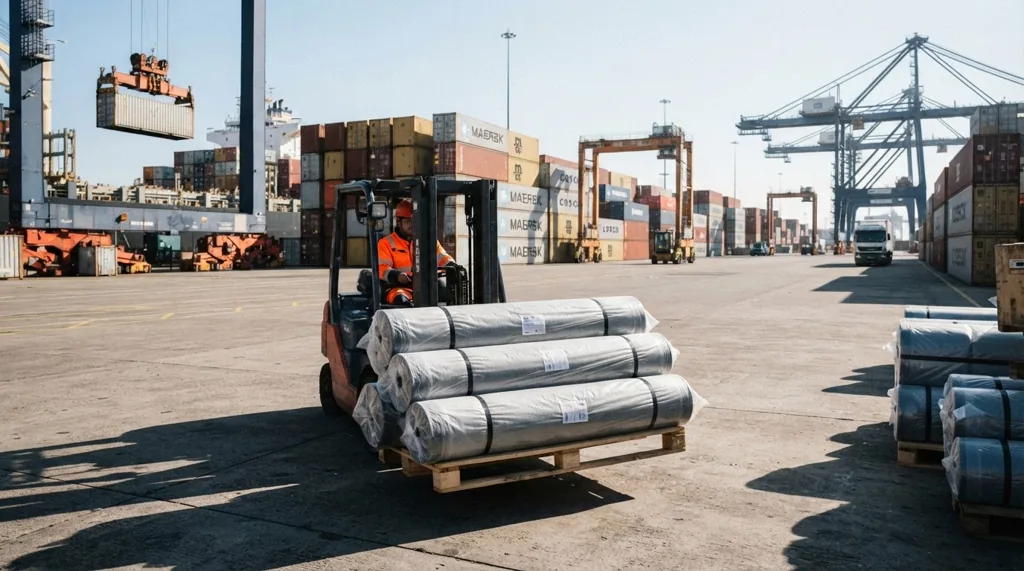
European Union importers of Chinese PET spunbond roofing fabric pay final extra duties of 39.8% to 48.1% from 31 October 2026.
The European Commission has set final anti-dumping duties of 39.8% to 48.1% on Chinese PET spunbond, a roofing fabric, from 31 October 2026.
Commission Implementing Regulation (EU) 2026/2393 appeared in the Official Journal of the European Union on 30 October 20261. EUR-Lex, the EU’s official law database, lists 31 October 2026 as its date of effect and 31 October 2031 as its end date2.
In short, Chinese PET spunbond entering the EU now pays an extra import tax of 39.8% to 48.1% for five years. Money already secured under the temporary duties since May 2026 will be collected for good.
What is PET spunbond and where is it used?
PET spunbond is a non-woven fabric made from polyester threads that are punched together with needles3. It may be reinforced with glass fibre or not3. Its main use is as a carrier for waterproofing material, for example on roofs in the construction sector3.
The provisional regulation explains how the fabric is made4. Factories melt plastic pellets called PET chips and spin them into long threads. The threads are laid into a web, joined by needle-punching and held together with a starch or plastic binder4.
Buyers usually receive it in large rolls or cut to size4. Roofing makers soak this carrier in bitumen, a petroleum-based material that keeps water out, to make bituminous roofing membranes4.
Which PET spunbond imports pay the new duty?
The duty covers a narrow product defined by weight, thickness and glass content. The goods must be non-woven, needle-punched sheets of polyester filaments, with or without glass fibre4. They must also meet all of these conditions4:
- weight above 70 g/m2, meaning more than 70 grams per square metre;
- thickness above 0.5 mm and no more than 1.8 mm;
- impregnated with one or more binders, the glue that holds the fibres together;
- less than 30% glass fibre by weight;
- not coated or covered.
What the covered fabric must be
| Feature | Condition |
|---|---|
| Weight | Above 70 g/m2 |
| Thickness | Above 0.5 mm, up to 1.8 mm |
| Binder | Impregnated with one or more binders |
| Glass fibre | Less than 30% by weight |
| Surface | Not coated or covered |
| Origin | China |
At the border, the goods fall under Combined Nomenclature (CN) codes, the EU’s customs product codes, ex 5603 13 90, 5603 14 20 and ex 5603 14 804. The "ex" means that only part of the code is covered. The detailed EU tariff codes, called TARIC codes, are 5603 13 90 70 and 5603 14 80 704.
Fabric made from short cut fibres, known as staple fibres, is outside the case4. Only fabric made of continuous man-made filaments is covered4. The duty applies only to goods that originate in China1.
How high are the new PET spunbond duties?
The final duties range from 39.8% to 48.1% of the import value, depending on the producer3. The Commission set them for five years3. Temporary duties of 45.6% to 50% had applied since May 20263.
PET spunbond duty rates, % of import value
The final rates are therefore lower than the temporary ones at both ends of the range. The top rate falls from 50% to 48.1%, and the lowest from 45.6% to 39.8%3.
The final regulation explains part of the change. After the Commission shared its final findings, comments from some parties led it to revise the dumping margins and the final duty levels1. A dumping margin is the gap between the export price and the product’s normal price. The Commission then sent all parties an extra notice of these changes and invited comments1.
Why did the European Commission act on PET spunbond?
The investigation found that PET spunbond from China was entering the EU at dumped prices, meaning prices below the product’s normal value3. The Commission said this was harming the EU’s own producers, which are in Germany, Italy and France3. It values the EU market for this product at €200m3.
Two companies filed the complaint on 8 August 2025: Freudenberg Performance Materials and Johns Manville1. The Commission describes them as the only known EU producers of PET spunbond1.
China’s economy was judged to have significant distortions in this sector, meaning prices there are shaped by the state1. The Commission therefore did not use Chinese costs to set the normal price. It chose Thailand as the reference country for this calculation1.
Hubei Unibon Nonwovens, a Chinese exporter, argued that Thai prices for PET chips were not comparable1. It said Indonesian import prices of RMB 7.3 per kg should be used instead of RMB 11.1 per kg for Thailand1. The Commission rejected this, because no evidence showed that the Thai chips were chemically different1.
Which Chinese companies were investigated?
Eight Chinese exporters came forward, and the Commission picked a sample of two, one of them made up of two companies4. Officials checked the records of these Chinese producers on site4:
- Changde Tiandingfeng Nonwovens Co Ltd, Changde City, Hunan province;
- Tiandingfeng Nonwovens Co Ltd, Dezhou City, Shandong province;
- Hubei Unibon Nonwovens Co Ltd, Jingmen City, Hubei province.
The final regulation refers to the two Tiandingfeng companies together as the TDF Group1. Officials also visited three EU producers: Johns Manville GmbH in Germany, Politex SAS di Freudenberg Politex SRL in Italy and Freudenberg Performance Materials S.A.S in France4.
The Commission’s announcement gives only the range of rates3. It does not list the rate for each company. Each exporter’s own rate is set in the final regulation.
What did EU roofing makers argue?
Users of the fabric pushed back. An Italian roofing membrane maker, Matco S.r.l, and SITEB, an Italian industry group, took part1. Four other Italian membrane makers also commented: Valli Zabban, General Membrane, Casali Industria Chimica e Bituminosa and Vetroasfalto1.
They said the Commission had not heard users properly and should have sent them a special questionnaire1. The Commission replied that users had to come forward within the deadline in the opening notice1. It said users did not send questionnaire replies, so it could not study jobs at risk in more detail1.
The Italian users also asked for different treatment of fabric built into membranes later sold outside the EU1. The Commission rejected this. It found that the fabric is the same product whether the final membrane is sold in the EU or exported1.
During the investigation, some suppliers to EU producers and the European nonwovens association, EDANA, supported the case4. A Polish roofing membrane association also backed it. A German user raised concern about its security of supply from China4.
What changes for importers and roofing makers?
Importers of the covered fabric from China must now pay the anti-dumping duty, an extra import tax on goods sold abroad below their normal price. Customs collects it on top of the normal import duty when the goods are released for sale in the EU.
Makers of roofing membranes that buy Chinese carrier fabric will likely face higher input costs. The EU producers named in the case gain protection from cheaper Chinese supply for five years3.
Chinese exporters face a rate that depends on their company. Fabric that falls outside the product definition, such as fabric with 30% or more glass fibre or coated sheets, is not covered by this duty4.
How did the PET spunbond case unfold?
The case moved from complaint to final duty in about 14 months. These are the main steps in the documents:
- 8 August 2025: Freudenberg Performance Materials and Johns Manville filed the complaint1.
- 15 September 2025: the Commission opened the investigation1. Hong Kong’s Trade and Industry Department told local traders the same day5.
- 1 December 2025: imports were made subject to registration under Implementing Regulation (EU) 2025/24091. Registration lets customs track shipments so duties could later be charged on them.
- 14 May 2026: temporary duties began under Implementing Regulation (EU) 2026/1063 of 12 May 20261.
- 29 October 2026: the Commission adopted the final regulation1.
- 31 October 2026: the final duties take effect2.
From complaint to final duty
The investigation covered sales from 1 July 2024 to 30 June 20251. Trends in harm to EU producers were studied from 1 January 20221.
What happens next for PET spunbond duties?
The final duties stay in place until 31 October 2031, according to EUR-Lex2. The case, numbered AD738 on the Commission’s trade defence website, lists the final measures as published on 29 October 20266.
The final regulation also collects the temporary duty for good1. This means amounts secured on shipments during the temporary period will be kept, under the regulation’s rules, rather than released.
Key points on the PET spunbond anti-dumping duty
The table below sums up the main facts of the case.
| Question | Answer |
|---|---|
| What changed? | Final anti-dumping duties on PET spunbond |
| Who issued it? | European Commission |
| Legal act | Implementing Regulation (EU) 2026/2393 |
| Which goods? | Polyester needle-punched roofing carrier fabric |
| Customs codes | ex 5603 13 90, 5603 14 20, ex 5603 14 80 |
| Which origin? | China |
| Final duty rates | 39.8% to 48.1% |
| Earlier temporary rates | 45.6% to 50% |
| Who pays? | Importers of Chinese PET spunbond |
| Start date | 31 October 2026 |
| End date | 31 October 2031 |
From 31 October 2026, each shipment of covered Chinese PET spunbond carries the extra duty for five years, until 31 October 20312.
Sources
- ↩ Implementing regulation – EU – 2026/2393 – EN – EUR-Lex — oj / eng https://eur-lex.europa.eu/eli/reg_impl/2026/2393/oj/eng
- ↩ Implementing regulation – EU – 2026/2393 – EN – EUR-Lex — EN / ALL https://eur-lex.europa.eu/legal-content/EN/ALL/?uri=CELEX:32026R2393
- ↩ Commission acts against imports of PET Spunbond from China – Trade and Economic Security https://policy.trade.ec.europa.eu/news/commission-acts-against-imports-pet-spunbond-china-2026-10-30_en
- ↩ Implementing regulation – EU – 2026/1063 – EN – EUR-Lex https://eur-lex.europa.eu/eli/reg_impl/2026/1063/oj/eng
- ↩ Trade and Industry Department – European Union (EU)* : Initiation of an anti-dumping proceeding on imports of PET Spunbond originating in the Mainland of China https://www.tid.gov.hk/en/tradecircular/2025/ci7842025.html
- ↩ Trade defence investigations https://tron.trade.ec.europa.eu/investigations/case-history?caseId=2811