
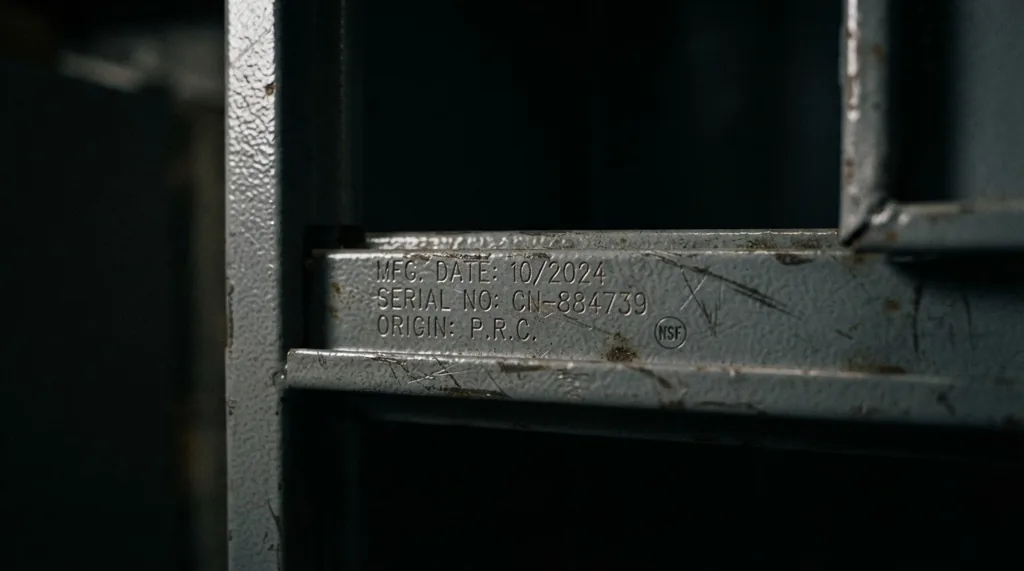
The United States found on Nov. 4, 2026, that Chinese metal lockers would still be dumped if the extra duty ended.
In a notice published Nov. 4, 2026, the U.S. Department of Commerce found dumping of Chinese metal lockers would continue without the duty.
The ruling is the first five-year check, called a sunset review, of the anti-dumping duty order on these lockers1. An anti-dumping duty is an extra import tax on goods sold abroad below their normal price.
In short, nothing changes yet at the border. Metal lockers and locker parts from China still face the extra duty, and a second agency must now decide whether the order stays.
What did Commerce decide on metal lockers?
Commerce found that ending the order "would be likely to lead to continuation or recurrence of dumping"1. In plain words, Chinese makers would probably go back to selling lockers in the United States below their normal price.
Commerce also estimated how deep that price-cutting would be. It said the dumping margins likely to return would reach up to 322.25%1. A dumping margin is the gap between the normal price and the export price, shown as a share of the export price.
The notice was signed on Oct. 30, 2026, by Scot Fullerton, Commerce’s acting deputy assistant secretary for anti-dumping and countervailing duty work1. It was published in the Federal Register, the U.S. government’s daily official journal, and applies from Nov. 4, 20261.
Why was the locker review fast-tracked?
The review was short because only one side took part. Commerce opened the review on July 2, 2026, under the Tariff Act of 1930, the main U.S. trade remedy law1.
Two U.S. locker makers then said they wanted to take part. List Industries, Inc. and Tennsco LLC filed a notice of intent on July 16, 20261. They claimed a place in the case as makers of lockers in the United States.
On July 31, 2026, the two companies filed a full written response to Commerce1. No Chinese maker, exporter or importer sent a response. Because of this, Commerce ran an expedited 120-day review instead of a full one1.
An expedited review means Commerce decides mainly on the record already in front of it. It does not collect new price data from Chinese companies. The 322.25% figure is the same as the highest rate found in the original 2021 case.
Where did the 322.25% figure come from?
The figure traces back to the original investigation. Commerce announced its final findings in that case on June 29, 20212. It set separate rates for different Chinese companies.
The rates from that 2021 case were:
- Hangzhou Xline Machinery & Equipment Co., Ltd., exported through Hangzhou Jusheng Metal Products Co., Ltd.: 0.00%2.
- Zhejiang Xingyi Metal Products Co., Ltd. and Xingyi Metalworking Technology (Zhejiang) Co., Ltd.: 21.25%, or 10.71% after adjustment2.
- Separate rate companies, which showed they act apart from the Chinese state: 21.25%, or 10.71% after adjustment2.
- The China-wide entity, covering all other Chinese exporters: 322.25%, or 311.71% after adjustment2.
The adjusted rates are lower because Commerce took away an amount for export subsidies2. This avoids taxing the same subsidy twice, since a second duty already targets it.
These are the rates set in 2021. Later yearly reviews of the order were also published, including final results in April 20251. Those reviews can change the rate for a single company, so the rate on a given shipment may differ from the 2021 table.
Is there also an anti-subsidy duty on lockers?
Yes. Commerce ran a second case at the same time, against Chinese government subsidies2. The duty from that case is called a countervailing duty. It is an extra import tax that cancels out help a foreign government gives its makers.
In 2021, Commerce set a subsidy rate of 24.66% for Zhejiang Xingyi Metal Products Co., Ltd. and for all other companies2. It set 131.51% for a group of Chinese companies that did not answer its questions2.
Both orders took effect on Aug. 20, 20213. Commerce’s new ruling covers only the anti-dumping order1. The second agency’s review, described below, covers both orders3.
Which lockers and parts does the order cover?
The order covers metal storage lockers, with or without doors, and their parts4. Each locker must be less than 27 inches wide and less than 27 inches deep4. In a bank of joined lockers, the width of each single locker counts, not the whole unit.
What the lockers order covers
| Point | Rule |
|---|---|
| Goods | Metal lockers, with or without doors, and parts |
| Size | Less than 27 inches wide and deep |
| Forms | Assembled units, flat-pack kits, bulk parts |
| Main tariff code | HTSUS 9403.20.0078 |
| Parts code | HTSUS 9403.90.8041 |
The lockers are usually made of flat sheet steel, stainless steel, aluminium, or metal mesh4. They can stand on the floor, sit on a base, or hang on a wall. Doors may include clear plastic panels.
The order covers lockers shipped in several forms4:
- Assembled units, welded or otherwise ready for use.
- Flat-pack kits, called knocked-down units, that a buyer must put together.
- Bulk parts, such as all backs in one crate and all sides in another.
The order also covers sheet metal parts imported on their own4. These include doors, frames, shelves, side panels, slanted tops, bases, filler panels, dividers, trim and end caps. Assembly hardware is covered when it ships with the locker, except the lock4.
U.S. customs usually classifies the lockers under tariff code HTSUS 9403.20.00784. Parts fall under 9403.90.8041, and some lockers may enter under 9403.20.00504. The codes are only a guide. The written product description decides what is covered4.
Which lockers are left out of the duty?
Several kinds of lockers are not covered4. The main exclusions are:
- Large wire mesh lockers, with at least three mesh sides, width and depth over 25 inches, and height over 90 inches.
- Lockers with non-metal bodies, made fully of plastic, wood or other non-metal material.
- Exchange lockers, with many small doors on one large master door, such as uniform exchange lockers.
- Internet-connected lockers, imported with an installed electronic lock that links to other online devices.
- Bulk hardware imported alone, such as locks, rivets, bolts, hinges, handles and coat hooks.
Parts for exchange lockers that arrive on their own, not as a full kit, stay covered4. Sheet metal accessories such as end panels and bases also stay covered.
Certain metal safes are also out. In 2024, Commerce removed safes that meet strict security tests from both orders4. These safes need pry-resistant hinges, steel walls of at least 17 gauge, and strong steel locking bolts. The exclusion applies back to Dec. 1, 20214.
Who is affected by the locker ruling?
U.S. importers of Chinese metal lockers carry the most direct cost. They must keep paying cash deposits of anti-dumping duty when shipments enter the United States. U.S. Customs and Border Protection, the border agency, collects those deposits.
Chinese locker makers and exporters face the same price barrier as before. The China-wide rate of 322.25% from 2021 is more than three times the value of the goods2. No Chinese company defended its case in this review1.
U.S. makers gain the most from the ruling. The original complaint in 2020 came from four companies2:
- DeBourgh Manufacturing Co., of La Junta, Colorado.
- List Industries, Inc., of Deerfield Beach, Florida.
- Penco Products, Inc., of Greenville, North Carolina.
- Tennsco LLC, of Dickson, Tennessee.
U.S. buyers of imported lockers keep paying prices that include the duty cost. Buyers of excluded goods, such as safes or connected smart lockers, are not affected.
How large was the trade in Chinese lockers?
The import figures show how much trade was at stake. Imports under the main locker tariff codes from China were worth $1.91 billion in 20182. They fell to $1.04 billion in 2019 and to $612 million in 20202.
Imports from China under locker tariff codes, USD
These figures may overstate locker trade. The same tariff codes also cover goods that are not part of the case2. The U.S. makers estimated 2019 imports at 79 million pounds of lockers and parts2.
The case moved through several steps before the order. The complaint was filed on July 9, 2020, and Commerce started its case on July 29, 20202. Commerce made its final finding on June 28, 2021, and the order was issued on Aug. 19, 20212.
What happens next for the lockers order?
The order does not stay in place on Commerce’s ruling alone. The U.S. International Trade Commission (ITC), an independent agency that judges harm to U.S. industry, must also decide5. It will rule on whether ending both orders would likely bring back harm to U.S. locker makers.
Next steps in the lockers review
The ITC started its review on July 1, 20263. On Oct. 5, 2026, it found the U.S. makers’ response adequate and the Chinese side’s response inadequate5. It therefore chose an expedited ITC review as well. One commissioner, Commissioner Kearns, voted for a full review5.
The ITC has set these next dates5:
- Jan. 28, 2027: the ITC staff report goes to parties with access to confidential files.
- Feb. 4, 2027: written comments on the decision are due by 5:15 p.m.
Only List Industries and Tennsco may file comments as parties5. People who are not parties may send a short statement by the same date. Comments may not contain new facts5.
If the ITC also votes yes, the orders on Chinese lockers stay in place for another five years. If it votes no, the orders end.
Key points on Chinese metal lockers duty
The table below sums up the ruling and the next steps.
| Question | Answer |
|---|---|
| What changed? | Commerce found dumping would continue without the order |
| Who issued it? | U.S. Department of Commerce |
| Which goods? | Metal lockers and parts from China |
| Size limit | Less than 27 inches wide and deep |
| Likely dumping margin | Up to 322.25% |
| Type of review | Expedited 120-day sunset review |
| Who took part? | List Industries and Tennsco |
| Applies from | Nov. 4, 2026 |
| Original order date | Aug. 20, 2021 |
| Who decides next? | U.S. International Trade Commission |
| Next deadline | ITC comments due Feb. 4, 2027 |
Until the ITC rules, shipments of covered Chinese metal lockers keep paying the anti-dumping duty at the border. The next fixed date is Feb. 4, 2027, when written comments to the ITC are due5.
Sources
- ↩ Federal Register :: Certain Metal Lockers and Parts Thereof From the People’s Republic of China: Final Results of the Expedited First Sunset Review of the Antidumping Duty Order https://www.federalregister.gov/documents/2026/11/04/2026-22524/certain-metal-lockers-and-parts-thereof-from-the-peoples-republic-of-china-final-results-of-the
- ↩ Final Determinations in Antidumping and Countervailing Duty Investigations of Certain Metal Lockers and Parts Thereof from China https://www.trade.gov/faq/final-determinations-antidumping-and-countervailing-duty-investigations-certain-metal-lockers
- ↩ Federal Register :: Metal Lockers From China; Institution of Five-Year Reviews https://www.federalregister.gov/documents/2026/07/02/2026-13411/metal-lockers-from-china-institution-of-five-year-reviews
- ↩ Federal Register :: Certain Metal Lockers and Parts Thereof From the People’s Republic of China: Final Results of Antidumping Duty Changed Circumstances Reviews, and Revocation of the Antidumping and Countervailing Duty Orders, in Part https://www.federalregister.gov/documents/2024/04/01/2024-06840/certain-metal-lockers-and-parts-thereof-from-the-peoples-republic-of-china-final-results-of
- ↩ 2026-22597.pdf https://public-inspection.federalregister.gov/2026-22597.pdf