
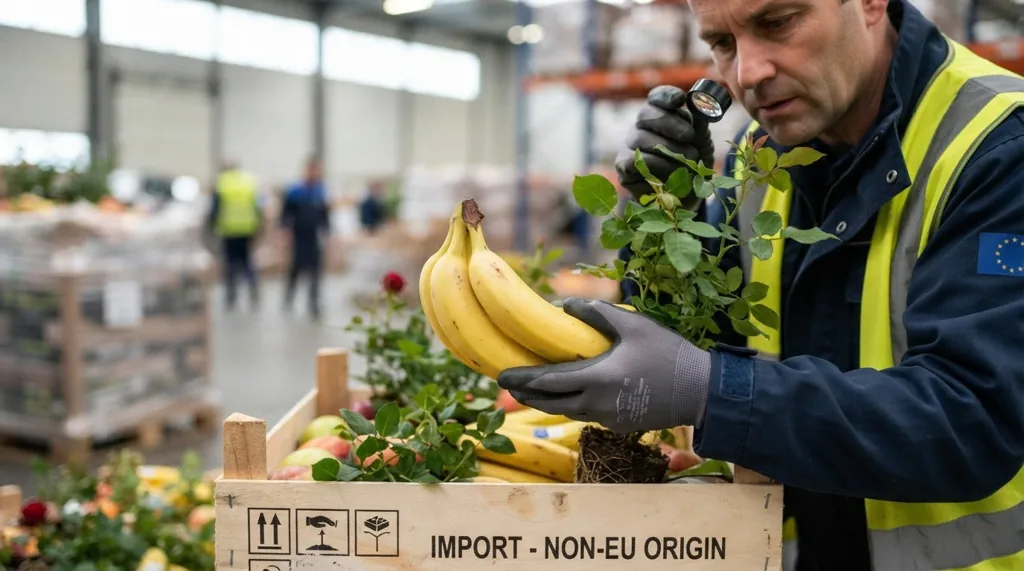
European Union proposes new plant-health import conditions for banana plants, rooted plants, roses and citrus, expected to be adopted in February 2027.
On Oct. 30, 2026, the European Commission notified draft plant-health import rules for banana plants, rooted plants, aquarium plants, roses and citrus.
The European Union (EU) sent the draft to the World Trade Organization (WTO) as notification G/SPS/N/EU/9871. Trading partners can send comments until Dec. 29, 20261.
In short, more plant shipments will need extra statements on their plant-health certificate. Some fruit and cut roses will also need a code for the farm or packhouse printed on the certificate and on each package.
What does the draft plant-health regulation change?
The draft amends two EU laws1. The main one is Implementing Regulation (EU) 2019/2072, the EU rulebook on protective measures against pests of plants2. The second is Implementing Regulation (EU) 2022/19411.
The 2019 rulebook lists the pests the EU wants to keep out2. It also sets the conditions that plants, plant products and other objects must meet when they come in from outside the EU2. Some plants and plant products from certain countries are banned outright2.
The draft updates three lists in this rulebook1:
- Union quarantine pests, the harmful pests the EU must keep out or stamp out.
- Protected zone quarantine pests, pests that are kept out of named regions only.
- Regulated non-quarantine pests, pests already present that are controlled in plants for planting.
It also changes the special import conditions linked to these pests1. The products affected fall under Harmonized System (HS) chapters 06, 07, 08, 09, 12, 14, 44, 84, 87 and 941. The notification describes them as plants, plant products and other objects.
Why is the Commission acting on these pests?
The draft rests on new scientific studies1. They come from the European Food Safety Authority (EFSA), the European and Mediterranean Plant Protection Organization (EPPO) and EU member states1.
The notification names 13 pests whose rules will change1. Two more pests, beet necrotic yellow vein virus and the bacterium Erwinia amylovora, see changes to their protected zones1.
The changes go both ways. Some pests join the lists because they could cause serious harm. Others leave the lists because the rules no longer serve a purpose.
Which pests join the EU quarantine list?
Five pests would become Union quarantine pests1:
- Xanthomonas citri pv. viticola, a bacterium that causes leaf spots and stem cankers on grapevines.
- Fusarium oxysporum f. sp. cubense Tropical Race 4 (TR4), a fungus that causes a serious disease of bananas.
- Chloridea virescens.
- Spodoptera ornithogalli.
- Spodoptera praefica.
Changes to the EU quarantine pest list, number of pests
Chloridea virescens and Spodoptera ornithogalli are now listed in the annex of Regulation (EU) 2022/19411. The draft removes them from that annex, because they will now be on the quarantine list instead1.
What will banana plant imports need?
The banana fungus brings a new import rule for banana plants for planting (Musa)1. It does not cover pollen or plants grown in tissue culture in a laboratory1.
The plants must meet one of two conditions1:
- They come from a country or area free from the fungus. The area must be named on the plant-health certificate. The exporting country must first tell the European Commission in writing.
- They come from a production site free from the fungus. The certificate must carry details that let officials trace the plants back to that site.
This means banana plant exporters cannot rely on checks at the EU border. The exporting country’s plant-health agency must confirm the pest-free status before the plants leave.
What changes for rooted plants and aquarium plants?
The draft tightens rules for rooted plants for planting because of Meloidogyne enterolobii, a pest that lives on plant roots1. Plants grown in tissue culture are not covered1.
New import conditions by type of plant
| Goods | Condition |
|---|---|
| Banana plants for planting | Pest-free country, area or production site |
| Rooted plants for planting | Yearly inspection, sampling to 1% with 95% confidence |
| Aquarium and pond plants | Official tests for nematodes, except from Switzerland |
| Cut roses, citrus and other fruit | Site code on certificate and each package |
| Pine plants for planting | 0% tolerance for Toumeyella parvicornis |
These plants must meet one of several conditions1:
- From a pest-free country or area.
- From a pest-free production site. The site must be inspected every year. Samples must be large enough to find 1% infection with 95% confidence.
- Roots in clean growing media only. The roots may only touch treated growing media or media without soil.
Aquarium and pond plants also face wider rules1. These are plants of the genera Anubias, Cabomba, Ceratophyllum, Cryptocoryne, Echinodorus, Hydrocotyle, Hygrophila, Myriophyllum, Najas, Nelumbo and Vallisneria1.
When they come from any country except Switzerland, they must be officially tested for nematodes1. Nematodes are tiny worms, and the test must rule out types such as Hirschmanniella1. The draft extends this rule to more water plants that can carry these worms1.
Why will roses and citrus need a farm code?
The draft targets a pest called Thaumatotibia leucotreta1. It covers cut roses and fruit of peppers, peaches, pomegranates and citrus1.
The rule applies to these goods from African countries, Cabo Verde, Saint Helena, Madagascar, Réunion, Mauritius and Israel1. The plant-health certificate must show the code of the farm or production site1. The same code must also appear on each package, where packages are used1.
Packing houses and exporters in these countries will need to label each box with the right code. Customs and plant-health inspectors in the EU can then trace a problem shipment back to its farm. The draft also drops some older requirements that are no longer needed1.
Which pests and rules are removed?
Three pests would leave the quarantine list1. The first is an insect called Aleurocanthus spiniferus. It has settled in parts of Croatia, France, Greece and Italy and cannot be wiped out1. Normal farming practice controls it, and it causes no major economic damage1.
The other two are a raspberry leaf curl virus and a strawberry leaf curl virus1. Their identity is not clear, and there is no tested method to detect them1. The draft also repeals Regulation (EU) 2022/1927, the special rules against spread of Aleurocanthus spiniferus1.
Taiwan would be removed from the list of places with import rules for the pest Agrilus planipennis1. The pest is now recognised as absent there1. Shipments of the affected plants and wood from Taiwan would then no longer need the extra statement for this pest.
What changes for pine plants and protected zones?
The pest Toumeyella parvicornis joins the regulated non-quarantine pest list1. It applies to pine plants for planting (Pinus), with a 0% tolerance1.
To stop its spread, the plants must meet conditions such as these1:
- They were grown in an area free from the pest.
- Or they are no taller than 2 metres, showed no symptoms in the last 3 growing seasons and were inspected before moving.
Some EU regions will also lose their special protected status, at the request of Spain and Portugal1. The Spanish provinces of Álava and Vizcaya in the Basque Country and the region of Cantabria would no longer be protected zones for Erwinia amylovora1. The Azores in Portugal would no longer be a protected zone for beet necrotic yellow vein virus1.
The draft also corrects several scientific names1. For example, Myndus crudus becomes Haplaxius crudus, and Gibberella fujikuroi becomes Fusarium fujikuroi1.
When would the new plant-health rules apply?
The Commission expects to adopt and publish the regulation in February 20271. It would enter into force 20 days after publication1.
The dates in the draft
The rules then start in two stages1:
- The package code rule for Thaumatotibia leucotreta applies from the first day of the fourth month after publication.
- The new pests and the new or updated import conditions apply from the first day of the seventh month after publication.
If publication takes place in February 2027 as planned, the first stage would begin on 1 June 2027. The second would begin on 1 September 2027. These dates will only be fixed once the final text appears in the Official Journal.
Who must act on the plant import changes?
The 2019 rulebook counts the plant-health certificate as an official statement on a shipment2. Most new conditions must be shown on that certificate before the goods leave. So the work falls first on growers, packers and plant-health agencies outside the EU.
Each group faces a different task:
- Banana plant exporters need pest-free status confirmed for the fungus.
- Nurseries shipping rooted plants need yearly inspections and sampling, or clean growing media.
- Aquarium plant exporters need official tests for nematodes.
- Fruit and rose packers in the named countries need site codes on certificates and boxes.
EU importers depend on those suppliers. A certificate without the new wording would not meet the EU’s import conditions once the rules apply.
Key points on the EU draft plant-health rules
The table below sums up the main facts.
| Question | Answer |
|---|---|
| What is proposed? | New pest lists and import conditions for plants |
| Who proposed it? | European Commission |
| Which law changes? | Implementing Regulations (EU) 2019/2072 and 2022/1941 |
| WTO notification | G/SPS/N/EU/987, Oct. 30, 2026 |
| New quarantine pests | 5, including banana fungus TR4 |
| Pests removed | 3, including Aleurocanthus spiniferus |
| Banana plants | Pest-free country, area or site |
| Aquarium plants | Official tests for nematodes |
| Roses and fruit | Site code on certificate and packages |
| Comment deadline | Dec. 29, 2026 |
| Expected adoption | February 2027 |
| Rules start | 4th and 7th month after publication |
The next date is Dec. 29, 2026, the last day for comments through the WTO1. After that, the Commission plans to adopt the text in February 2027, and the new certificate conditions would follow in two stages1.
Sources
- ↩ G/SPS/N/EU/987 – VĂN PHÒNG SPS VIỆT NAM http://www.spsvietnam.gov.vn/en/gspsneu987-1
- ↩ EUR-Lex – 02019R2072-20261015 – EN – EUR-Lex https://eur-lex.europa.eu/eli/reg_impl/2019/2072/2026-10-15/eng