
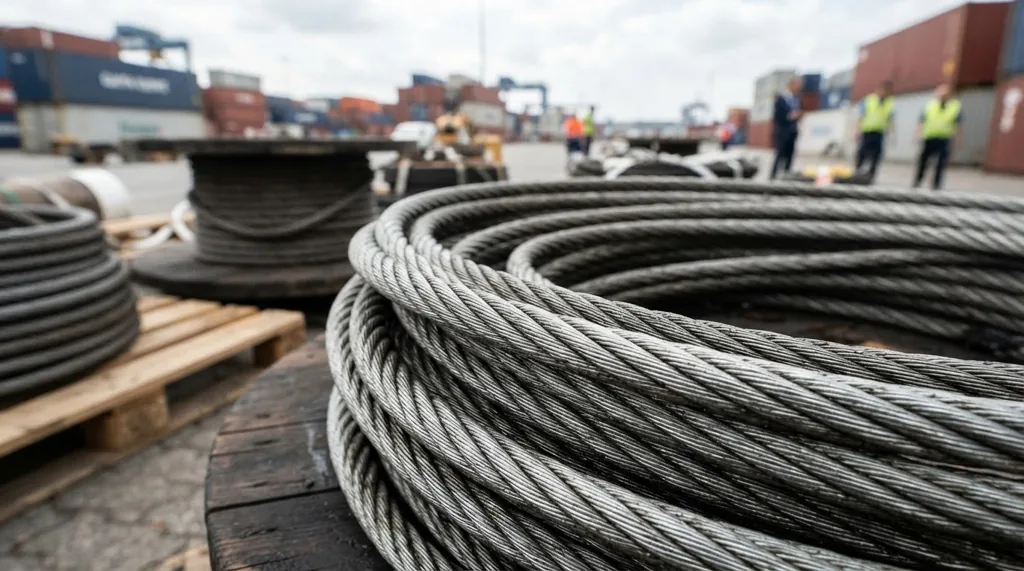
European Union customs must record steel wire rope imports from India, Thailand and Türkiye from Oct. 31, 2026, ahead of possible anti-dumping duties.
The European Commission ordered customs on Oct. 30, 2026 to register imports of steel wire ropes and cables from India, Thailand and Türkiye1.
The order is Commission Implementing Regulation (EU) 2026/2396, dated Oct. 29, 2026 and published in the Official Journal of the European Union on Oct. 301. It enters into force the day after publication1.
In short, no extra duty is charged today. But customs will keep a record of each shipment, so that anti-dumping duties can later be charged on these ropes if the investigation finds a case for it.
What does registration mean for steel rope shipments?
Registration is a step that keeps a door open for the European Union (EU). Customs authorities in every member state must take steps to record imports of the ropes covered1. The purpose is to make sure that anti-dumping duties can be charged retroactively on registered imports, if the legal conditions are met1.
An anti-dumping duty is an extra import tax on goods sold abroad below their normal price. Charging it retroactively means it could apply to goods that entered the EU before the duty itself was set. The registration regulation says any future liability would come from the findings of the investigation1.
So the shipment still clears customs in the normal way. The difference is that the importer may face a bill later for goods it has already brought in.
Which steel wire ropes are covered?
The regulation covers steel ropes and cables, including locked coil ropes1. Locked coil ropes are a type of heavy rope with shaped outer wires that lock together. Two limits define the goods:
- Stainless steel ropes are excluded. Ropes and cables of stainless steel are outside the measure1.
- Only ropes thicker than 3 mm. The rope’s maximum cross-sectional dimension must exceed 3 mm1.
- Only three origins. The ropes must originate in India, Thailand or Türkiye1.
What the registration covers
| Point | Rule |
|---|---|
| Goods | Steel ropes and cables, including locked coil ropes |
| Size | Thicker than 3 mm |
| Excluded | Stainless steel ropes and cables |
| Origins | India, Thailand, Türkiye |
| Duration | Nine months after entry into force |
Ropes from other countries are not registered. Thin ropes of 3 mm or less are not registered either, whatever their origin.
Which customs codes apply to the ropes?
The ropes currently fall under five codes of the Combined Nomenclature (CN), the EU’s list of goods for customs1. These are parts of codes 7312 10 81, 7312 10 83, 7312 10 85, 7312 10 89 and 7312 10 981.
Within those, the regulation lists 15 more detailed codes of TARIC, the EU’s integrated customs tariff1. Each of the five CN codes is split into three TARIC codes ending in 12, 13 and 191. For example, code 7312 10 81 covers TARIC codes 7312 10 81 12, 7312 10 81 13 and 7312 10 81 191.
The codes are given for information only1. What decides whether a rope is covered is the product description, not the code. A later change in tariff classification does not change the scope1.
Why did the European Commission act on Indian, Thai and Turkish ropes?
The registration follows an anti-dumping investigation. The Commission opened it with a notice of initiation published on Sept. 24, 20261. The case began with a complaint lodged on Aug. 10, 2026 by the European Federation of Steel Wire Rope Industries (EWRIS)2.
How the rope case unfolded
EWRIS complained on behalf of producers making more than 25% of total EU output of these ropes1. The initiation notice says imports from the three countries have grown, both in volume and in market share2. It says these imports hurt EU makers’ sales, prices, market share, finances and jobs2.
The Commission decided to register imports on its own initiative1. It did not wait for a request from the EU industry to do so. It used Article 14(5) of the EU’s basic anti-dumping law, Regulation (EU) 2016/10361.
How high could the duties on steel wire ropes be?
The complaint gave estimates of dumping margins, meaning how far export prices fall below normal value. It covered the period from January to December 20251. The estimates were:
Complaint’s top dumping estimate, 2025, %
The complaint also estimated injury elimination levels, the price rise needed to stop the harm to EU makers. These were 157% to 243% for India, 174% to 238% for Thailand and 199% to 207% for Türkiye1.
Under EU rules, a duty is normally set at the lower of the dumping level or the injury level1. But the Commission says it cannot yet estimate the possible future liability1. The complaint’s figures are for information only and create no expectation about the final rate1.
How does the dumping case work?
The initiation notice explains how the Commission tests the claim. For India and Thailand, it compares prices in the home market, or a built-up cost, with the export price to the EU2. For Türkiye, it uses only a built-up cost, because reliable home-market prices were not available2.
The investigation covers the period from July 1, 2025 to June 30, 20262. To judge harm to EU makers, the Commission looks at trends from Jan. 1, 2023 to the end of that period2.
If the findings are positive, the Commission will also check whether duties would go against the wider EU interest2. Only then would definitive duties follow.
Who is affected by the rope registration?
EU importers carry the main risk. They pay customs duties, so a retroactive duty would fall on them for registered shipments. Customs brokers will see these shipments recorded under the listed codes.
Makers in India, Thailand and Türkiye are the target of the case. The Commission may pick a sample of exporting producers to study, because there may be many of them2. Sampled producers must return a questionnaire within 30 days of being told they are in the sample2.
Exporters who agree to be sampled but are not chosen count as cooperating2. Their duty would not exceed the weighted average margin found for the sampled producers2. Unrelated importers may also be sampled and receive their own questionnaire2.
When does registration of steel wire ropes start and end?
The regulation was published on Oct. 30, 2026 and enters into force the next day1. That means customs start recording shipments from Oct. 31, 2026.
Registration expires nine months after entry into force1. The regulation that imposes definitive duties, if any, will judge whether the conditions for retroactive collection are met1.
The initiation notice set early deadlines for parties counted from Sept. 24, 2026. Exporters and importers had 7 days to give sampling details2. Product scope comments were due within 10 days, hearing requests within 15 days and comments on the complaint within 37 days2.
Key points on EU registration of steel wire rope imports
The main facts of the measure are set out below.
| Question | Answer |
|---|---|
| What changed? | Customs must register imports |
| Who issued it? | European Commission |
| Legal act | Implementing Regulation (EU) 2026/2396 |
| Which goods? | Steel ropes and cables over 3 mm |
| What is excluded? | Stainless steel ropes |
| Which origins? | India, Thailand, Türkiye |
| Customs codes | Parts of CN 7312 10 81 to 7312 10 98 |
| Is a duty charged now? | No, but it may apply retroactively |
| Complaint dumping estimates | 23% to 134% |
| Registration starts | Oct. 31, 2026 |
| Registration ends | Nine months after entry into force |
| Investigation period | July 1, 2025 to June 30, 2026 |
From Oct. 31, 2026, every covered rope shipment from the three countries enters the EU under a record. If the investigation ends in definitive duties, those registered shipments could face the duty after they have cleared customs1.
Sources
- ↩ Implementing regulation – EU – 2026/2396 – EN – EUR-Lex https://eur-lex.europa.eu/eli/reg_impl/2026/2396
- ↩ EUR-Lex – 52026XC04914 – EN – EUR-Lex https://eur-lex.europa.eu/eli/C/2026/4914/oj