
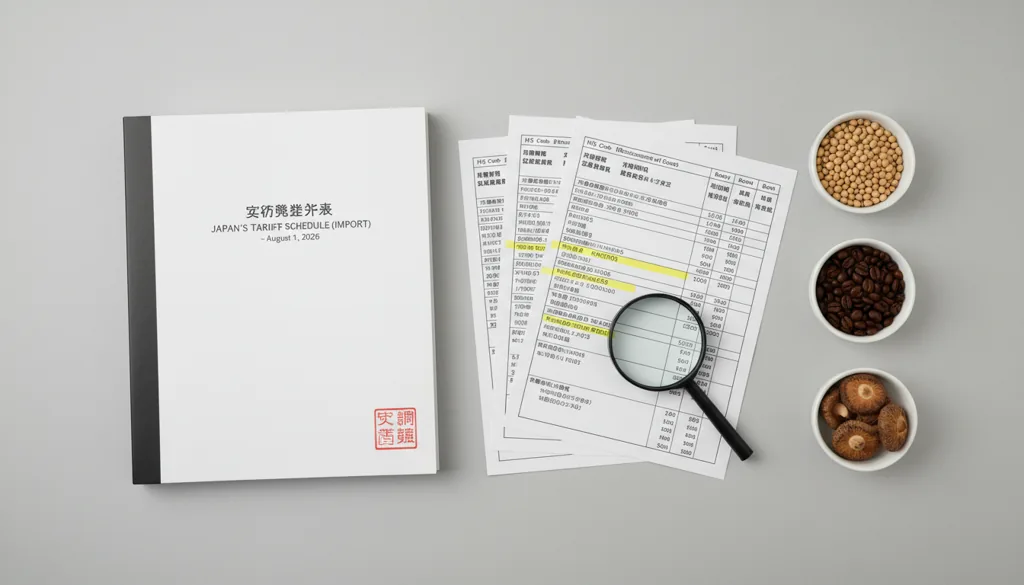
Japan released an updated version of its tariff schedule and statistical code for import on August 1, 2026.
Japan released an updated import tariff schedule and statistical code on Aug. 1, 2026, revising the classification framework used for goods entering the country.
The tariff material spans products from animal goods and processed fruit to clothing, machinery-related metals, medicines, vehicles and aircraft. The accompanying government code list, issued in a September 2026 edition, covers the surveys and administrative records used to organise official statistics.
The change is for identifying imported goods and assigning the right customs treatment. The resulting classification work is paid for through the normal cost of importing, including the time spent by companies and customs brokers checking product descriptions against the schedule.
The Aug. 1 tariff chapters
The most immediate effect is on the reference point used when an import declaration is prepared. The tariff schedule separates goods into chapters, each grouping a broad family of products. Chapter 5 covers animal-origin products that are not classified elsewhere, while Chapter 20 covers preparations made from vegetables, fruit, nuts and other plant parts.1
Three apparel chapters, kept apart
| Question | Chapter 61 | Chapter 62 | Chapter 64 |
|---|---|---|---|
| Goods covered | Knitted or crocheted garments | Clothing not knitted or crocheted | Footwear, gaiters and parts |
| Deciding detail | Knitted construction | Woven or other construction | Shoe construction |
| Typical item | Knitted jumper | Woven shirt | Shoes |
That structure reaches everyday consumer goods as well as industrial materials. Chapter 18 covers cocoa and cocoa preparations, Chapter 19 covers preparations of cereals, flour, starch or milk, and Chapter 30 covers pharmaceutical products. The range means a change in the schedule can affect food manufacturers, medicine suppliers and distributors as well as brokers handling general cargo.
For companies dealing with clothing, the schedule keeps knitted and crocheted apparel apart from other clothing. Chapter 61 covers knitted or crocheted garments, while Chapter 62 covers clothing that is not knitted or crocheted. The distinction makes the Chapter 61 apparel entries a classification reference rather than a description that can be applied to every garment.1
The published material labels each chapter with a tariff-rate field. That field is central to the customs calculation, even where the supplied schedule extract does not reproduce the individual rates. A product description therefore remains only the starting point; the material, construction and use of the goods determine which part of the schedule is relevant.
Metals, plastics and factory goods
The industrial sections show how widely the update reaches. Chapter 39 covers plastics and articles made from them, Chapter 72 covers iron and steel, and Chapter 73 covers articles of iron or steel. These categories can divide raw materials from finished or partly finished goods, making the classification decision important for manufacturers and distributors.1
Paperwork the schedule does not replace
The metals chapters continue beyond steel. Chapter 78 covers lead and articles made from lead, Chapter 79 zinc and its articles, and Chapter 80 tin and its articles. Chapter 83 then groups miscellaneous articles of base metal. The schedule therefore places several closely related materials in separate chapters, requiring declarations to follow the product’s main identity rather than simply its broad industrial use.
The same pattern appears in specialised manufactured goods. Chapter 69 covers ceramic products, Chapter 88 aircraft, spacecraft and their parts, and Chapter 91 clocks, watches and their parts. The updated file’s breadth matters because a classification change can affect a high-value component as well as a routine consumer item.1
For customs teams, the practical obligation is to work from the Aug. 1 tariff schedule when classifying imports covered by the update. The schedule is not a shipping document and it does not replace commercial invoices, packing records or transport paperwork. It is the legal reference behind the tariff line selected on the declaration.
Clothing and consumer imports
The apparel chapters are among the clearest examples of why product details matter. A knitted jumper belongs to a different chapter from a woven shirt, even though both are clothing. Footwear is handled separately in Chapter 64, which covers shoes, gaiters and similar articles and their parts.1
That separation affects the chain of information running from a producer to a customs broker. Product catalogues, bills of materials and invoices need to describe what the goods are made from and how they are constructed. A generic label such as “clothing” or “footwear” cannot, by itself, carry the full classification decision.
Other consumer categories sit elsewhere in the schedule. Chapter 49 covers printed books, newspapers, pictures and other printing-industry products, while Chapter 96 covers miscellaneous manufactured articles. Chapter 53 covers certain vegetable textile fibres and woven fabrics made with paper yarn.1
These entries also show why the measure is more than a rate announcement. It is an updated map for sorting goods into the tariff system. Where a product could appear to fit more than one broad description, the commercial paperwork and the technical characteristics become the evidence supporting the selected entry.
The consequence for importers is mainly administrative, but it can become financial when a classification changes the duty calculation or prompts a customs query. The cost is carried through declaration preparation, broker review and any later correction. The schedule itself provides the framework; the company importing the goods remains responsible for the accuracy of the information supplied.
The September statistical code
The separate statistical material adds another layer to Japan’s trade-data system. The September 2026 edition lists government statistics by producing agency, survey type and registration information. In the communications field, it includes surveys on investment in equipment, patterns of information and communications technology use, and basic conditions in the information and communications industry.2
Two systems, two references
Those records are not tariff chapters, but they matter to the wider official system in which trade information is organised. The list assigns codes such as 00200355, 00200356 and 00200357 to the communications-related entries. The codes identify statistical sources rather than imported products, so they should not be confused with tariff classifications.
The edition also includes a five-year merchandise distribution survey and industrial structure surveys prepared by Japan’s Ministry of Economy, Trade and Industry. The listed codes include 00550410 for the merchandise distribution survey, 00550420 for the capital-goods sales destination survey and 00550425 for an extended input-output table.2
For businesses, the distinction between the two publications is important. The tariff schedule supports customs declarations and duty treatment, while the government statistics code list supports the naming and organisation of official data. A company may encounter both systems in trade reporting, but a statistical code is not a substitute for the tariff classification used at import.
What the update leaves in view
The statistical list extends beyond trade and manufacturing. It includes surveys on retail prices, tourism, waste treatment, ports and defence-related facilities. The retail-price survey describes search functions for government statistics, datasets and individual data files, including the ability to search metadata and material inside databases.3
That material indicates a broad administrative information system rather than a second tariff schedule. It can help explain why several codes and government datasets appear alongside the customs update, but it does not change the product categories in the Aug. 1 tariff document. The two publications therefore need to be read for different purposes.
The wider list includes records connected with ports, container logistics, tourism spending and waste treatment. It also identifies surveys with different frequencies, including quarterly and one-time studies.2 Those entries may help organise government information about activity around trade, but they do not set the duty on a shipment.
The defence-related section follows the same coding approach. It includes records on defence personnel ethics, defence facilities and areas used by United States forces in Japan, with codes including 00700009, 00700010 and 00700011.2 Their presence in the statistical edition reinforces the need to keep statistical identifiers separate from customs tariff lines.
For brokers and compliance teams, the central operational point is therefore straightforward: product declarations must be checked against the revised tariff schedule, while requests involving official datasets must use the relevant statistical code. Mixing the two systems could send a company to the wrong reference, even though both documents were released as part of Japan’s updated official information.
The tariff chapters also cover pharmaceuticals, vehicles, vehicle parts, man-made textile filaments, leather, chemicals and paper-based textile materials. Chapters 38, 41, 54 and 87 provide the relevant product families, while Chapters 20, 30 and 39 cover processed food, medicines and plastics.1
Because the supplied schedule identifies chapters and tariff-rate fields without showing every line-level rate, the immediate change is clearest as a classification update. Its commercial effect will depend on the precise tariff line used for each product. That makes accurate descriptions and consistent broker records more important than a broad claim that all imports in a chapter will face the same treatment.
The new reference now governs imports released under the Aug. 1 version, while the September statistical edition governs the separate coding of government data. The next shipments affected will be those whose products fall into the listed chapters, from knitted garments and cocoa preparations to steel articles, aircraft parts and watches. The result is a wider customs reference set, but not a single rate applied across all of Japan’s imports.
Sources
- ↩ Japan’s Tariff Schedule as of August 1 2026 https://www.customs.go.jp/english/tariff/2026_08_01/index.htm
- ↩ List of Government Statistics Codes (September 2026 Edition) https://www.e-stat.go.jp/estat/html/tokei_itiran.pdf
- ↩ Monthly Retail Price Statistics Survey https://www.e-stat.go.jp/stat-search?toukei=00200571