
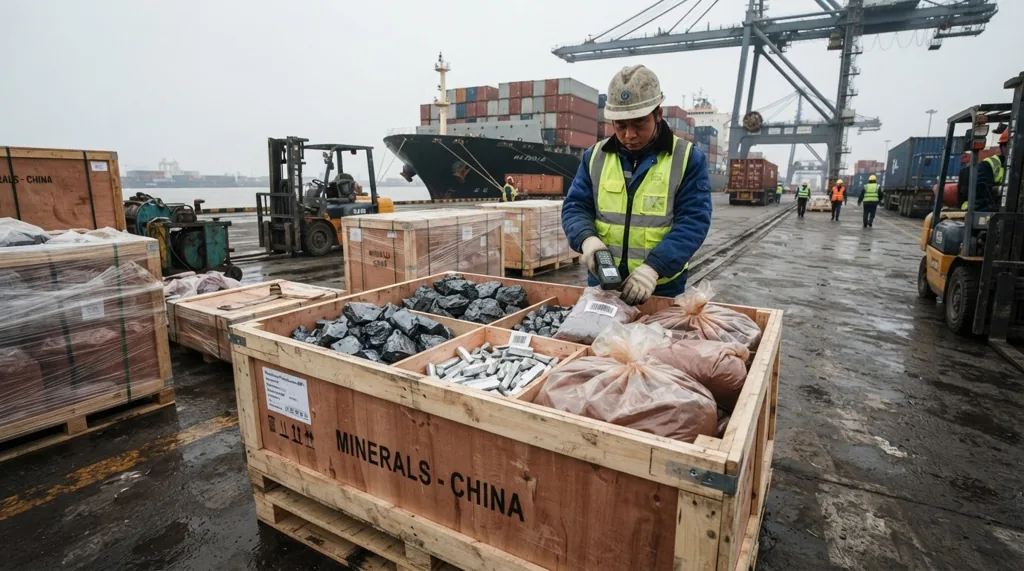
China keeps six 2025 export-control rules on rare earths, batteries and synthetic diamonds suspended from Nov. 11, 2026 to Jan. 10, 2027.
China’s Ministry of Commerce and customs agency will keep six 2025 export-control rules on rare earths and related goods paused until Jan. 10, 2027.
The Ministry of Commerce (MOFCOM) and the General Administration of Customs published Announcement No. 58 of 2026 on Nov. 9, 20261. It says the six rules stay suspended from Nov. 11, 2026 to Jan. 10, 20271.
In short, Chinese exporters of the listed rare earths, magnets, battery materials, synthetic diamonds and machinery can keep shipping without the extra licences these six rules would demand. Foreign companies also keep a break from China’s licence rule on their own products that contain Chinese rare earths. The break is short, however: about two months.
Which six rare earth rules stay paused?
The new announcement names four joint notices of the ministry and customs and two ministry notices, all from 20251. Each one was a separate set of export controls. A licence is official permission from the ministry before goods leave the country.
The six suspended 2025 rules
| Rule | Goods or activity covered |
|---|---|
| No. 55 of 2025 | Synthetic diamond powders, crystals, wire saws, grinding wheels |
| No. 56 of 2025 | Rare earth machinery, ores and separation chemicals |
| No. 57 of 2025 | Holmium, erbium, thulium, europium, ytterbium |
| No. 58 of 2025 | Lithium-ion batteries, cathode and graphite anode materials |
| No. 61 of 2025 | Foreign-made goods with Chinese rare earths |
| No. 62 of 2025 | Rare earth mining, processing and magnet technology |
The six suspended rules are:
- Announcement No. 55 of 2025, controls on synthetic diamond powders, crystals, wire saws, grinding wheels and the equipment that makes them2.
- Announcement No. 56 of 2025, controls on rare earth production machinery, rare earth ores and chemicals used to separate rare earths3.
- Announcement No. 57 of 2025, controls on five medium and heavy rare earths: holmium, erbium, thulium, europium and ytterbium4.
- Announcement No. 58 of 2025, controls on high-energy lithium-ion batteries, battery cathode materials, graphite anode materials and the machines that make them5.
- Announcement No. 61 of 2025, a licence rule for foreign companies that export goods made abroad with Chinese rare earths or Chinese rare earth technology6.
- Announcement No. 62 of 2025, controls on rare earth mining, processing and magnet-making technology7.
The text of the new announcement is one sentence long1. It says the pause was approved but gives no reason and no list of goods. The goods covered are therefore those listed in the six original notices.
How did the pause on rare earth controls begin?
The six rules were all dated Oct. 9, 20254. The four joint notices were due to take effect on Nov. 8, 20252. Announcement No. 62 took effect on the day it was published7.
Length of each suspension, days
Announcement No. 61 had two start dates. Its rule on Chinese-origin goods applied from publication. Its rules on foreign-made goods were due to start on Dec. 1, 20256.
Before most of these dates arrived, the two agencies stepped back. Announcement No. 70 of 2025, dated Nov. 7, 2025, suspended all six rules from that day until Nov. 10, 20268. That first pause lasted 369 days, counting both the first and the last day.
The new announcement picks up the next day, Nov. 11, 20261. It uses the words "continue to suspend", so there is no gap between the two pauses. The second pause runs for 61 days, again counting both ends.
Why did China bring in the controls?
The joint notices said the controls aimed to protect national security and interests4. They also said they would help China meet international duties against the spread of weapons4. Each notice was approved by the State Council, China’s cabinet3.
On the day the rules came out, a ministry spokesman said the goods had clear "dual-use" features9. Dual-use goods are goods that have both civilian and military uses. He said the measures did not target any country and that legal export requests would be approved after review9.
The spokesman also said China had told the countries and regions concerned in advance9. Neither the first suspension nor the new one gives a reason for the pause8.
What did the rare earth metal rules cover?
Announcement No. 57 put five rare earth elements under licence4. For each element it listed the pure metal, alloys, targets used to coat surfaces, and oxides and compounds4. The pure metals carry the reference tariff code 280530194.
The list went further than raw metal. It covered permanent magnets containing holmium, erbium in optical fibres and ceramics, and europium in phosphor powders used in lighting4. It also named ytterbium in heat-shield coatings and thulium in light-emitting materials4.
Announcement No. 56 covered the materials used to make rare earths3. These included three kinds of rare earth ore: bastnaesite, monazite and ion-adsorption clay, under tariff code 253090203. It also listed five chemical extractants, such as P507 and P204, used to separate rare earths3.
Which machines and battery goods were covered?
Announcement No. 56 also listed 26 groups of machinery used in rare earth work3. They range from extraction tanks and furnaces to magnet-making presses, sintering furnaces and cutting machines3. Many entries carry technical limits. For example, rare earth electrolysis cells were covered only with a current of 6,000 to 30,000 A3.
Announcement No. 58 dealt with batteries5. It covered rechargeable lithium-ion batteries with an energy density of at least 300 Wh/kg, both single cells and packs5. These carry reference tariff code 850760005.
The same notice covered battery materials. It listed lithium iron phosphate cathode material above set density and capacity limits, and two cathode precursor chemicals5. It also covered artificial graphite anode material and anode blends of artificial and natural graphite5. Winding, stacking and filling machines for battery making were included too5.
Announcement No. 55 covered synthetic diamonds2. It listed diamond micro-powder with an average grain of 50 μm or less, under tariff code 710510202. It also covered larger single crystals up to 500 μm, fine diamond wire saws and diamond grinding wheels2. Lab-grown diamonds for jewellery and decoration were excluded2.
What did the paused rules ask of exporters?
Under the four joint notices, an exporter of a listed item had to apply to the ministry for a licence5. The exporter also had to mark the customs declaration2.
Steps the paused rules required
| Requirement | Details |
|---|---|
| Export licence | Apply to the ministry before export |
| Listed items | Declare as “a dual-use item” with control code |
| Similar unlisted items | Mark “not a controlled item” with actual values |
| Customs query | Shipment not released during the check |
The marking rule worked in two ways. A listed item had to be declared as "a dual-use item" with its control code4. An item that was not listed but came close in its technical values had to be marked "not a controlled item", with its actual values4.
Customs could question any declaration that looked incomplete or false3. During that check, the shipment would not be released3. With the rules paused, these extra steps for these goods do not apply until Jan. 10, 2027.
How does the pause affect foreign manufacturers?
Announcement No. 61 reached beyond China’s border6. It required foreign companies to get a Chinese dual-use export licence before they shipped certain goods to a third country6.
The rule covered three cases6:
- Goods made abroad that contain Chinese-origin rare earth items worth 0.1% or more of the product’s value.
- Listed items made abroad using Chinese rare earth mining, processing, magnet-making or recycling technology.
- Listed rare earth items of Chinese origin.
The notice said licence requests for military users would in principle be refused6. Requests for some uses would be checked one by one. These included making logic chips of 14 nanometres or smaller and memory chips of 256 layers or more6. Humanitarian shipments were exempt but had to be reported within 10 working days6.
Chinese exporters of the listed items also had to name the final destination and give buyers a written notice about the rule6. With Announcement No. 61 paused, foreign makers of magnets, motors and chips do not need these Chinese licences during the pause.
What about rare earth technology exports?
Announcement No. 62 required a licence to export rare earth mining, processing, metal-making, magnet-making and recycling technology7. Magnet-making covered samarium-cobalt, neodymium-iron-boron and cerium magnets7.
The notice defined "export" widely. It included licensing, investment, exhibitions, testing, training, joint research and consulting7. It also barred freight, customs and payment services that help someone break the rule7.
Technology already public, basic research and what is needed for a normal patent filing were outside the rule7. This notice is also paused until Jan. 10, 20271.
What happens after Jan. 10, 2027?
The new announcement says nothing about what follows the end date1. It does not say whether the six rules will start to apply on Jan. 11, 2027, or whether a third pause will follow.
Rare earth controls and their pauses
The pattern so far is two suspensions issued close to the end of the previous window8. The first pause was announced one day before most of the rules were due to start. The second came on Nov. 9, 2026, one day before the first pause ended1.
For traders, the short window matters most. Contracts for rare earths, magnets, battery materials or diamond tools that ship after Jan. 10, 2027 may again face licence checks at Chinese customs. Shipments held during a customs query would not be released until it is settled2.
Key points on China’s rare earth export-control pause
The table sets out the main facts of the extended suspension.
| Question | Answer |
|---|---|
| What changed? | Six 2025 export-control rules stay suspended |
| Who issued it? | Ministry of Commerce and General Administration of Customs |
| Which instrument? | Announcement No. 58 of 2026 |
| When published? | Nov. 9, 2026 |
| Pause period | Nov. 11, 2026 to Jan. 10, 2027 |
| Earlier pause | Nov. 7, 2025 to Nov. 10, 2026 |
| Rules paused | Announcements No. 55, 56, 57, 58, 61 and 62 of 2025 |
| Main goods | Rare earths, magnets, batteries, graphite anodes, synthetic diamonds |
| Rare earths named | Holmium, erbium, thulium, europium, ytterbium |
| Foreign-made goods rule | 0.1% Chinese rare earth value threshold, paused |
| Reason given for pause | None stated |
| Next date | Jan. 10, 2027, end of the pause |
The pause now ends on Jan. 10, 20271. Until then, Chinese exporters of the listed goods do not face the licence and declaration steps in the six rules. Foreign makers also stay outside the 0.1% rule.
Sources
- ↩ 商务部、海关总署公告2026年第58号 公布继续暂停实施商务部、海关总署公告2025年第55号、56号、57号、58号及商务部公告2025年第61号、62号的决定 https://www.mofcom.gov.cn/zwgk/zcfb/art/2026/art_91466027f465467985942a639a9485f4.html
- ↩ 商务部 海关总署公告2025年第55号 公布对超硬材料相关物项实施出口管制的决定 https://www.mofcom.gov.cn/zwgk/zcfb/art/2025/art_949f47563b834dad95b0010f375a892c.html
- ↩ 商务部 海关总署公告2025年第56号 公布对部分稀土设备和原辅料相关物项实施出口管制的决定 https://www.mofcom.gov.cn/zwgk/zcfb/art/2025/art_1315078cebe04210bc35c72a4e7f7967.html
- ↩ 商务部 海关总署公告2025年第57号 公布对部分中重稀土相关物项实施出口管制的决定 https://www.mofcom.gov.cn/zwgk/zcfb/art/2025/art_59ec4f6bec0b459aa4a30c4bbd0a41c1.html
- ↩ 商务部 海关总署公告2025年第58号 公布对锂电池和人造石墨负极材料相关物项实施出口管制的决定 https://www.mofcom.gov.cn/zwgk/zcfb/art/2025/art_79646f0161564975a938fe00fee158d5.html
- ↩ 商务部公告2025第61号 公布对境外相关稀土物项实施出口管制的决定 https://www.mofcom.gov.cn/zwgk/zcfb/art/2025/art_7fc9bff0fb4546ecb02f66ee77d0e5f6.html
- ↩ 商务部公告2025第62号 公布对稀土相关技术实施出口管制的决定 https://www.mofcom.gov.cn/zwgk/zcfb/art/2025/art_6cb42957741440c6984de696b70df9ae.html
- ↩ 商务部、海关总署公告2025年第70号 公布暂停实施商务部、海关总署公告2025年第55号、56号、57号、58号及商务部公告2025年第61号、62号的决定 http://www.mofcom.gov.cn/zwgk/zcfb/art/2025/art_b1ec77dd3f0d4762952904df7cdaadec.html
- ↩ 商务部新闻发言人就对超硬材料等相关物项实施出口管制应询答记者问 http://www.mofcom.gov.cn/syxwfb/art/2025/art_9ef35b6a69f24e61a8cbd63ed0a42d16.html