
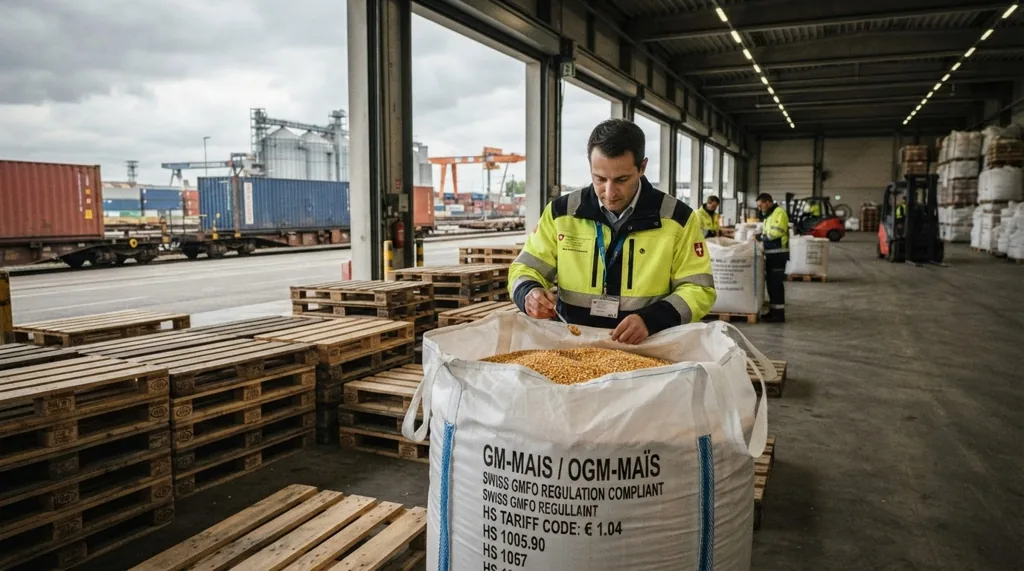
Switzerland has issued updated ordinances governing the importation and trade of genetically modified foodstuffs, affecting key agricultural product categories including cereals and grain ingredients.
Switzerland’s food safety office added three genetically modified maize types to its list of tolerated traces in food, effective Aug. 1, 2026.
The Federal Food Safety and Veterinary Office (BLV, from its German name) signed the change on June 19, 20261. It amends Annex 2 of the Swiss ordinance on genetically modified foods, the list of tolerated materials1.
In short, a food shipment that contains very small traces of these three maize types is no longer illegal for that reason alone. The traces must stay at or below 0.5% of the ingredient by weight2.
Which maize types join the Swiss list?
The amendment inserts three new entries into Annex 2, in alphabetical order1. Each entry carries a unique identifier, a code that laboratories and trading papers use to name a modified plant. The three entries are:
- Maize DAS1131, identifier DAS-Ø1131-3
- Maize DP51291, identifier DP-Ø51291-2
- Maize DP910521, identifier DP-91Ø521-2
For all three, the column for restrictions and conditions reads "none"1. This means the office set no special limits on these maize types beyond the general rules of the ordinance.
The updated version of the ordinance, valid from Aug. 1, 2026, shows the three maize types in their places in the list2. A footnote to Annex 2 confirms that the June 19 change has been in force since Aug. 1, 20262.
What does "tolerated" mean for maize imports?
Switzerland normally requires an approval from the food safety office before a genetically modified food can be sold2. The ordinance calls these foods GMO products, meaning foods that are, contain or come from genetically modified organisms (GMOs)2.
Tolerance is a narrow exemption. Without an approval, the ordinance accepts small traces of food from genetically modified plants when several conditions are met2. The tolerated materials are those listed in Annex 22.
A tolerated maize type is therefore not an approved maize type. The list only covers small, unplanned amounts that end up in a shipment, for example by mixing during harvest, storage or transport. A trader cannot use the tolerance to sell food made mainly from these maize types.
What conditions must a trace meet?
The ordinance sets out the conditions for tolerance in Article 62. The conditions are:
- The share must not exceed 0.5% by mass, measured against the ingredient2.
- Suitable testing methods and reference samples for detecting the plant must be publicly available2.
- The food safety office must rule out a health risk based on current science, or a foreign authority must have found the material fit for food2.
Conditions for a tolerated trace
| Requirement | Standard / Details |
|---|---|
| Share of trace | No more than 0.5% of the ingredient by mass |
| Testing | Testing methods and reference samples publicly available |
| Health | Risk ruled out by BLV, or food use accepted abroad |
| Environment | For living plant material, BAFU rules out risk within 30 days |
The foreign authority in the third step must use a procedure comparable to the Swiss one2. When the traces are living plants, or contain living plant material, one more step applies. The Federal Office for the Environment (BAFU, from its German name) must rule out a risk to the environment2.
The environment office gives its opinion to the food safety office within 30 days2. The food safety office may also limit a tolerance or attach conditions to it2.
Why did the food safety office update the list?
The amendment itself gives no reasons or figures beyond the legal basis. It rests on Article 12, paragraph 1, of the ordinance of May 27, 2020, on genetically modified foods1.
That article tells the food safety office to update Annex 2 based on the assessments made under Article 62. The same article allows the office to set transition rules2. The June 19 amendment sets none and simply takes effect on Aug. 1, 20261.
Read together, the two documents show the process. The three maize types passed the Article 6 assessment, so the office added them to the list. The amendment was signed by Laurent Monnerat for the food safety office1.
How does the change affect food importers?
Before Aug. 1, 2026, these three maize types were not on the Swiss list of tolerated materials. Since that date, they are listed, so traces up to the 0.5% limit are tolerated1.
This matters most for foods made with maize, such as maize flour, corn grits, starch and cereal products. A Swiss laboratory test that finds one of these maize types at a low level no longer leads to a rejection on that ground alone.
The change also helps exporters abroad who ship maize-based food to Switzerland. They face less risk that a shipment is refused because of small traces from neighbouring crops or shared equipment. Traces above 0.5% still need a full approval from the food safety office2.
Do the labelling rules change for these traces?
The labelling rules in Article 8 stay the same2. A food that is a GMO product must carry the words "made from genetically modified X", where X is the name of the plant2.
Swiss limits on GMO share in one ingredient, % by mass
The note goes in the list of ingredients, in brackets right after the ingredient concerned2. If there is no list of ingredients, the note goes next to the name of the food2.
A label note is not needed when no ingredient holds more than 0.9% by mass of GMO material2. The seller must also show that suitable steps were taken to avoid such material in the ingredient2. Other wording about genetic modification is not allowed, with one exception linked to a European Union rule2.
What papers and controls still apply?
The ordinance keeps its duties on records and separation of goods2. For a GMO product, the trading papers must show the following:
- that the food is a GMO product2
- the names of the GMOs it contains, using their unique identifiers2
- the batch name, where food information rules require one2
- the names and addresses of the people who supply and receive it2
What GMO product trading papers must show
| Document / Filing | Issuing authority or requirement |
|---|---|
| GMO status | States that the food is a GMO product |
| GMO names | Named by unique identifier under Regulation (EC) No. 65/2004 |
| Batch name | Where food information rules require one |
| Supplier and receiver | Names and addresses, papers kept five years |
The identifier must follow the European Union system set out in Regulation (EC) No. 65/20042. Anyone who supplies or receives these papers must keep them for five years after handing them over2.
Firms that handle foods which are or contain GMOs must also run a quality system to keep goods apart2. The system must find the points where unwanted mixing can happen and set steps to prevent it2. Staff must be trained, and the system must be checked regularly and documented2.
How do full approvals differ from tolerance?
A full approval is a separate process. A company applies to the food safety office in an official Swiss language or in English2. The application must include the details listed in Annex 1 and any foreign approvals or assessments2.
The office checks the file and writes a report, taking foreign assessments into account2. An approval runs for 10 years and can be renewed on request2. It ends if no renewal request is filed before it runs out2.
The office withdraws an approval when its conditions are no longer met2. This includes a serious breach of the approval’s conditions or a well-founded suspicion of a risk to health or the environment2.
Key points on the Swiss maize tolerance list
The table sums up the June 19, 2026 change and the rules around it.
| Question | Answer |
|---|---|
| What changed? | Three maize types added to tolerated list1 |
| Who issued it? | Federal Food Safety and Veterinary Office1 |
| Which goods? | Maize DAS1131, DP51291 and DP9105211 |
| Which list? | Annex 2 of the GMO food ordinance1 |
| Conditions set? | None beyond general rules1 |
| Trace limit | 0.5% of the ingredient by mass2 |
| Label-free limit | 0.9% by mass per ingredient2 |
| Record keeping | Five years after handover2 |
| Date signed | June 19, 20261 |
| In force | Aug. 1, 20261 |
The new entries have applied since Aug. 1, 2026, with no transition period1. From that date, Swiss food controls treat small traces of the three maize types like the other materials on the list.
Sources
- ↩ Verordnung des EDI über gentechnisch veränderte Lebensmittel (VGVL) https://www.fedlex.admin.ch/filestore/fedlex.data.admin.ch/eli/oc/2026/373/de/pdf-a/fedlex-data-admin-ch-eli-oc-2026-373-de-pdf-a.pdf
- ↩ Verordnung des EDI vom 27. Mai 2020 über gentechnisch veränderte Lebensmittel (VGVL) https://www.fedlex.admin.ch/filestore/fedlex.data.admin.ch/eli/cc/2020/456/20260801/de/pdf-a/fedlex-data-admin-ch-eli-cc-2020-456-20260801-de-pdf-a.pdf