
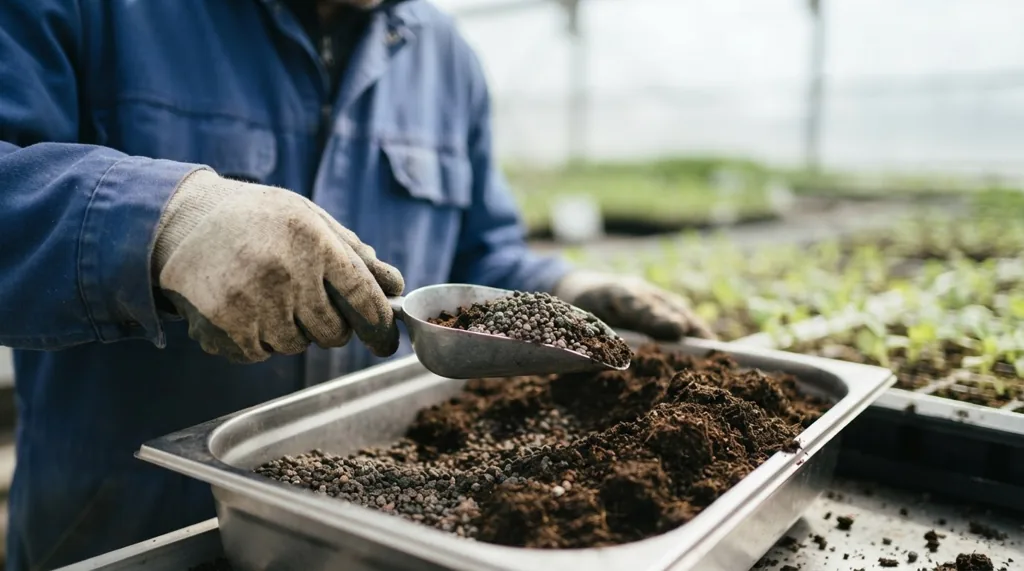
France has implemented comprehensive regulatory updates addressing cadmium limits and mineral nutrient composition across fertilizers, compost extracts, and compost teas.
France’s government will cap cadmium in phosphate fertilizers at 60 mg per kg of phosphate from Jan. 1, 2027, with lower limits planned later.
The government announced the plan on Oct. 5, 2026, and said the limit would fall to 40 mg in 2028 and 20 mg in 20301. The first step rests on two orders signed on Sept. 18, 2026. The two later steps are in a draft order that the agriculture ministry put out for public comment on Oct. 27, 20262.
In short, from 2027 every bag of fertilizer sold or spread in France must stay under a cadmium limit. The limit then tightens in steps. A fertilizer made with high-cadmium phosphate rock may pass in 2027 but fail in 2028 or 2030.
What is changing for phosphate fertilizers?
Cadmium is a heavy metal. It occurs naturally in some phosphate rocks used to make fertilizers1. The new rules set the most cadmium a fertilizer may contain. They also set the most cadmium that farmers may add to a hectare of soil each year.
Cadmium limit in mineral fertilizers, mg per kg of P2O5
For mineral fertilizers and organo-mineral fertilizers (mixes of mineral and organic matter), the limit is measured against their phosphate content. Phosphate is written in the rules as P2O5, or phosphorus pentoxide. From Jan. 1, 2027, the limit is 60 mg of cadmium per kg of P2O52.
The draft order then lowers this limit twice2:
- From Jan. 1, 2028: 40 mg per kg of P2O5, or 2 mg per kg of dry matter, depending on the phosphate content.
- From Jan. 1, 2030: 20 mg per kg of P2O5, or 1 mg per kg of dry matter, depending on the phosphate content.
The government’s announcement presents the same three steps as one path: 60 mg in 2027, 40 mg in 2028 and 20 mg in 20301.
Which other fertilizers and growing media are covered?
The rules do not stop at phosphate fertilizers. They cover all fertilizing materials and growing media, the products plants grow in, such as potting soils2. Fertilizing materials include fertilizers, soil improvers and biostimulants, which help plants take up nutrients and resist stress2.
For these other fertilizing materials and growing media, the cadmium limit is 3 mg per kg of dry matter from Jan. 1, 20272. The draft keeps it at 3 mg in 2028. In 2030 it is set at 3 mg at most.
Waste products spread on fields under a permit face their own limit. These include materials from sites that hold an environmental permit for industry or water works. Their limit is 10 mg per kg of dry matter in 2027 and 5 mg in 2028 under the draft2.
How much cadmium can reach the soil each year?
The second set of limits looks at the field, not the bag. It caps the cadmium that fertilizing adds to the soil each year, in grams per hectare2.
Most cadmium added to soil, grams per hectare per year
| Start date | Fertilizers and growing media | Waste products |
|---|---|---|
| Jan. 1, 2027 | 3 g | 10 g |
| Jan. 1, 2028 | 3 g | 5 g |
| Jan. 1, 2030 | 2 g | 2 g |
From Jan. 1, 2027, mineral and organo-mineral fertilizers may add no more than 3 g of cadmium per hectare per year1. The same 3 g cap applies to other fertilizing materials and growing media. Waste products have a cap of 10 g2.
Under the draft, the waste cap falls to 5 g in 2028. In 2030, all three groups share one cap of 2 g per hectare per year2.
Why did the government act on cadmium?
Cadmium can build up in soil for a long time. Crops can take it up, and it then reaches people through food1. The government says long exposure can harm the kidneys and bones1.
The plan follows advice from Anses, France’s national agency for food, environmental and workplace health safety1. In a 2021 opinion, updated in February 2026, Anses said farming must control the cadmium it adds to soil. It pointed in particular to the spreading of mineral phosphate fertilizers2.
Anses gave two figures. It said 2 g of cadmium per hectare per year from fertilizing materials is the recommended upper level. It also said a limit of 20 mg per kg of P2O5 for mineral phosphate fertilizers would stop cadmium building up in soil2. The 2030 values in the draft match both figures.
What legal steps sit behind the limits?
The rules come from France’s 2020 law on waste and the circular economy, known as the AGEC law2. Through an order of July 29, 2020, it added article L. 255-9-1 to the rural code. That article says a decree, issued after Anses gives its view, must set quality and safety criteria for fertilizing materials and growing media2.
The aim in the law is clear. Selling and using these products must not harm public health, animal health or the environment2.
The 2027 values come from two orders dated Sept. 18, 20262:
- The safety-criteria order sets the contaminant limits for fertilizing materials and growing media. It also sets when waste stops being waste and can be sold as a fertilizer.
- The soil-input order sets the most trace metals and organic pollutants that can reach the soil when these products are used.
The new draft order amends both of them to add the 2028 and 2030 steps2.
Which other contaminants do the new rules limit?
Cadmium is the headline, but the rules reach further. They also cover other contaminants in fertilizing materials and growing media1. These include:
- Trace metals, such as cadmium and chromium.
- Organic pollutants, including PAHs (polycyclic aromatic hydrocarbons), PCBs (polychlorinated biphenyls), dioxins and furans.
- Inert matter, such as plastic, glass and metal pieces.
- Certain disease-causing microbes.
For each, the texts set two kinds of limit1. One is the most a product may contain. The other is the most that may reach the soil when the product is used.
How did the draft change between May and October?
The ministry ran a first public consultation on an earlier draft from May 26 to June 30, 20263. That version was slower. It planned only one more cut, to 40 mg per kg of P2O5, from Jan. 1, 20303.
First draft and second draft
| Question | May 2026 draft | October 2026 draft |
|---|---|---|
| When does 40 mg apply? | Jan. 1, 2030 | Jan. 1, 2028 |
| When does 20 mg apply? | By Jan. 1, 2038 at the latest | Jan. 1, 2030 |
The first draft left the 20 mg target to a later report. That report was due by Jan. 1, 20323. It was to propose dates to reach 20 mg and 2 g per hectare by Jan. 1, 2038 at the latest3. The first draft also drew a line at 5% P2O5 by weight. Products above that line would be measured per kg of P2O5, and those below it per kg of dry matter3.
The second draft, published on Oct. 27, 2026, moves both targets forward. The 40 mg step now comes in 2028, and the 20 mg step in 20302. The second draft also follows a joint report by two government inspection bodies. The report looked at how lower cadmium limits for phosphate fertilizers and sewage sludge could affect fertilizer supply2.
Who must act, and what changes for sellers?
The limits apply to mineral and organo-mineral fertilizers that are sold and spread in France2. This means they apply to the product on the French market, wherever it was made. A maker abroad that ships phosphate fertilizer to France must keep cadmium under each year’s limit.
The tighter steps matter most for phosphate made from high-cadmium rock. A product that meets 60 mg in 2027 may not meet 40 mg in 2028. Buyers in France will need fertilizer that meets each new value by its start date.
Farmers who spread the products face the per-hectare caps. A lower cap on what reaches the soil limits how much of a high-cadmium product a farm can use.
Can the 2028 and 2030 dates move?
Yes. The draft order builds in two reviews before the deadlines2:
- By Oct. 1, 2027, a report on the effect of the 2028 values.
- By Oct. 1, 2029, a report on the effect of the 2030 values. It will also look at lowering the limits for the other product groups.
Each report must weigh technology, social and economic factors, and the security of fertilizer supply. The start dates can be changed if needed2. The government’s announcement says the same: the timetable may be adapted to technology, economic factors and supply needs1.
The ministry said the comment period on the second draft would be extended. Its online comment form was temporarily unavailable, and the period must meet the legal minimum length2.
Key points on France’s cadmium limits for fertilizers
The main facts of the new limits are below.
| Question | Answer |
|---|---|
| What changes? | Lower cadmium limits in fertilizers |
| Who acts? | French government and agriculture ministry |
| Which goods? | Fertilizers, soil improvers, growing media |
| Limit from Jan. 1, 2027 | 60 mg per kg P2O5 |
| Planned limit from Jan. 1, 2028 | 40 mg per kg P2O5 |
| Planned limit from Jan. 1, 2030 | 20 mg per kg P2O5 |
| Other fertilizing materials | 3 mg per kg dry matter |
| Soil cap from 2027 | 3 g per hectare per year |
| Soil cap from 2030 | 2 g per hectare per year |
| Legal basis | Two orders of Sept. 18, 2026 |
| Status of later steps | Draft order out for comment |
| Next review | Report due by Oct. 1, 2027 |
The 60 mg limit starts on Jan. 1, 2027. The first review of the 2028 step is due by Oct. 1, 2027, three months before that step begins2.
Sources
- ↩ Cadmium dans les engrais : de nouvelles limites dès 2027 | info.gouv.fr https://www.info.gouv.fr/actualite/cadmium-dans-les-engrais-de-nouvelles-limites-des-2027
- ↩ Consultation publique : nouveau projet d’arrêté modifiant la teneur maximale en cadmium de certaines matières fertilisantes ainsi que les apports maximaux admissibles de ce contaminant lors de l’utilisation des matières fertilisantes | Ministère de l’Agriculture, de l’Agro-alimentaire et de la Souveraineté alimentaire https://agriculture.gouv.fr/consultation-publique-nouveau-projet-darrete-modifiant-la-teneur-maximale-en-cadmium-de-certaines
- ↩ Consultation publique : projet d’arrêté modifiant la teneur maximale en cadmium de certaines matières fertilisantes | Ministère de l’Agriculture, de l’Agro-alimentaire et de la Souveraineté alimentaire https://agriculture.gouv.fr/consultation-publique-projet-darrete-modifiant-la-teneur-maximale-en-cadmium