
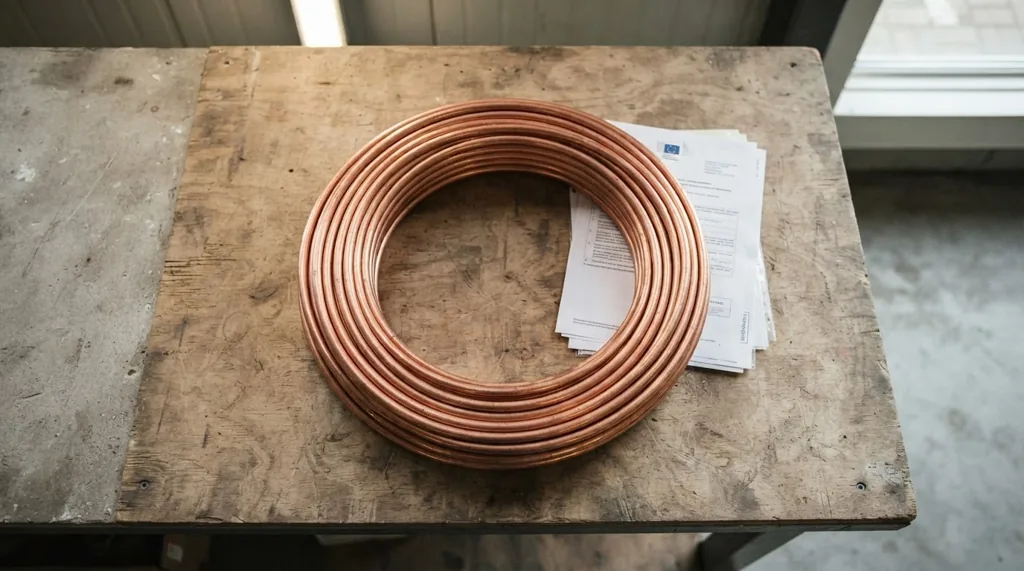
European Union applies temporary extra import duties on coiled copper tubes from China, Mexico, Vietnam and Uzbekistan from November 2026.
The European Commission has imposed temporary anti-dumping duties on coiled copper tubes from China, Mexico, Vietnam and Uzbekistan in a regulation published Nov. 11, 2026.
The measure is Commission Implementing Regulation (EU) 2026/2497 of Nov. 10, 2026, which imposes a provisional anti-dumping duty on these tubes1. An anti-dumping duty is an extra import tax on goods sold abroad below their normal price.
In short, copper tubes in large wound coils from these four countries now cost more to bring into the European Union (EU). Customs will apply the extra duty when these tubes enter the EU.
Which copper tubes are covered?
The duty covers pipes and tubes of refined copper in level wound coils2. Level wound coils are large reels on which the tube is wound in even layers. The tubes can be smooth or have grooves on the inside, but they must not be further processed2.
What the copper tube duty covers
| Point | What the regulation says |
|---|---|
| Goods covered | Refined copper tubes in level wound coils, smooth or grooved inside |
| Customs code | CN ex 7411 10 90, TARIC 7411 10 90 10 |
| Countries | China, Mexico, Vietnam, Uzbekistan |
| Not covered | Straight pipes, pancake coils, insulated or coated tubes |
| Capillary tubes | Covered when sold in level wound coils |
At the border, these tubes fall under customs code CN ex 7411 10 90, with the detailed EU code TARIC 7411 10 90 102. The Commission says these codes are for information only. The written product description decides what is covered3.
The tubes are made by melting copper cathodes or scrap, casting the metal and drawing it into tubes of the right size2. Producers then heat-treat the tube and wind it into coils.
Buyers use these tubes in heating, ventilation, air-conditioning and refrigeration. They also go into plumbing, medical and industrial systems, and into some renewable energy networks2.
Which copper products stay outside the duty?
During the case, Chinese and Vietnamese makers asked the Commission to confirm what falls outside. The Commission agreed that several products do not match the description2:
- Straight copper pipes, sold in lengths rather than coils.
- Pancake coils, a different coil shape.
- Insulated or coated copper tubes, because coating is a visible extra processing step.
These products are not covered by the investigation. The list matters for buyers of insulated tubes for air-conditioning, which often arrive coated.
Are thin capillary tubes covered?
Capillary tubes are very thin copper tubes used to control the flow of a liquid precisely. Their outside diameter is typically between 1 and 3.6 millimetres, according to two Jintian companies2.
The Commission rejected the request to exclude them. Capillary tubes are covered when sold in level wound coils, because the product description sets no limit on diameter2. The only visible difference from other covered tubes is their smaller size.
The Commission also found that imports of such tubes from the four countries were non-existent or negligible during the investigation period2. So the decision has little practical effect for now.
Why did the European Commission act?
The case began with a complaint on Jan. 26, 2026, by the EU Copper Tubes Defence Committee1. The group spoke for producers making more than 25% of EU copper tube output4.
The complaint said tubes from the four countries were sold in the EU at dumped prices. It said rising imports hurt EU producers’ sales, profits and jobs3. It also said EU producers could not raise prices to match rising costs for copper and energy.
According to the complaint, import prices from other countries rose, while the four countries kept their prices low or cut them3. EU producers also reported growing stocks of unsold tubes.
The complaint raised a further point about raw materials. Copper metal makes up 75% of the cost of making these tubes, and China and Vietnam charge export taxes on it3. The complaint argued this keeps copper prices in those countries well below world prices.
This matters for the size of the duty. Where the Commission finds such raw material distortions, it may set the duty at the full dumping margin, rather than a lower rate that only removes the harm4.
How did the investigation work?
The Commission opened the investigation on March 12, 20261. The opening notice set out the product and the evidence from the complaint3.
The investigation looked at prices and dumping in the year from Jan. 1, 2025, to Dec. 31, 20252. For the harm to EU producers, it studied trends from Jan. 1, 2022, to the end of that period.
The Commission chose three EU producers as a sample. Together they made more than 40% of the EU’s estimated copper tube production and sales1. Inspectors visited Elvalhalcor in Greece, Feinrohren in Italy and Wieland-Werke in Germany2.
The complaint compared different prices in each country3:
- China: the complaint said Chinese prices and costs are distorted by the state. It used Thailand as a reference country to build a fair price.
- Mexico: the complaint compared prices in Mexico with export prices to the EU.
- Vietnam: the complaint used Vietnamese home prices and also a price built from costs and profit.
- Uzbekistan: Uzbekistan is not a member of the World Trade Organization (WTO), so the complaint built a price using Mexico and Thailand.
Which companies does the case name?
The world market for these tubes is led by three large Chinese groups1. They are Golden Dragon Precise Copper Tube Group, the Jintian Group and the Hailiang Group. Their factories are in China, Mexico and Vietnam.
The Commission examined these exporters1:
- Mexico: GD Affiliates de RL de CV, part of the Golden Dragon group, which made all of Mexico’s exports to the EU.
- Vietnam: Hailiang (Vietnam) Copper Manufacturing and Jintian Copper Industrial (Vietnam), together over 90% of the cooperating Vietnamese exports.
- Uzbekistan: JV Sharq Tubes, ICG Infinity Copper Group and Angren Pipe Plant, which made all of Uzbekistan’s exports to the EU.
- China: Ningbo Jintian Copper Tube, which asked for its own rate.
In China, few exporters cooperated. The companies that answered made only 3% to 5% of Chinese exports to the EU1. The Commission therefore based its findings for China mostly on the facts available, rather than on company data1.
A smaller Vietnamese exporter, Toan Phat Copper Tube, objected to the sample choice. It said the two chosen firms were Chinese-owned and did not reflect its own situation1. The Commission rejected this, because the two firms were by far the largest Vietnamese exporters.
Uzbekistan’s government and its three exporters argued their sales were too small to include1. The Commission said it would deal with this in its review of harm to EU producers.
What were the earlier warning signs for importers?
Since May 2026, EU customs authorities have kept a record of these imports. Implementing Regulation (EU) 2026/1161 of May 22, 2026, ordered this registration4.
Complaint estimates quoted in May 2026, %
Registration lets the EU charge duties backwards in time on recorded imports, if legal conditions are met4. The Commission said it would decide on this in the final regulation, if final duties are imposed. Registration lasts nine months from the day after publication.
The registration regulation also quoted the complaint’s estimates. It put dumping margins between 5% and 35% and the level needed to remove harm between 8% and 20%4. The Commission said these figures were for information only and set no expectation for the final duty.
When do the duties apply and what happens next?
The regulation appeared in the Official Journal of the European Union on Nov. 11, 20261. The Commission’s case timetable gave Nov. 12, 2026, as the latest date for provisional measures to start5.
Next steps in the copper tube case
| Date | What happens |
|---|---|
| Nov. 11, 2026 | Provisional duty regulation published |
| Nov. 26, 2026 | Comments on provisional duties due |
| Jan. 25, 2027 | Comments on final findings due |
| May 11, 2027 | Final duties or end of case |
Provisional anti-dumping duties last for a maximum of 6 months5. During that time, the Commission continues its investigation before any final decision.
The Commission’s timetable sets these next dates5:
- Comments on the provisional duties are due by Nov. 26, 2026.
- Cooperating companies can comment on the final findings by Jan. 25, 2027.
- Final duties, or the end of the case, must be published by May 11, 2027.
Final anti-dumping duties normally last five years5. A review can be requested at the earliest one year after they start.
What changes for EU buyers and foreign makers?
EU importers of coiled copper tubes from the four countries now face the provisional duty at customs. Makers of air-conditioners, heat pumps and refrigeration equipment that buy these tubes face higher costs.
Exporters in Mexico, Vietnam and Uzbekistan that took part in the case had their own company data examined. Most Chinese exporters did not cooperate, so their findings rest on the facts available1.
Customs brokers must check the product description carefully. Coated and straight tubes are outside the duty, but thin capillary tubes in level wound coils are inside it2.
Key points on EU copper tube duties
The table below sums up the main facts of the measure.
| Question | Answer |
|---|---|
| What changed? | Provisional anti-dumping duty on copper tubes |
| Who issued it? | European Commission |
| Legal act | Implementing Regulation (EU) 2026/2497 |
| Which countries? | China, Mexico, Vietnam, Uzbekistan |
| Which goods? | Refined copper tubes in level wound coils |
| Customs code | CN ex 7411 10 90, TARIC 7411 10 90 10 |
| What is excluded? | Straight pipes, pancake coils, coated tubes |
| Who complained? | EU Copper Tubes Defence Committee |
| Published | Nov. 11, 2026 |
| Comments due | Nov. 26, 2026 |
| Maximum length | 6 months |
| Final decision by | May 11, 2027 |
The next fixed date is Nov. 26, 2026, the deadline for comments on the provisional duties5. The Commission must then publish final duties, or close the case, by May 11, 20275.
Sources
- ↩ Implementing regulation – EU – 2026/2497 – EN – EUR-Lex http://data.europa.eu/eli/reg_impl/2026/2497/oj
- ↩ L_202602497EN.000101.fmx.xml https://eur-lex.europa.eu/legal-content/EN/TXT/HTML/?uri=OJ:L_202602497
- ↩ EUR-Lex – 52026XC01506 – EN – EUR-Lex https://eur-lex.europa.eu/eli/C/2026/1506/oj/eng
- ↩ Implementing regulation – EU – 2026/1161 – EN – EUR-Lex http://data.europa.eu/eli/reg_impl/2026/1161/oj
- ↩ Trade defence investigations https://tron.trade.ec.europa.eu/investigations/case-view?caseId=2847