
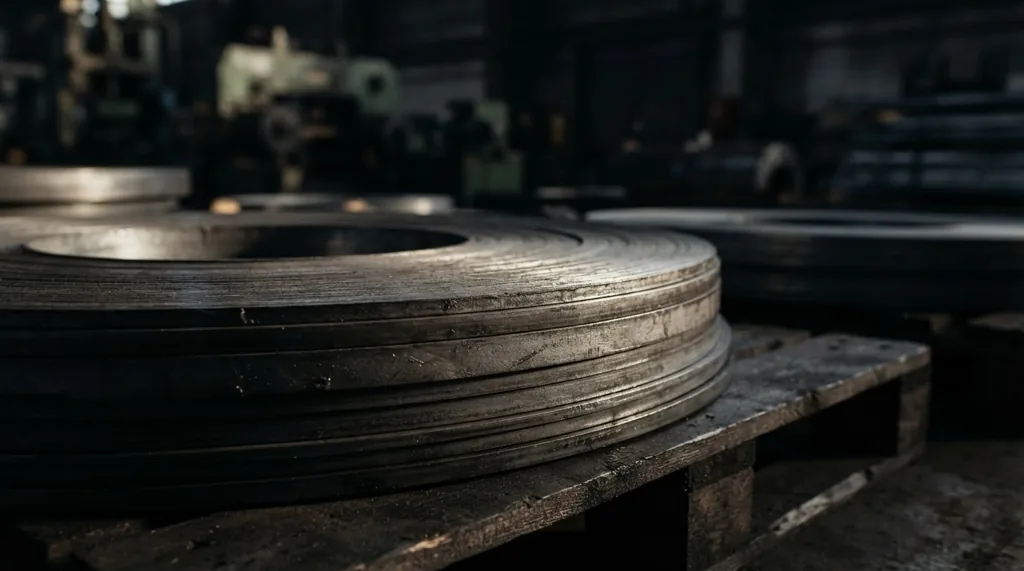
European Union sets final extra import taxes of 3% to 27.9% on cold-rolled steel, published 16 November 2026.
The European Commission has set final anti-dumping duties of 3% to 27.9% on cold-rolled flat steel from India, Japan, Taiwan, Türkiye and Vietnam1.
The duties are in Commission Implementing Regulation (EU) 2026/2547 of 13 November 2026. It was published in the Official Journal of the European Union on 16 November 20262.
In short, a shipment of this steel from the five countries now pays an extra import tax at the EU border. The rate depends on the country and, for Taiwan and Türkiye, on the company that made the steel1.
How high are the new cold-rolled steel duties?
An anti-dumping duty is an extra import tax on goods sold abroad below their normal price. The importer pays it when the goods enter the European Union (EU). The Commission’s announcement of 16 November 2026 gives the rates for each country1.
The rates are:
- India: 9.5% on cold-rolled flat steel.
- Japan: 27.9%, the highest rate in the case.
- Taiwan: 20.7% to 27%, depending on the company.
- Türkiye: 3% to 7.8%, depending on the company.
- Vietnam: 16% on cold-rolled flat steel.
The Commission calls these duties "definitive", which means final1. They follow an investigation that found this steel was entering the EU at dumped prices. A dumped price is an export price below the steel’s normal value1.
Which steel products does the case cover?
Cold-rolled flat steel is steel sheet and coil rolled thin at room temperature. The Commission says it is used in most areas of manufacturing1.
What the duties cover
| Point | Rule |
|---|---|
| Goods covered | Cold-rolled flat steel, not clad, plated or coated |
| Widths | All widths |
| Excluded | Stainless, electrical, silicon-electrical and high-speed steel, black plates |
| CN headings | 7209, 7211, 7225 and 7226 |
| Origins | India, Japan, Taiwan, Türkiye, Vietnam |
The registration regulation of December 2025 describes the goods in detail3. It covers flat-rolled products of iron or non-alloy steel, or other alloy steel, of all widths. The steel must be cold-rolled and not clad, plated or coated. It must not be worked further than cold-rolling3.
Stainless steel is excluded. Four other types of steel are also left out3:
- Electrical steel made of iron or non-alloy steel, of any thickness.
- Black plates, annealed steel in coils thinner than 0.35 mm.
- Silicon-electrical steel made of other alloy steel.
- High-speed steel, an alloy steel, when not worked further than cold-rolling.
The regulation lists the customs tariff numbers, or CN codes, where these goods are found3. They include codes in headings 7209, 7211, 7225 and 7226, such as 7209 16 90, 7209 17 90 and 7225 50 80. Some codes carry the mark "ex", which means only part of the code is covered3. The Commission says these codes are given for information only. A later change in classification does not change which goods are covered3.
Why did the Commission act on these imports?
The case began with a complaint from EUROFER, the European Steel Association. It lodged the complaint on 4 August 2025 on behalf of EU makers of cold-rolled flat steel2. Those makers represented more than 25% of EU production3.
From complaint to final duties
The complaint gave evidence of dumping and of serious harm to EU industry. The Commission found this evidence strong enough to open an investigation2. It did so on 18 September 20252.
The EU market for cold-rolled flat steel is worth some €23.2 billion1. EU production is based in 12 EU countries and employs over 8,600 people1. The Commission says its measures are designed to protect this industry effectively1.
How much steel comes from the five countries?
The Commission’s announcement gives the value of imports from each country1. Taiwan is the largest supplier among the five, with €345 million. India follows with €282 million1.
EU imports of cold-rolled flat steel, € million
Türkiye supplies €240 million and Japan €180 million. Vietnam supplies €125 million1. Together, the five countries account for about €1.17 billion of imports, by this newsroom’s addition of the announced figures.
The rates do not follow the size of the trade. Japan sends less steel than Taiwan or India but faces the highest rate, 27.9%1. Türkiye’s rates, from 3% to 7.8%, are the lowest of the five1.
What is a particular market situation in this steel case?
The Commission says this is its first case that found a particular market situation in some of the countries investigated1. This is a situation where conditions in the exporting country’s home market prevent a fair comparison of prices. In that case, the Commission does not use home-market sales prices1.
Instead, the Commission may build the normal value from other data. Normal value is the price used to measure dumping1. A higher normal value can show a larger dumping margin, the gap between the normal value and the export price.
The Commission found such situations in India and Taiwan1:
- In India, government measures affected the home price of iron ore, a raw material for this steel.
- In Taiwan, Chinese overcapacity raised imports of cold-rolled steel from China. This pushed down home prices and hurt the profits of Taiwanese makers.
The Commission says it took corrective steps for these situations1. It says the investigation therefore showed the full size of the dumping on the EU market1.
What did exporters and governments argue?
Several exporters and governments rejected the claims of a particular market situation2. POSCO VIETNAM Co., Ltd and the Turkish maker Tatmetal said the complaint’s evidence for Vietnam and Türkiye was too weak2. They argued that Chinese overcapacity was a global trend, not a local one2.
Tatmetal said imports into Türkiye were only 3.5% of Chinese exports of this steel2. The authorities of Taiwan said the evidence for Taiwan was too weak and did not concern its home market2. The Government of Japan said the claim for Japan lacked evidence2.
Three Japanese makers, Nippon Steel, JFE Steel Corporation and Kobe Steel, made similar points. They said Japan took only 2.3% of Chinese exports of this steel in 20242. The Commission rejected these claims at the start of the case2. It said the complaint gave enough evidence of how Chinese overcapacity lowered home prices in each country2.
The Trade Remedies Authority of Vietnam also challenged the complaint’s evidence on Vietnam2. The Commission said the complaint showed several Vietnamese measures that affected the cost of making this steel2. In the end, the Commission’s announcement names only India and Taiwan as countries with a particular market situation1.
Which companies are named in the regulation?
The regulation names several companies that took part in the investigation2:
- Nippon Steel Corporation, a sampled exporting producer in Japan.
- JFE Steel Corporation and Kobe Steel, Ltd. of Japan.
- POSCO VIETNAM Co., Ltd, of Ho Chi Minh City.
- Tatmetal Çelik Sanayi ve Ticaret A.Ş., of Istanbul.
A sampled producer is one of a small group of companies the Commission studies in detail. Daido Steel Co., Ltd, a Japanese maker of specialty steel, asked to join the case on 18 September 20252. The Commission first refused because Daido had not exported the product during the investigation period2. It later found Daido was related to Nippon Steel, so Daido could take part as part of that group2. Daido filed a product exclusion request on 4 March 20262.
The Turkish exporter Tezcan Galvanizli Yapı Elemanları asked to be treated as a cooperating company after the final findings2. The Commission refused. It said Tezcan was told about the case on its first day but did not reply or register2.
What does registration mean for earlier shipments?
The Commission ordered customs to register imports of this steel through Implementing Regulation (EU) 2025/24322. That regulation was adopted on 3 December 20253. Registration means customs keeps a record of each shipment while a case is open.
The purpose of registration is to allow anti-dumping duties to be charged later on those earlier shipments, if legal conditions are met3. The Commission said it would assess those conditions in the regulation that sets the final duties3. Registration expired nine months after the registration regulation entered into force3.
The complaint had estimated dumping margins of 3.2% to 31.3% for 20243. It estimated the level needed to remove harm to EU makers at 22% to 35%3. The final rates of 3% to 27.9% fall within the range of those early estimates1.
Who pays the cold-rolled steel duties?
The importer in the EU pays the anti-dumping duty when the steel is cleared through customs. Buyers of cold-rolled steel from Japan, Taiwan and Vietnam face the largest added cost. On a Japanese shipment, the duty rate is 27.9%1.
Makers abroad in the five countries now sell into the EU with this extra charge. Turkish suppliers face the smallest added cost, from 3% to 7.8%1. EU steel makers face less low-priced competition from the five countries.
Customs brokers must check the product description and the CN code of each shipment. They must also check the country of origin and, for Taiwan and Türkiye, the company that made the steel1. Excluded products, such as stainless steel and electrical steel, do not pay this duty3.
Key points on the EU cold-rolled steel duties
The table below sums up the main facts of the measure.
| Question | Answer |
|---|---|
| What changed? | Final anti-dumping duties on cold-rolled flat steel |
| Who issued it? | European Commission |
| Legal act | Implementing Regulation (EU) 2026/2547 |
| Date published | 16 November 2026 |
| Countries covered | India, Japan, Taiwan, Türkiye, Vietnam |
| India rate | 9.5% |
| Japan rate | 27.9% |
| Taiwan rate | 20.7% to 27% |
| Türkiye rate | 3% to 7.8% |
| Vietnam rate | 16% |
| Goods excluded | Stainless, electrical, silicon-electrical, high-speed steel, black plates |
| Who pays? | The EU importer, at customs |
Imports of these steel products from the five countries were worth about €1.17 billion. From now on, each shipment from those countries carries the country or company rate set in the regulation of 13 November 20262.
Sources
- ↩ Commission imposes anti-dumping duties on certain cold-rolled flat steel products – Trade and Economic Security https://policy.trade.ec.europa.eu/news/commission-imposes-anti-dumping-duties-certain-cold-rolled-flat-steel-products-2026-11-16_en
- ↩ Implementing regulation – EU – 2026/2547 – EN – EUR-Lex https://eur-lex.europa.eu/eli/reg_impl/2026/2547/oj/eng
- ↩ Implementing regulation – EU – 2025/2432 – EN – EUR-Lex https://eur-lex.europa.eu/eli/reg_impl/2025/2432/oj/eng