
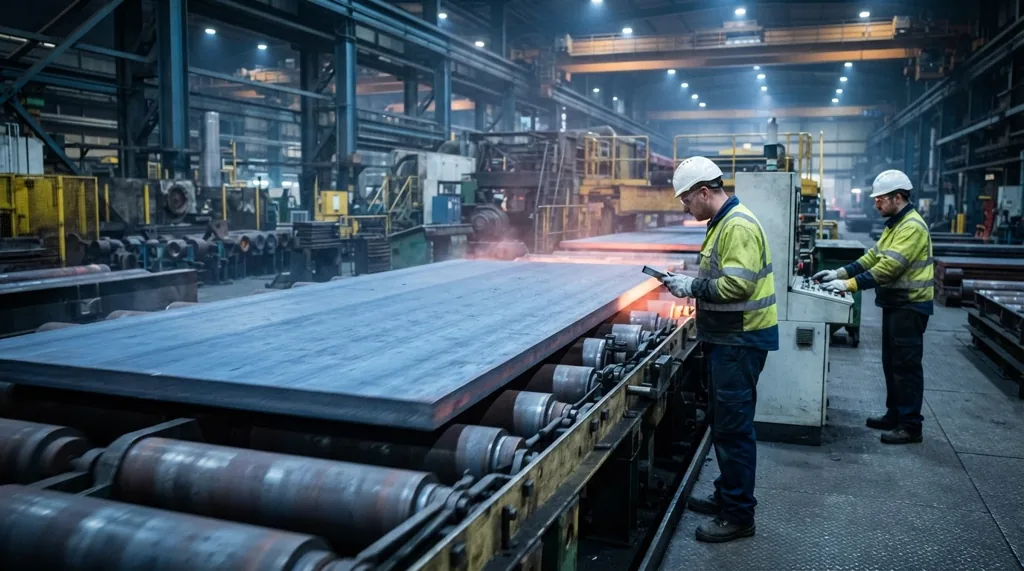
United Kingdom charges extra duties of 7.04% to 23.07% on Korean steel plate up to 2,100mm wide from 19 November 2026.
The UK government applied anti-dumping duties of 7.04% to 23.07% on South Korean hot-rolled steel plate up to 2,100mm wide from 19 November 20261.
The duties follow an investigation by the Trade Remedies Authority (TRA), the UK body that looks into unfairly priced imports2. An anti-dumping duty is an extra import tax on goods sold abroad below their normal price. Plate wider than 2,100mm gets a 0% rate1.
In short, a UK importer of Korean steel plate up to 2,100mm wide now pays an extra charge at the border. The size of the charge depends on which Korean company made the steel.
What has the UK decided on Korean steel plate?
The decision is set out in Trade remedies notice 2026/32, published on 18 November 20261. The Secretary of State for Business, Innovation, Science and Trade issued it3. The notice rests on the Taxation (Cross-border Trade) Act 2018. That law gives the UK its powers over trade remedies, the duties used against unfair imports.
The notice applies duties of 7.04% to 23.07% on Korean plate that is 2,100mm wide or less1. It applies a 0% rate to Korean plate wider than 2,100mm. The government says both rates form one single definitive measure. A definitive measure is a final duty, not a temporary one.
The measure is a full duty, not a deposit. Before this notice, Korean plate entered the UK with no anti-dumping charge at all. From 19 November 2026, most of it pays one.
Why did the government change the TRA’s recommendation?
The TRA finished its investigation on 4 September 20262. It sent its final recommendation to Lord Sarwar, the Minister for Trade. It found that dumped imports from South Korea were harming UK steel makers during the period it studied.
Recommendation and decision
| Question | TRA recommendation | Government decision |
|---|---|---|
| Duty range | 5.98% to 25.71% | 7.04% to 23.07% |
| Width line | Test met below 2,500mm | Duty up to 2,100mm |
| Wider plate | Duty on full scope | 0% above 2,100mm |
The TRA recommended duties of 5.98% to 25.71% on all the plate in its investigation, depending on the exporter1. But the TRA also ran its Economic Interest Test. This test asks whether a duty would be good for the UK economy as a whole. The TRA found the test was met for plate narrower than 2,500mm, but not for the full range of goods2.
The minister accepted that the World Trade Organization (WTO) conditions for a duty were met2. He still judged that accepting the recommendation in full was not in the public interest. He gave two reasons:
- The economic interest finding. The TRA itself said a duty on every size of plate would not serve the UK economy.
- Defence use. Korean hot-rolled plate is used in defence work, the statement says.
The minister also noted that the UK can make plate wider than 2,100mm2. However, there is currently no sustained UK production of plate at that width. So the government set the dividing line at 2,100mm, not the 2,500mm the TRA had used.
How much duty does each Korean steel maker pay?
The notice lists three rates for plate 2,100mm wide or less in its first annex1. Each rate comes with an additional code. This is a four-character code that the importer enters on the customs declaration.
Anti-dumping duty on plate up to 2,100mm wide, %
The rates are:
- Hyundai Steel: 7.04%, additional code 8A78.
- POSCO: 12.19%, additional code 8A79.
- All other Korean exporters and producers: 23.07%, additional code 8A80.
- Plate wider than 2,100mm: 0%, additional code 8A81.
The 23.07% rate is the residual rate, the rate for any Korean maker not named in the notice1. It is more than three times the rate for Hyundai Steel. A buyer who sources from a smaller Korean mill or a trader therefore faces the highest charge.
How is the duty worked out at the border?
The duty is charged on the net, free-at-the-frontier price of the goods1. This means the price of the goods delivered to the UK border, before any other import duty is added.
The duty is calculated before other amounts of import duty1. In practice, the importer pays the anti-dumping duty on top of any normal customs duty. HM Revenue and Customs (HMRC), the UK tax and customs authority, collects it.
The importer must use the right additional code for each shipment. Plate over 2,100mm wide uses code 8A81 and pays nothing extra. The width of each plate therefore decides which code applies.
What papers must a shipment carry for the lower rates?
A shipment only gets the Hyundai Steel or POSCO rate if the right paperwork reaches customs1. The importer must present a valid commercial invoice to HMRC when the goods are imported. The invoice must carry a signed declaration.
Papers for the Hyundai Steel or POSCO rate
| Document | Requirement |
|---|---|
| Commercial invoice | Valid invoice presented to HMRC on import |
| Signed declaration | Dated and signed by a named official of the invoicing company |
| Additional code | 8A78 for Hyundai Steel, 8A79 for POSCO |
The text of the declaration is fixed in the notice’s second annex1. An official of the company that issued the invoice must complete, date and sign it. That person must be named and their job title must be clear.
In the declaration, the official certifies the volume of goods on the invoice for export to the UK. The official also states which company made them, its address, its additional code and the country. The official confirms that the invoice information is complete and correct.
If the invoice is missing, or the declaration is not made, the residual rate of 23.07% applies1. So a Hyundai Steel shipment without the declaration pays the same as a shipment from an unnamed mill.
Which steel products and codes are covered?
The measure covers hot-rolled steel plate made in South Korea and exported to the UK1. The notice describes three groups of flat steel products:
- Plain hot-rolled plate of iron or non-alloy steel, at least 600mm wide and 4.75mm thick. It is not in coils, not clad, plated or coated, and has no raised patterns. Tool steel is excluded. Plate that is perforated or cut into non-rectangular shapes is included.
- Clad plate of iron or non-alloy steel, at least 600mm wide. Clad plate has a layer of another metal bonded to it.
- Alloy steel plate, at least 600mm wide and 4.75mm thick, not in coils. Tool steel, high-speed steel and silicon-electrical steel are excluded.
The investigation covered 11 commodity codes, the numbers used to classify goods at customs1:
- 7208 5120, 7208 5191, 7208 5198
- 7208 5210, 7208 5291, 7208 5299
- 7208 9020, 7208 9080
- 7210 9030
- 7225 4040, 7225 4060
The same 11 codes appeared in the 2025 notice that started the registration of imports4. Width is what splits the goods into the duty and the 0% rate.
What happens to the registration of imports?
Since 24 July 2025, HMRC has been registering imports of these goods4. Registration means customs kept a record of each shipment while the investigation ran. That notice, number 2025/16, warned that duties could later be charged on registered goods.
Under UK rules, duties on registered goods may be payable from up to 90 days before any provisional duty starts4. A provisional duty is a temporary charge during an investigation. But in June 2026, the government had rejected the TRA’s call for a provisional duty on this plate5.
The new notice ends the registration1. It instructs HMRC to stop registering the goods from the day after publication. The government says there is no longer any need to keep the records for a possible trade remedy.
How did the case reach this point?
The investigation, case AD0071, began on 6 June 20254. The government page for the case lists three notices so far3:
- Notice 2025/16 started the registration of imports from 24 July 2025.
- Notice 2026/17, published on 9 June 2026, rejected a provisional duty.
- Notice 2026/32, published on 18 November 2026, applies the definitive duty.
The Korean steel plate case
The TRA had asked for a provisional duty for 6 months, paid as a bank guarantee, bond or cash5. The Secretary of State said no. He pointed to new steel trade measures the government had announced from 1 July 2026 to protect UK steel production. He also cited the importance of the UK-South Korea trade relationship.
That June decision meant Korean plate kept entering the UK with no anti-dumping charge5. The new notice is the first time importers of this plate pay an anti-dumping duty in this case.
When do the duties start and end?
The duty applies from 19 November 20261. It lasts for 5 years from the day after the notice was published. It ends on 19 November 2031.
Before that date, the TRA will tell interested parties that the duty is due to expire1. They can then apply for an expiry review, a check on whether the duty should continue.
The minister said the TRA could review the measure earlier if UK production of plate wider than 2,100mm starts again2. The government will also respond if it finds evidence that importers are avoiding the duty2. That evidence could include changes in import patterns.
Key points on the Korean steel plate duty
The table below sums up the measure.
| Question | Answer |
|---|---|
| What changed? | Definitive anti-dumping duty on Korean plate |
| Who issued it? | UK Secretary of State for Business, Innovation, Science and Trade |
| Which notice? | Trade remedies notice 2026/32 |
| Which goods? | Hot-rolled steel plate from South Korea |
| Duty on plate up to 2,100mm | 7.04% to 23.07% |
| Duty on plate over 2,100mm | 0% |
| Hyundai Steel rate | 7.04% |
| POSCO rate | 12.19% |
| Rate for all others | 23.07% |
| What papers are needed? | Commercial invoice with signed declaration |
| Start date | 19 November 2026 |
| End date | 19 November 2031 |
From 19 November 2026, Korean plate up to 2,100mm wide pays between 7.04% and 23.07% at the UK border1. The next set date is the expiry on 19 November 2031, unless a review comes first.
Sources
- ↩ Trade remedies notice 2026/32: definitive anti-dumping measure on hot-rolled steel plate originating from South Korea – GOV.UK https://www.gov.uk/government/publications/trade-remedies-notice-hot-rolled-steel-plates-originating-from-south-korea-anti-dumping/trade-remedies-notice-202632-definitive-anti-dumping-measure-on-hot-rolled-steel-plate-originating-from-south-korea
- ↩ Written statements – Written questions, answers and statements – UK Parliament https://questions-statements.parliament.uk/written-statements/detail/2026-11-18/hlws491
- ↩ Trade remedies notice: hot-rolled steel plates originating from South Korea (anti-dumping) – GOV.UK https://www.gov.uk/government/publications/trade-remedies-notice-hot-rolled-steel-plates-originating-from-south-korea-anti-dumping
- ↩ Trade remedies notice 2025/16: registration of imports of hot-rolled steel plates originating from South Korea – GOV.UK https://www.gov.uk/government/publications/trade-remedies-notice-hot-rolled-steel-plates-originating-from-south-korea-anti-dumping/trade-remedies-notice-202514-registration-of-imports-of-hot-rolled-steel-plates-originating-from-south-korea
- ↩ Trade remedies notice 2026/17: rejection of the TRA’s recommendation to apply a provisional anti-dumping measure on hot-rolled steel plate originating from South Korea – GOV.UK https://www.gov.uk/government/publications/trade-remedies-notice-hot-rolled-steel-plates-originating-from-south-korea-anti-dumping/trade-remedies-notice-202617-rejection-of-the-tras-recommendation-to-apply-a-provisional-anti-dumping-measure-on-hot-rolled-steel-plate-originating