
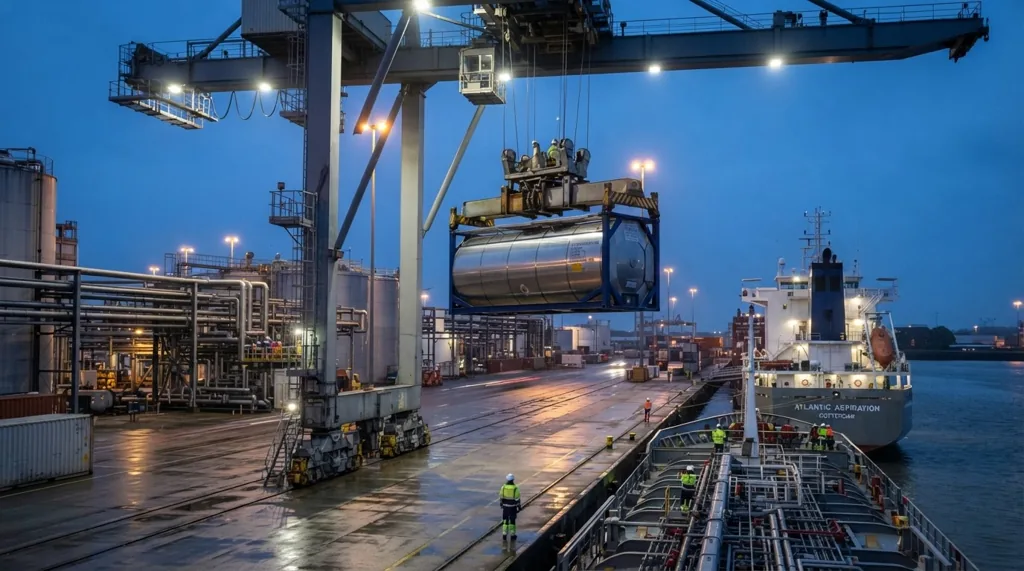
European Union importers must lodge guarantees of 22.3% to 40.3% on two acrylic chemicals from 12 November 2026.
The European Commission put temporary duties of up to 40.3% on two acrylic chemicals from four countries, starting Nov. 12, 2026.
The measure is Commission Implementing Regulation (EU) 2026/2512 of Nov. 10, 2026, published in the Official Journal of the European Union on Nov. 111. It covers butyl acrylate and 2-ethylhexyl acrylate, two liquid chemicals used to make paints, glues and inks1.
In short, a shipment of these chemicals from the four countries can now enter the European Union (EU) only if the importer lodges a guarantee. That guarantee equals the extra duty, so a shipment from Saudi Arabia ties up money worth 40.3% of its border value2.
What are provisional anti-dumping duties on acrylic esters?
An anti-dumping duty is an extra import tax on goods sold abroad below their normal price. "Provisional" means the duty is temporary while the investigation goes on. The Commission can still change it when it takes its final decision2.
The goods are called acrylic esters. The regulation names two of them: butyl acrylate and 2-ethylhexyl acrylate1. Both are made mostly from the same raw material, propylene. Propylene makes up around 50% of their production cost1.
These chemicals give paints and plastics colour stability, clarity, and resistance to heat, ageing and weather1. Their main end uses are coatings, adhesives and sealants, paper, polymer additives, textiles and inks1. So the duty reaches EU paint, glue and ink makers who buy them from abroad.
Which acrylic chemicals are covered, and which are not?
The duty covers butyl acrylate, with Chemical Abstracts Service number (CAS RN) 141-32-2. It also covers 2-ethylhexyl acrylate, with CAS RN 103-11-71. A CAS number is a world reference number for one chemical.
What the duty covers
| Point | Rule |
|---|---|
| Goods covered | Butyl acrylate (CAS RN 141-32-2) and 2-ethylhexyl acrylate (CAS RN 103-11-7) |
| Customs code | ex 2916 12 00, TARIC 2916 12 00 15 |
| Origins | China, Saudi Arabia, South Africa, United States |
| Not covered | Ethyl acrylate, methyl acrylate and specialty acrylates |
At the border, both fall under customs code ex 2916 12 00, with the detailed code 2916 12 00 15 in TARIC, the EU’s online customs tariff1. The "ex" means that only part of that customs heading is covered.
Other acrylates are outside the measure. The regulation excludes ethyl acrylate and methyl acrylate. It also excludes specialty acrylates such as alkyl acrylates, hydroxy-alkyl acrylates and dialkylaminoethyl acrylates1.
South African exporter Sasol argued that the two covered chemicals differ too much to be treated as one product. The Commission rejected that claim. It said both belong to the same family of "soft" acrylic esters and can often replace each other in coatings1.
How high are the new duties on acrylic esters?
The rates differ by country and by company. Germany Trade & Invest (GTAI), Germany’s federal trade agency, published the full rate table from the regulation2. The rates apply to the net price free at the EU border, before duty2.
Provisional duty by exporter, %
For China, the rates are:
- Shanghai Huayi New Material Co., Ltd.: 29.0%.
- Pinghu Petro Chemical Co., Ltd.: 22.3%.
- Other cooperating Chinese companies listed in the annex: 23.9%.
- All other imports from China: 29.0%2.
For the other three countries, the rates are:
- All imports from Saudi Arabia: 40.3%.
- Sasol South Africa Ltd and all other South African imports: 32.4%.
- Dow Chemical Company and all other US imports: 39.0%2.
Each named company has its own additional code in TARIC. For example, Shanghai Huayi uses 88GR and Dow uses 88GW. All other imports use the code 89992.
How does the duty work at the EU border?
The duty is not paid in cash at this stage. Instead, the goods can be released for sale in the EU only when a security equal to the provisional duty is lodged2. A security is a deposit or bank guarantee held by customs.
The steps for a shipment are:
- The importer declares the goods under TARIC code 2916 12 00 15 and states the country of origin.
- The importer gives the additional code of the maker, or 8999 for an unnamed maker.
- Customs works out the security at the company’s rate on the border value.
- Customs releases the goods once the security is lodged2.
The final decision will say whether the security is collected as duty or released. The duties may still change during the rest of the investigation2.
Why did the European Commission act on acrylic esters?
The case began with a complaint lodged on Jan. 28, 2026 by a group of EU makers called the Consortium for certain acrylic esters1. The Commission opened the investigation on March 12, 20261.
The Commission kept the complainants’ names secret. It said naming them could expose them to retaliation1. Three EU producers were sampled: Synthomer in the Czech Republic, BASF in Germany and Arkema in France1. Together, the sampled producers made over 80% of EU output1.
The investigation checked prices and costs from Jan. 1, 2025 to Dec. 31, 20251. For harm to EU makers, it looked at trends from Jan. 1, 2022 to the end of 20251.
The complaint itself estimated large price gaps. It put dumping margins, the gap between export price and normal price, at 43.51% to 48.22% for China3. It gave 37.35% for Saudi Arabia, 67.88% for South Africa and 23.97% to 30.49% for the United States3. These were the complaint’s own estimates, not the Commission’s findings3.
Which exporters does the acrylic esters case name?
The Commission checked data at the offices of several foreign makers. They were:
- Dow US: Rohm and Haas Texas, Rohm and Haas Chemical and Union Carbide, in the United States.
- Pinghu Petro Chemical and Shanghai Huayi New Material, in China.
- Sasol South Africa Limited, in South Africa1.
Five Chinese exporters replied to the Commission’s first request. The Commission picked a sample of the two with the largest export volumes to the EU1. Those two received their own rates.
Saudi Arabia has one exporter, Saudi Acrylic Monomers Company (SAMCO). SAMCO told the Commission it would not answer the questionnaire1. The Commission then used other available facts, including the complaint, to calculate dumping for all Saudi exports1. That country now faces the highest rate, 40.3%2.
Could importers pay duty on earlier shipments?
Yes, that remains possible. Customs has been recording these imports since May 2026 under Commission Implementing Regulation (EU) 2026/10852. That registration of imports lets the EU collect duty later on goods that arrived before the provisional duty3.
The registration regulation says this can happen only if certain legal conditions are met3. The Commission will judge those conditions in the regulation that sets final duties3. The registration itself runs for nine months from its start3.
So importers who brought in these chemicals since May 2026 do not yet know their final bill. GTAI notes that the decision on backdated duty will come with the final measures2.
Who is affected by the acrylic ester duties?
EU importers of the two chemicals from the four countries must lodge the security before release. Customs brokers must enter the right TARIC code and additional code on each declaration2.
Some importers belong to the same groups as the exporters. The case names Dow Europe GmbH and Sasol Chemie Hamburg as related importers1. Paint, adhesive, paper, textile and ink makers in the EU buy these chemicals1. They may face higher prices from these four sources.
Exporters in the four countries now sell into the EU with a duty attached. US exporters were warned in March by the International Trade Administration (ITA), the US trade agency, that duties might follow4.
When will the EU decide final duties on acrylic esters?
The provisional duties apply from Nov. 12, 20262. The Commission has 14 months in total to finish the case, so by May 2027 at the latest2. The ITA’s estimated date for the final decision is May 11, 20274.
Acrylic esters case dates
Until then, the rates can still change. The final regulation will set the definitive duties and decide on backdating2.
Key points on EU acrylic ester duties
The main facts of the measure are below.
| Question | Answer |
|---|---|
| What changed? | Provisional anti-dumping duties on acrylic esters |
| Who issued it? | European Commission |
| Legal act | Implementing Regulation (EU) 2026/2512 |
| Which goods? | Butyl acrylate and 2-ethylhexyl acrylate |
| Customs code | TARIC 2916 12 00 15 |
| Which countries? | China, Saudi Arabia, South Africa, United States |
| Rate range | 22.3% to 40.3% |
| Highest rate | 40.3%, all Saudi imports |
| What must importers do? | Lodge a security equal to the duty |
| Start date | Nov. 12, 2026 |
| Earlier imports | Registered since May 2026 |
| Final decision | By May 2027 |
The next step is the final regulation, due by May 2027, which will fix the duties and decide whether earlier shipments pay too2.
Sources
- ↩ L_202602512EN.000101.fmx.xml https://eur-lex.europa.eu/legal-content/EN/TXT/HTML/?uri=OJ:L_202602512
- ↩ Antidumping – Acrylester mit Ursprung in China | EU Customs & Trade News | EU | Antidumping, Antisubvention https://www.gtai.de/de/trade/eu/zoll/antidumping-acrylester-china-1983840
- ↩ Implementing regulation – EU – 2026/1085 – EN – EUR-Lex https://eur-lex.europa.eu/eli/reg_impl/2026/1085/oj
- ↩ The European Union Initiates Antidumping Duty Investigation into Acrylic Esters from the United States, China, Saudi Arabia, and South Africa https://www.trade.gov/european-union-initiates-antidumping-duty-investigation-acrylic-esters-united-states-china-saudi