
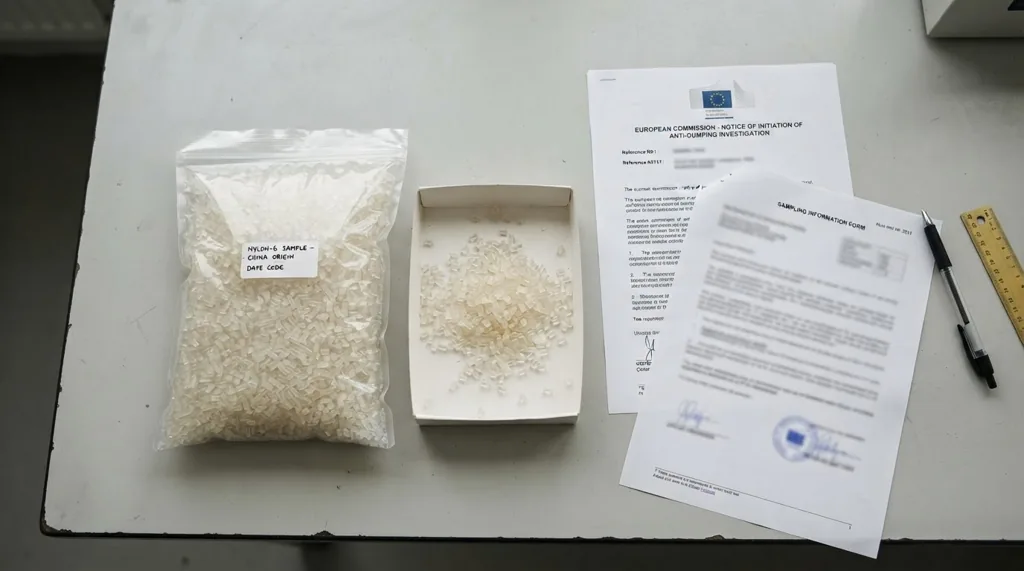
European Union opened an anti-dumping investigation into Chinese nylon-6 plastic on Nov. 6, 2026, which could bring extra duties by July 2027.
The European Commission opened an anti-dumping investigation on Nov. 6, 2026, into nylon-6 plastic (polyamide-6) imported from China, which could lead to extra duties.
The investigation was announced in a notice in the Official Journal of the European Union, the EU’s official gazette1. An anti-dumping duty is an extra import tax on goods sold abroad below their normal price.
In short, nothing changes yet for a shipment of Chinese nylon-6 entering the EU. But buyers now face a risk of extra duties from mid-2027, and the Commission has set short deadlines for companies that want a say.
What is the EU investigating in nylon-6 imports?
The notice covers polyamide-6 polymer (PA 6) with a PA 6 content of 95% or more by weight1. This is the raw nylon-6 plastic that factories melt and shape into parts, fibres and film. The product also has the chemical registry number CAS 25038-54-4, a code from the Chemicals Abstracts Service1.
What the polyamide-6 case covers
| Point | Detail |
|---|---|
| Goods | Polyamide-6 polymer, 95% or more PA 6 by weight |
| Chemical number | CAS 25038-54-4 |
| Customs code | TARIC 3908 10 00 10 |
| Country | China only |
| Case name | AD765 Polyamide-6 |
At the border, the goods currently fall under customs code ex 3908 10 001. The "ex" means only part of that code is covered. The exact EU tariff code is TARIC 3908 10 00 101.
The Commission says these codes are for information only1. What counts is the product description. A later change in the tariff code would not take the goods out of the case.
Only goods made in China are under investigation1. The Commission’s case page lists the People’s Republic of China as the only country investigated and names the case AD765 Polyamide-62.
Who asked for duties on Chinese polyamide-6?
Three European producers lodged the complaint on Sept. 23, 20261. They are:
- Envalior Deutschland GmbH
- Nurel SA
- UBE Corporation Europe
They made the complaint on behalf of the EU’s nylon-6 industry as a whole1. The Commission checked, after informing the EU member states, that the complaint had enough support and enough evidence to start a case1.
The investigation rests on the EU’s main anti-dumping law, Regulation (EU) 2016/1036 of June 8, 20161. Under Article 5 of that law, an industry can ask the Commission to act against dumped imports.
Why does the Commission think prices are too low?
The complainants say prices and costs inside China cannot be trusted as a fair benchmark1. They point to "significant distortions", meaning heavy state influence on prices, land, energy, money, raw materials and labour.
To support this, they relied on a Commission report on distortions in China’s economy, dated April 10, 20241. They also cited China’s 15th Five-Year Plan for 2026 to 2030 and the Made in China 2025 Roadmap1. Lists of industries that China encourages, which include the PA 6 sector, were also named1.
Because of these distortions, the complainants did not use Chinese prices. Instead, they built a "normal value" from costs and prices in another country1. They proposed Türkiye as the comparison country1. The Commission also names Türkiye as a possible choice1.
They then compared that normal value with the price of nylon-6 sold for export to the EU1. Both prices were taken at the factory gate. The notice says the resulting dumping margins are significant, but it does not publish them1.
How do Chinese imports hurt EU producers?
The complainants say imports from China grew, both in volume and in share of the EU market1. They say these imports cut the amounts EU producers sold and the prices they could charge1.
The complaint links this to serious harm to the EU industry’s finances and jobs1. The investigation will test whether the dumped imports caused this harm1.
Why does benzene matter in this case?
The complaint also raises a problem with a raw material. Benzene, which makes up more than 17% of the cost of producing nylon-6, faces an export tax in China1.
The complainants compared benzene prices in the United States, South Korea and Europe with prices in China1. They say the Chinese prices are significantly lower because of this distortion1.
This matters for the size of any duty. Normally, the EU may set a duty lower than the dumping margin if a lower rate is enough to stop the harm1. When raw material distortions are found, that lower rate may not apply1.
Before deciding, the Commission will run a separate test of the EU’s wider interest1. It asks for facts on spare production capacity in China, competition for raw materials, and effects on EU supply chains1. If companies do not cooperate, the Commission may decide the full rate is in the EU’s interest1.
Which period will the polyamide-6 case examine?
The Commission will check dumping and harm over July 1, 2025, to June 30, 20261. This is called the investigation period.
To judge trends in harm, it will look further back. That wider period runs from Jan. 1, 2023, to the end of the investigation period1.
What must Chinese makers and EU importers do now?
The Commission expects many companies to come forward. It may therefore study only a sample of them1.
Chinese makers that export to the EU must send company details within 7 days of publication1. They do this through TRON, the Commission’s online filing system1. Producers in China must also report the raw materials and energy they use within 15 days1.
Importers in the EU that are not linked to a Chinese maker face the same 7-day deadline1. They must send the company details listed in the notice’s annex1. Companies chosen for a sample then have 30 days to return a full questionnaire1.
Chinese exporters left out of the sample can still cooperate. Their duty would then not exceed the average margin found for the sampled companies1. They can also ask for their own rate by returning a questionnaire within 30 days of the sample decision1.
The Commission has already picked a provisional sample of EU producers1. Other EU producers that want to be included must make contact within 7 days1.
Users of nylon-6, such as companies that make parts from it, can also take part1. So can trade unions and consumer groups1. The Commission has published a questionnaire for users2.
What are the deadlines in the notice?
All deadlines count from the date the notice was published, Nov. 6, 20261. The main ones are:
- 7 days: sampling details from exporters, unrelated importers and EU producers.
- 10 days: comments on which products the case covers.
- 15 days: requests for a hearing, data on inputs from Chinese producers, and proposals for a comparison country.
- 37 days: comments on the complaint and information on the EU’s wider interest.
- 65 days: facts to set fair costs and prices in the comparison country.
Days after Nov. 6, 2026, to act
A company that misses the 7-day sampling date may lose the chance to be studied or to count as cooperating.
When could duties on Chinese nylon-6 start?
The Commission’s case page sets out an indicative timetable2. It lists Nov. 5, 2026, as the date of initiation, one day before the notice appeared in the Official Journal2.
Indicative timetable
The Commission may visit companies to check their answers between Jan. 21, 2027, and March 8, 20272. It plans to give advance notice of any temporary duties on June 7, 20272.
The latest date for provisional duties is July 6, 20272. Provisional duties are temporary duties set before the case ends. In anti-dumping cases they can last up to 6 months2.
The latest date for a final decision is Jan. 5, 20282. The Commission must then publish either final duties or the end of the case2. Final duties normally last five years2. A review can be requested one year after they start, at the earliest2.
The case page says only the deadlines in the law and the notice are binding2. The other dates are a guide.
Key points on the EU polyamide-6 investigation
The table below sums up the main facts of the case.
| Question | Answer |
|---|---|
| What happened? | EU opened an anti-dumping investigation |
| Who issued it? | European Commission |
| Which goods? | Polyamide-6 (nylon-6), 95% PA 6 or more |
| Customs code | TARIC 3908 10 00 10 |
| Which country? | China |
| Who complained? | Envalior, Nurel, UBE Corporation Europe |
| Published | Nov. 6, 2026 |
| Period examined | July 1, 2025, to June 30, 2026 |
| First deadline | 7 days after publication |
| Latest provisional duties | July 6, 2027 |
| Latest final decision | Jan. 5, 2028 |
No extra duty applies to Chinese nylon-6 today. The next fixed point is July 6, 2027, the latest date for temporary duties, with a final decision due by Jan. 5, 20282.
Sources
- ↩ C_202605783EN.000101.fmx.xml https://eur-lex.europa.eu/legal-content/EN/TXT/HTML/?uri=OJ:C_202605783
- ↩ Trade defence investigations https://tron.trade.ec.europa.eu/investigations/case-view?caseId=2919