
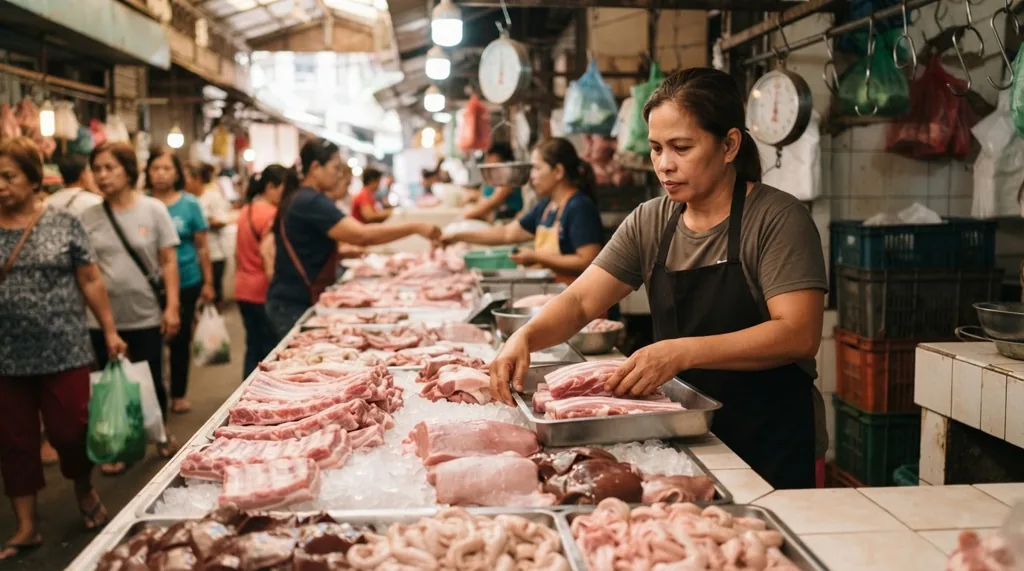
Philippines stops imports of fresh, chilled and frozen pork for 60 days, starting no later than Nov. 26, 2026.
The Philippine Department of Agriculture (DA) ordered a 60-day stop on imports of fresh, chilled and frozen pork and pig offal on Nov. 7, 2026.
Secretary Francisco P. Tiu Laurel Jr. signed Department Order No. 33 under the country’s Safeguard Measures Act, Republic Act 88001. The order is a provisional safeguard, a temporary emergency limit on imports that harm local producers.
In short, pork shipments under the listed codes cannot enter the Philippines for 60 days once the ban starts. Exporters and importers with pork at sea or under contract face a period with no entry at all.
What does the pork order stop?
The order takes the form of a temporary import restriction, a limit on quantity rather than an extra duty2. The DA calls it a 60-day temporary suspension of pork imports1.
Department Order No. 33 at a glance
| Point | Provision |
|---|---|
| Measure | Temporary import restriction on pork |
| Length | 60 days |
| Goods | Pig meat (0203) and pig offal (0206) |
| Origin | Pork from various countries |
| Maximum provisional period | 200 days |
The order does not set a quota or a reduced volume. It simply suspends imports of the listed products for the full period. It does not name any country as exempt, and the case covers pork "from various countries"2.
The DA has kept the right to change the measure at any time1. That right runs within the 200-day maximum that the law and the World Trade Organization (WTO) Agreement on Safeguards allow for a provisional measure1.
Which pork products are covered?
The ban covers nine product lines under the ASEAN Harmonized Tariff Nomenclature (AHTN), the shared tariff code list of Southeast Asian countries2. They fall into two groups: pig meat under heading 0203 and pig offal under heading 02061.
The pig meat lines are:
- Fresh or chilled carcasses and half-carcasses (0203.11)
- Fresh or chilled hams, shoulders and cuts with bone in (0203.12)
- Other fresh or chilled pork (0203.19)
- Frozen carcasses and half-carcasses (0203.21)
- Frozen hams, shoulders and cuts with bone in (0203.22)
- Other frozen pork (0203.29)
The offal lines are:
- Fresh or chilled pig offal (0206.30)
- Frozen pig livers (0206.41)
- Other frozen pig offal (0206.49)
These codes are listed in the order’s product table2. Both meat and offal are covered, whether fresh, chilled or frozen.
The investigation also looked at products under heading 0209, which covers pig fat2. That heading appears in the order’s title, but not in its list of restricted goods2. The DA’s announcement names only headings 0203 and 02061.
Why did the Agriculture Department act?
The DA’s Trade Remedies Office ran the preliminary investigation1. It found that rising imports from 2021 to August 2026 caused serious injury to local pig farmers1. It also found "critical circumstances", meaning any delay could cause damage that cannot be repaired1.
Philippine pork imports, tonnes
The order sets out the import figures behind that finding2. Pork imports rose from 589,674.59 tonnes in 2023 to 836,239.91 tonnes in 2025. That is a rise of 41.8% in two years2.
Imports also grew compared with local output. They equalled 39% of domestic pork production in 2021, 61% in 2025 and 65% in the first half of 20262.
The order lists these signs of harm to local producers2:
- Self-sufficiency fell from 74.3% in 2021 to 65.5% in 2025, and to 54% in January to August 2026.
- Imports’ share of local pork use rose from 36% in 2021 to 55% in 2026.
- Frozen pork stocks, 94% of them imported, rose from 78.8 thousand tonnes in January 2026 to about 121 thousand tonnes in July 2026.
- Farm-gate prices, the prices farmers receive, rose from PhP 155.80 per kg in 2021 to PhP 198.30 in 2025, then fell to an average of PhP 175.75 in January to June 2026.
Some farmers said prices fell by about 30% from the 2025 level2. In the worst cases, prices halved from PhP 240 to PhP 120 per kg2.
How large are the losses the order cites?
The order puts farmers’ gross losses at about PhP 27.9 billion for January to July 2026, compared with the same months of 20252. If low prices last to the end of the year, it says full-year losses could reach PhP 55.8 billion, or about USD 0.9 billion2.
Using figures from parties’ submissions, the order says 2026 losses could reach PhP 100 billion, or USD 1.6 billion2.
The order also blames the price gap. Imported pork was cheaper than local pork by about 58% in 2021 and 64% in 2025, it says2. In its view, that gap held down farm prices and pushed local production out of the market2.
When does the pork import ban start?
The 60 days do not start on the signing date. They start on whichever comes first of two events1:
- The Bureau of Customs issues an order putting the measure into effect.
- Fifteen days pass after the order appears in two newspapers of general circulation.
Key dates for the pork ban
The DA says the order was published in the Manila Times and the Manila Standard on Nov. 11, 20261. Fifteen days after that date falls on Nov. 26, 2026. The ban will therefore start no later than that day, and earlier if the Bureau of Customs acts first.
The order itself states that it takes effect immediately and stays in force until revoked in writing2. The 60-day count for the import stop, however, follows the two events above2.
How did the pork safeguard case begin?
The DA started the case on its own initiative, without a complaint from industry2. The case is numbered Safeguard Measures Case No. 02-20262.
The Philippines told the WTO Committee on Safeguards about the investigation on Oct. 21, 20263. Its notice gave interested parties five working days from the notice’s publication to send comments and evidence3. The order says the DA’s review drew on submissions from producers, importers, exporters, WTO members and foreign pork industry groups2.
The dates differ between documents. The WTO notice says the investigation began on Oct. 9, 20263. The order gives Oct. 17, 20262.
Who is affected by the pork suspension?
Philippine importers of fresh, chilled and frozen pork and pig offal lose access to foreign supply while the ban runs. Shipments under the listed codes that arrive after the start date will not be cleared.
Foreign pork exporters lose a large market for at least 60 days. The order covers pork from all countries, so no supplier gains an edge over another.
Local pig farmers are the intended winners. The DA says the stop aims to protect the domestic pork industry from further harm1.
Meat processors and buyers that rely on imported pork must use local supply or frozen stocks already in the country. The order notes that frozen stocks were at record levels from April to August 20262.
What happens next in the pork case?
The Philippines must notify the WTO and hold consultations under Article 12 of the WTO Safeguards Agreement2. Section 17 of the Safeguard Measures Act sets the same duty2.
The DA will send the case records to the Tariff Commission2. The commission will run a formal investigation to decide whether a definitive safeguard, a longer-lasting measure, is needed2.
The DA has published the order and its Preliminary Investigation Report for download1. Its Trade Remedies Office handles questions about the findings and the measure1.
Key points on the Philippine pork import suspension
The table sums up the main facts of Department Order No. 33.
| Question | Answer |
|---|---|
| What changed? | Pork imports suspended for 60 days |
| Who issued it? | Philippine Department of Agriculture |
| Which instrument? | Department Order No. 33, 2026 |
| Legal basis | Safeguard Measures Act, Republic Act 8800 |
| Which goods? | Fresh, chilled and frozen pork and pig offal |
| Which codes? | Nine lines under AHTN 0203 and 0206 |
| Which countries? | Pork from all countries |
| Date signed | Nov. 7, 2026 |
| Newspaper publication | Nov. 11, 2026 |
| Start of 60 days | Customs order or 15 days after publication |
| Maximum provisional period | 200 days |
| Next step | Tariff Commission formal investigation |
The import stop begins no later than Nov. 26, 2026, unless the Bureau of Customs acts sooner. The Tariff Commission’s formal investigation will then decide whether a longer safeguard on pork follows.
Sources
- ↩ Issuance of DO No. 33 Imposing a 60-Day Temporary Suspension of Importation of Pork as the Provisional Safeguard Measure under the DA Safeguard Measures Case No. 2, 2026 | Official Portal of the Department of Agriculture https://www.da.gov.ph/announcements/issuance-of-do-no-33-imposing-a-60-day-temporary-suspension-of-importation-of-pork-as-the-provisional-safeguard-measure-under-the-da-safeguard-measures-case-no-2-2026/
- ↩ SUSPENSAO-9.NOV_.2026.pdf https://static.poder360.com.br/uploads/2026/11/SUSPENSAO-9.NOV_.2026.pdf
- ↩ WTO | 2026 News items – The Philippines launches safeguard investigation on pork https://www.wto.org/english/news_e/news26_e/safe_phl_21oct26_520_e.htm